

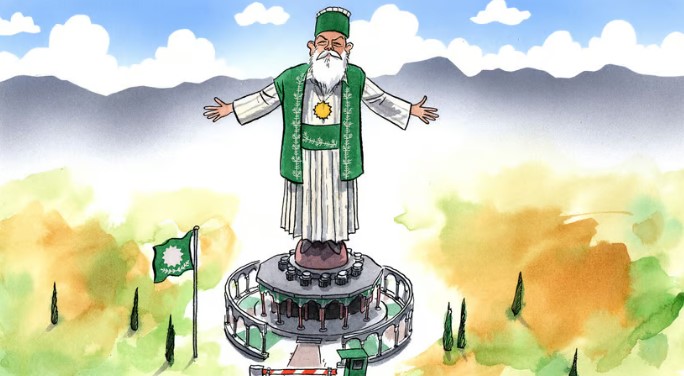
“The Economist” has devoted an article to the creation of the new Bektashi state, entitled “Hope for religious harmony comes to life in the Muslim Vatican”.
The article in “The Economist” explores the creation of a new Bektashi state in Albania, describing it as a “Muslim Vatican” and linking it to aspirations for religious harmony.
The article presents a welcoming image of Albania, mentioning that the Bektashi leader, Baba Mondi, appears as a loving and open figure who accepts different traditions and promotes interfaith tolerance.
THE ECONOMIST ARTICLE:
It is suggested that you should not drink heavy alcoholic beverages after lunch. But what’s the problem if the alcoholic drink offered is a glass of brandy, extracted from the fruits of the Balkans and which is a sign of hospitality for visitors?
What if, moreover, the host is a Muslim cleric who, while explaining the tenets of his faith, puffs on a sharp cigar? And what if the holy man is soon to become the head of the world’s newest state, a tiny sovereign Muslim enclave carved into the low-rent suburbs of Albania’s capital? It was pushing noon after all.
When placed in close proximity to each other, the words “Islamic” and “state” tend to evoke more panic than enthusiasm. For Albanians who practice a mild local variant of the faith – far removed from jihads, caliphates and other Western giants – this is a perversion that must be challenged. Proud of the liberal strand of Islam known as Bektashism that prevails in this corner of the Balkans, the authorities have decided to give the order their own state, flag, passport and all.
The birth of most countries can be traced back to decades of struggles, upheavals and revolutions. The new Bektashi country was announced by Edi Rama, the Albanian Prime Minister, in an interview with the “New York Times” last month. Once a few legalities are ironed out, the world will celebrate its 200th country perhaps at the end of the year – if anyone knows what has inevitably been called the “Muslim Vatican”.
If the Vatican is this, Baba Mondi will be the same as the Holy Father. Wearing a 12-pointed hat as he greets visitors to the compound outside Tirana and his white beard flowing over his embroidered green robes, the preacher rejects comparisons to the Catholic headquarters in Rome. But this is more an act of modesty than a refutation of a theological insult (there are photographs in hand of him greeting various popes).
The World Center of the Bektashians, squeezed between an industrial area and several fields where sheep graze, extends to only 11 hectares. A newly built auditorium and museum provide a focal point for visitors.
There are more Muslims than Catholics in the world, although only a small part would accept their faith in this Albanian variant. Formed in 13th century Turkey, the Bektashis are a mystical Sufi order, combining teachings from the Koran with devotion to their traditions. Once the religion of the Ottoman military elite, it rose very high until it was banned there in the 19th century. When Turkey became secular in the 1920s, Bektash leaders moved to Albania. Through their love of the arts, the dervishes were credited with helping the country escape the Ottoman yoke in 1912; some describe it as the Albanian “national religion”, although more people adhere to Sunni Islam. The reward for faith was facing persecution, along with all other faiths, by the Stalinist regime that ruled Albania from 1944.
The Bektashis claim to have 20 million followers spread over 32 countries. This may be an exaggeration. Some describe it as more of a philosophy than a religion. Baba Mondi, speaks with reverence for all faiths. ” Don’t tighten yourself while God has set you free ,” he declares. There is some fasting (but not a full Ramadan’s worth), some daily prayers (but no imposing mosques or minarets), and much talk of people “sharing the same fate”. Being a good Bektashi is about love and tolerance. Their leader calls himself a friend to all, including Israel, whose president he met only last month – hospitality unlikely to extend to Tehran or Mecca. Bektashis avoid politics and condemn violence. In other words, they are easily compatible with the ways that shun God but prevail in much of Europe these days.
If Baba Mondi is the religious leader of the Bektashites, Mr. Rama serves as the chief ambassador of the faith. In an evening chat, the former artist raved about his generosity to the order, describing them as “a national treasure that must be helped to survive in the coming years”.
Never mind his (secret) Catholic faith, helping his Muslim brothers is a roundabout way of telling Albania’s proud history of tolerance. It was the only country occupied by the Nazis during World War II that had more Jews at the end than when the war began.
A Muslim-majority country that honors Mother Teresa, a Catholic nun with local roots. Why stigmatize those who do good, based on something as mundane as faith? The Bektashis are very deserving. ” Precisely because some people in Europe have a problem with the word “Muslim”, this is something that must be done “, says Mr. Rama.
Not everyone is a fan of the Bektashi enclave, condemning what they see as an attempt at religious engineering. Other Muslim interests are busy trying to gain ground in the Balkans. Last week Recep Tayyip Erdogan, the Turkish president, appeared in Tirana to open a mosque with a capacity of 8,000 seats. Many see the Bektashi movement as a PR stunt by Mr. Rama. Maybe. But the goal is noble, in line with the benevolent behavior of the Bektashis. Showing Albanian tolerance by subtly shaming that of other Europeans is certainly worth redrawing some maps and a glass of brandy.




