

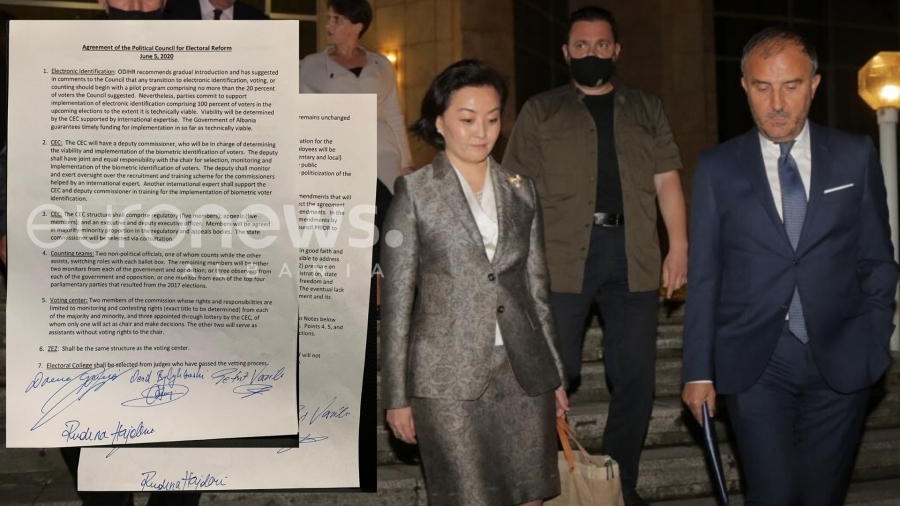
Euronews Albania has been able to secure exclusively the document signed by the Political Council on the Electoral Reform in the cross party meeting at the Palace of Congresses on Friday.
The agreement is composed of 12 points which specify in detail the changes in the process:
As of June 5, 2020
Electronic Identification: ODIHR recommends gradual introduction and has suggested in comments to the Council that any transition to electronic identification, voting, or counting should begin with a pilot program comprising no more than 20 per cent of voters the Council suggested. Nevertheless, parties commit to support implementation of electronic identification comprising 100 per cent of voters in the upcoming elections to the extent it is technically viable. Viability will be determined by the CEC supported by international expertise. The Government of Albania guarantees timely funding for the implementation in so far as technically viable.
CEC: The CEC will have a deputy commissioner, who will be in charge of determining the viability and implementation of the biometric identification of voters. The deputy shall have joint and equal responsibility with the chair for selection. monitoring and implementation of the biometric identification of voters. The deputy shall monitor and exert oversight over the recruitment and training scheme for the commissioners helped by an international expert. Another international expert shall support the CEC and deputy commissioner in training for the implementation of biometric voter identification.
CEC: The CEC structure shall comprise regulatory (five members); appeals (five members); and an executive and deputy executive officer. Members will be agreed in majority-minority proportion in the regulatory and appeals bodies. The state commissioner will be selected via consultation.
Counting Teams: Two non-political officials, one of whom counts while the other assists switching roles with each ballot box. The remaining members will be either two monitors from each of the government and opposition; or three observers from each the government and opposition; or one monitor from each of the top four parliamentary parties that resulted from the 2017 elections.
Voting center: Two members of the commission whose rights and responsibilities are limited to monitoring and contesting rights (exact title to be determined) from each the majority and minority, and three appointed through lottery by CEC, of whom only one will act as chair and make decisions. The other two will serve as assistants without rights to the chair.
ZEZ: Shall be the same structure as the voting center.
Electoral College shall be selected from judges who have passed the vetting process.
Appeals Process: The Electoral College hearing appeals process remains unchanged (i.e., hearing appeals will not begin at the Constitutional Court).
Depoliticization: No changes will be made to electoral administration for the upcoming (parliamentary and local) elections. Public sector employees will be eligible to be part of the electoral administration in the (parliamentary and local) elections following the next elections. The ongoing reform of the public administration in Albania will further enhance its focus on the de politicization of the civil service.
Adoption: All of the agreed proposals will be drafted into legal amendments that will be reviewed and checked by the Political Council to properly reflect the agreement BEFORE passing Parliament, WITHOUT any further changes or amendments. In the eventuality of any technical legal corrections proposes to these amendments by parliamentary bodies, these MUST be approved by the Political Council PRIOR to voting.
Additional Measures: The Political Council will continue to discuss in good faith and strive to reach mutually acceptable solutions whereas and when possible to address the main recommendations of ODIHR: regarding: (1) vote-buying; (2) pressure on voters and public administration; (3) misuse of and abuse of administration, state and financial resources; (4) collusion with criminal groups; (5) vote freedom and secrecy; and (6) manipulation and falsification of electoral results. The eventual lack of progress on these proposals will NOT preclude or delay an agreement and its adoption in Parliament of measures as agreed in Items 1-9.
Entry into Force: Points 1,2,3,7,8, 9, 10 and 11 above and the two Notes below enter into force for the incoming (parliamentary and local) elections. Points 4,5 and 6 and above enter into force after the next (parliamentary and local) elections.
Notes
The proposal for caretaker government and caretaker police chief will not constitute a condition for the approval and adoption on the above.
There was no consensus on changing the system.





