

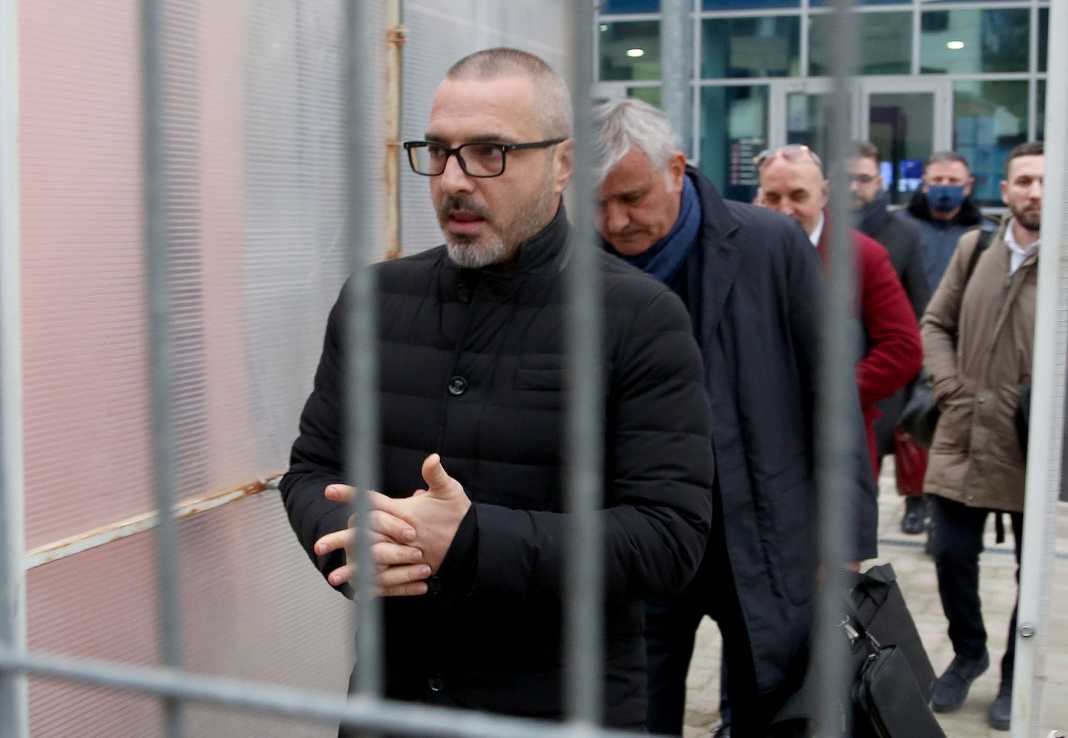
Saimir Tahiri is the second former minister in PM Edi Rama’s administration to end up in prison, alongside former environment minister, Lefter Koka. But what was the timeline of events that led up to Saimir Tahiri’s decline?
Earlier today, the Special Appeals Court sentenced Tahiri to 3.4 years in prison, valid immediately.
Tahiri was elected MP for the first time back in 2009, following an election that was won by the Democratic Party (DP). After the Socialist Party (SP) came into power in 2013, Tahiri was appointed minister of internal affairs in the co-government cabinet led by the SP-SMI coalition.
To date, he is the longest-serving minister in a single ministry, during all of Albania’s 30-year-transition into democracy.
He served as minister of internal affairs until March 2017.
The widespread illegal cultivation of cannabis in our country was at an alarming level in 2016, lowering the public approval rating for Rama’s administration and raising concerns amongst the international community, who started calling for the interior minister’s resignation, due to his inability to keep the situation under control.
Criticism against Tahiri peaked when he sold his car to several relatives – who were convicted drug traffickers – and failed to declare it.
During the 2017 elections, Tahiri led the electoral campaign in Tirana, as SP’s district chair in the capital city.
A few months after the 2017 elections, a wiretap was made public, where the same drug-trafficking relatives who had bought Tahiri’s car, were heard admitting to some unsettling truths about the minister pulling the necessary strings that had helped them advance their illegal cannabis trade.
After this publication, the Criminal Prosecution called for Tahiri’s immediate termination but the Socialist-led Parliament at the time did everything to hamper the process, once again saving Tahiri from going to prison.
In May 2018, as his trial continued, Tahiri decided to relinquish his MP mandate and face justice as a regular citizen, without his legislative immunity to act as a protective shield.
In February 2019 – two years since the beginning of his battles in court – the former minister was summoned by the Criminal Prosecution.
At the end of the investigation, the Prosecution called for Tahiri to be given a 12-year prison sentence, on several counts of corruption, drug trafficking, and collaboration with a structured criminal group.
In September 2019, the Serious Crimes Court overturned these charges, by converting Tahiri’s sentence to 5-years-probation only on one count of abuse of power, thus acquitting him on all other charges.
The Prosecution appealed the Court’s decision, bringing us to June 2020, when the Special Appeals Court against Corruption and Organized Crime decided to return Tahiri’s case for retrial at a lower court.
In September 2020, the former minister sent his case for recourse at the High Court, appealing the decision made by the Special Appeals Court.
In September 2021, the High Court approved Tahiri’s request to return his case for retrial at the Special Appeals Court, where it was going to be judged by a new judicial panel.
This brings us to today’s ruling on February 4, 2022, when the Special Appeals Court upheld the decision made by the First Instance Court in 2019, sentencing Tahiri to 5 years in prison.
In conclusion, Tahiri’s 5-year-sentence was reduced to 3.4 years.
Tahiri will now have to start serving his time immediately but does have the right to appeal his case within a 45-day time limit.
YOU MIGHT ALSO LIKE
- Saimir Tahiri reacts to guilty verdict: It’s an injustice!
- Ex-minister Saimir Tahiri sentenced to 3 years and 4 months
- Saimir Tahiri’s trial gets postponed after prosecutors don’t show up




