

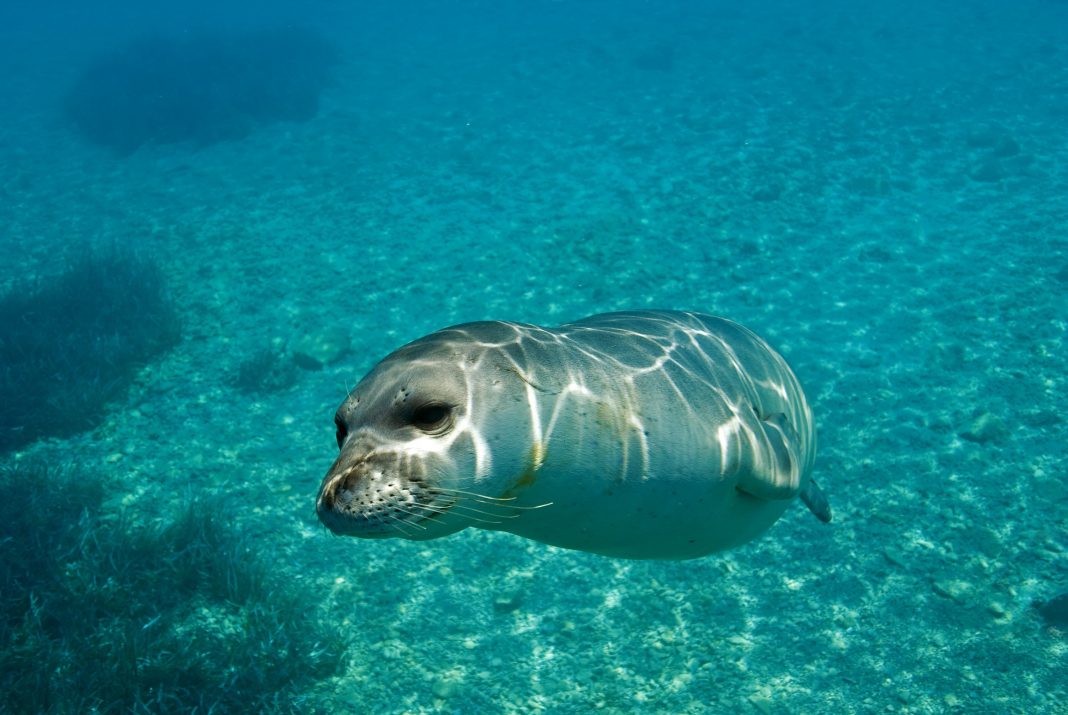
The Mediterranean monk seals, once popular to the Adriatic and Ionian waters, are now wandering lesser and lesser in these territories.
For two years now, a team of Albanian marine biologists are scanning the blue waters of the Ionian Sea for a sign of one of the rarest marine mammals in the world.
There are only a few hundred monk seals in the Mediterranean, but their presence has also been evidenced in the national marine park of Karaburun-Sazan.
“To understand just how endangered the species is, it’s enough to mention numbers in the Mediterranean Sea: only 700. We are still studying the population and how it can be protected. What we often propose is to declare protected areas; such as the marine park of Karaburun-Sazan, where human activity is regulated, not prohibited. Fishing or tourism are activities that can only be regulated by the administration, this is the only protection we can offer,” says Nexhip Hysolakoj, protected areas administration expert.
The monk seal is one of the most important species to be found in this park.
The International Union for Nature evaluated it as an endangered species, a sign of the importance the species has.
That’s why protection measures and giving these seals a chance of development in their own habitat, are of utmost priority.
“Our documentations show that the maximal number of the Mediterranean seal monks in our park is two. We’ve been able to document this through cameras, videos and photos taken by fisherman or nature lovers. It’s worth mentioning that younger individuals have been spotted, seal pups. This gives us the idea that the habitat of this park can be used for reproduction,” says biologist Laureta Sadikllari.
To biologists, the main risk threatening the Mediterranean monk seal is the habitat destruction.
This is closely related to tourism as well as the urbanization of the coastline.
“To our luck, the national marine park of Karaburun-Sazan has a positive interaction between its visitors and the seal. The fishermen themselves have become partners with us in protecting the Mediterranean seal,” the biologist says.
Poaching, habitat destruction and other factors have forced the Mediterranean seal to completely change its biologic behavior.




