

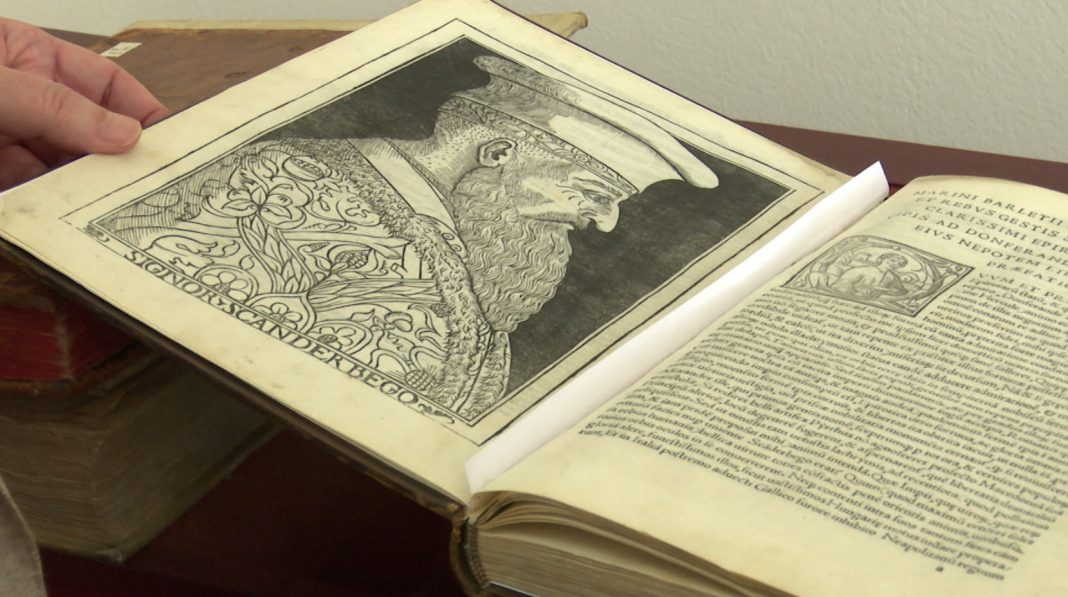
The history of Skanderbeg written by Marin Barleti and a book on Byzantine families are two of the oldest treasures that the National Library keeps. Barleti’s book is one of the first copies published around the year 1510. Meanwhile, the book on Byzantine families is a printing of 1729, by author Charles du Fresne, sieur Du Cange. Both these works are fanatically preserved.
“There are real treasures, some of the oldest books which help in writing the history,” says Piro Misha, director of the National Library.
These books have survived the trials of time, but traces of it are visible. All pictures are originals, painted by hand. They require a special kind of care. They must not be touched, because the ink risks being spoiled. So far, the process has been done manually. However, soon enough, the first modern laboratory will open in the library lobby.
“Having a new library is a necessity, there are more books than we have space. The preserving process does not only mean preserving, but also repairing every dent the books might have. A modern laboratory will be built in the annex of the National Library. There are almost 300 thousand books and among them are some true gems,” Misha further explains.
There are three underground floors in the National Library, where a number of universal treasures are stored, including collections of Greco-Roman and Byzantine artifacts.




