

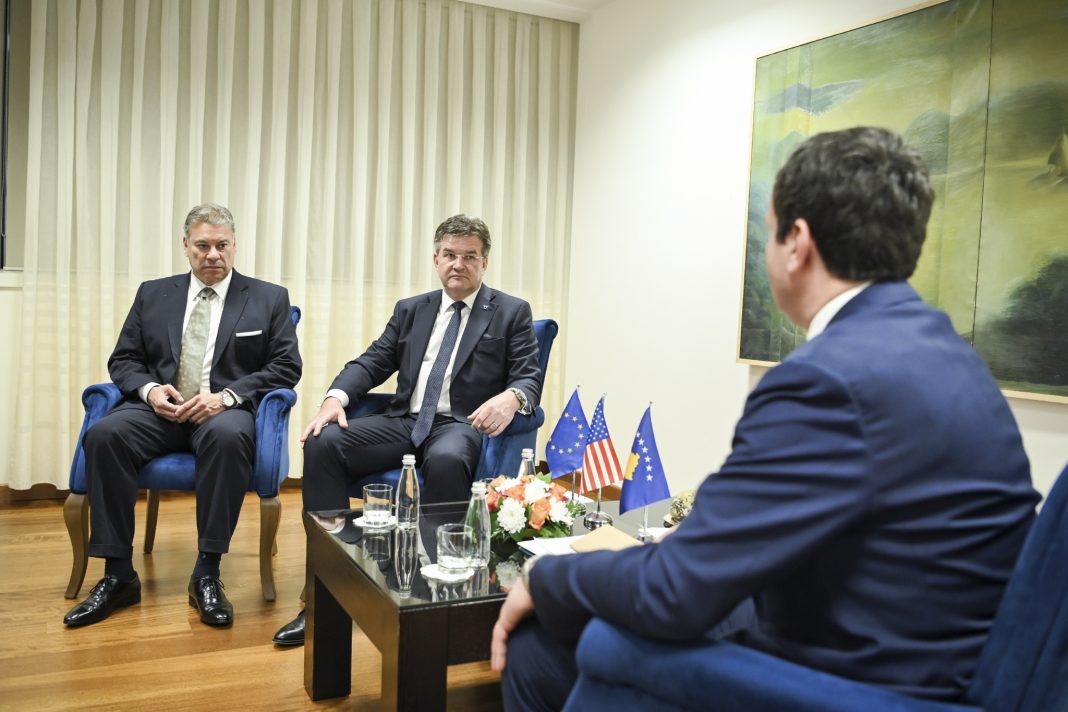
The U.S. envoy for the Western Balkans Gabriel Escobar has described Kosovo Prime Minister Albin Kurti as a partner of the United States, although he stated that he is sometimes a “difficult partner”.
Escobar made these comments in an interview with the Institute for Political and Economic Studies of Southeast Europe, based in Belgrade, Serbia, where he also emphasized that Kosovo remains an important partner of the United States.
“Mr. [Albin] Kurti is our partner. Sometimes he is a difficult partner, but he is a partner. Kosovo is a partner. So, as we move forward, we want to use the good relations we have with Kosovo and the improvement of our relations with Serbia to find a way, to find an acceptable and mutually beneficial path for both [countries] to be part of the European Union,” Escobar stated.
Escobar made these comments when asked about the statement made by the US ambassador to Belgrade Christopher Hill, who said this week to the Voice of America that Washington has “some very fundamental problems” with Prime Minister Kurti.
Hill made this comment in response to a question about whether Prime Minister Kurti is willing to accept the three requests of the international community to reduce tensions in northern Kosovo, including holding new local elections in four northern municipalities and returning to dialogue.
“I think we have a problem with Mr. Kurti; he is not willing to accept it. It seems to me that we have some very fundamental problems with him if we can still consider him a partner. But this decision is left to our embassy in Pristina,” Hill said on June 8th.
Meanwhile, Escobar further stated that the United States is committed to assisting both Kosovo and Serbia in their integration into the European Union.
Escobar also discussed the agreement reached between Kosovo and Serbia in Ohrid, North Macedonia, in March of this year. According to Escobar, the implementation of this agreement paves the way for a “peaceful and constructive relationship” between Kosovo and Serbia.
“We need to find a way to immediately deescalate the processes, to deescalate the situation, and immediately return to focusing on the implementation of the Ohrid Agreement,” Escobar emphasized.
According to him, for Serbia, this would mean ending the blockage of Kosovo’s European and international integration, and for Kosovo, it would mean starting the process of implementing the Association of Serb-Majority Municipalities.
“We need to work on both of these things immediately,” Escobar said.
For the past two weeks, relations between Kosovo and Serbia have been tense again. Protests have been taking place in the four northern municipalities by local Serb groups who oppose the appointment of new mayors in North Mitrovica, Zvečan, Zubin Potok, and Leposavić.
On May 29th, the situation escalated in Zvečan, and masked Serb groups injured 30 KFOR soldiers, three of them with firearms.
This situation led to the visit of the US envoy Gabriel Escobar, and the EU special envoy for the Kosovo-Serbia dialogue Miroslav Lajčák to Pristina.
The two officials presented three requests to the Government of Kosovo: calming the situation in northern Kosovo, holding new local elections in the four northern municipalities, and returning to the dialogue for the normalization of Kosovo-Serbia relations.
After their visit to Pristina, both officials also visited Belgrade in a renewed effort to calm the situation.