

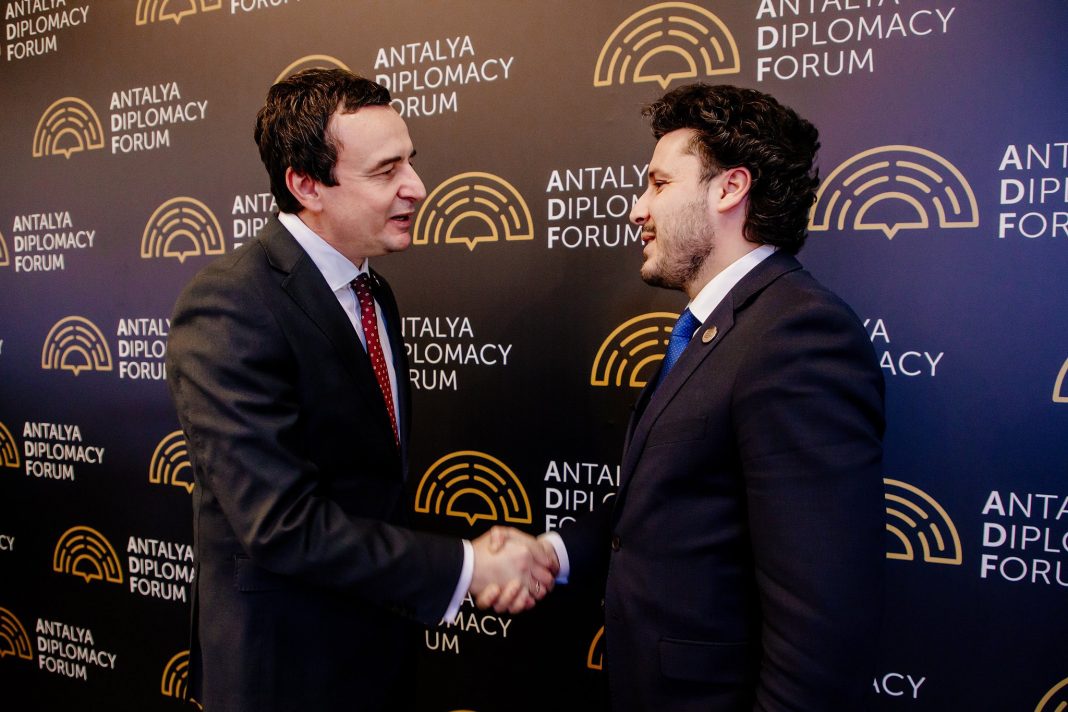
Acting Prime Minister of Montenegro Dritan Abazović commented on the relationship between the Government of Kosovo, the United States and the European Union.
Abazović stated that the situation in the northern part of the country has only served Serbia.
“The political situation in Serbia was complicated, and I think what has happened in the north has unfortunately served the Serbian government because they want to divert attention from certain problems within their own state. I believe that in this case, the north of Kosovo is also being exploited for political maneuvers,” said Abazović in an interview to Klan Kosova.
Abazović expressed his opposition to violence and appealed to those who have resorted to violence against KFOR not to repeat such actions.
He emphasized that he does not like the lack of coordination between Kosovo Prime Minister Albin Kurti’s government and the international community.
“I am convinced that the Government of Kosovo, led by Prime Minister Kurti will soon improve communications and find a common solution. This is the issue in the Balkans. We are not superpowers; we are very small states, microstates. It is true that Kosovo is larger than Montenegro, but we cannot prevent the influence or friendship with our main allies, first and foremost the United States and the European Union. Therefore, a form of communication must be established,” Abazović stated.
Abazović took care to emphasize that he was not criticizing the Government of Kosovo with these remarks.
“This is not a criticism of the government; I am saying this because some messages have been conveyed and do not sound so positive. I am confident that in the future, there will be a leveling of those messages and support towards these states,” he concluded.
Kurti came under fire from the international community, following the unrest that erupted in Leposavić, Zvečan, and Zubin Potok – municipalities in northern Kosovo with a Serbian majority, where the security situation worsened with Albanian mayors officially taking office despite resistance from local residents.
Violence escalated on May 29th when local Serbs clashed with members of the NATO mission in Kosovo, KFOR, and dozens of people from both sides were injured.
The US and the EU presented three requests to Kosovo: calming the situation in the north, holding new elections in the four northern municipalities, and resuming the dialogue for the normalization of relations between Kosovo and Serbia, while slapping sanctions against Kosovo, including the cancellation of participation in the “Defender Europe 23” military exercises and condemning Pristina for its stubbornness.
However, Kurti insisted that the presence of special units of the Kosovo Police in the three municipalities in the north would not be reduced unless the “Serbian criminal gangs” either leave or are arrested. He said that there would be peace in Kosovo if there were “no orders for violence coming from Belgrade”.
According to him, Western powers should not “spoil” Belgrade, which he considers the main problem of violence in the Western Balkans.
The April 23rd elections, which brought Albanian mayors to power, were boycotted by the Serbian community.
Kurti alongside President Vjosa Osmani have declared readiness to hold new elections in the north, on the condition that 20% of the voters will sign a petition with such a request, in order to guarantee the participation of Serbs in the process.




