

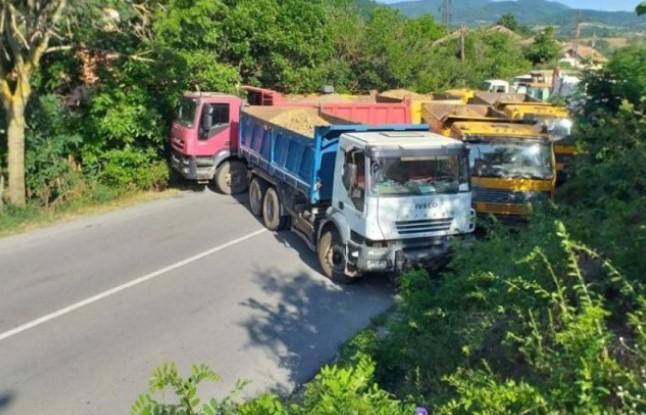
The Ministry of Foreign Affairs and Diaspora of Kosovo announced on Monday evening that the traveling of buses and trucks from Kosovo to Serbia, at the Jarinjë and Merdare crossing points, has been disabled.
According to the website of the Ministry of Internal Affairs, the crossing point in Bërnjak is completely blocked.
The blockades are believed to have been caused as a result of the protests that are being held in Serbian territory.
According to the ministry, even the passage of cars is not safe.
In some road axes, trucks have also been placed to block the roads as a sign of revolt against the decision of the Kosovo authorities not to allow the entry of trucks with Serbian license plates and goods into the territory of Kosovo.
The Government of Kosovo has made a decision, on June 14, to tighten border controls with Serbia.
The decision was taken after the arrest of three members of the Kosovo Police by the Serbian authorities.
The Kosovo authorities have said that it is about their abduction in the territory of Kosovo, while Belgrade has said that they were arrested in the Serbian territory.
The High Representative of the European Union for Foreign Policy and Security, Josep Borrell, has said that he will invite the representatives of Kosovo and Serbia this week in Brussels, an urgent meeting for crisis management.
The President of Serbia, Aleksandar Vucic, has refused to meet with the Prime Minister of Kosovo, Albin Kurti, while Kurti has not yet decided whether he will participate in the meeting in Brussels.
The international community has addressed three requests to the Prime Minister of Kosovo, Albin Kurti, regarding the situation in the north:
Escalation of the situation there
Holding new elections
The return to the dialogue for the normalization of Kosovo-Serbia relations, mediated by the European Union.
NATO deployed additional troops in Kosovo after tensions erupted on May 26 in northern Kosovo, where groups of Serbian protesters took to the streets to oppose the placement in municipal offices of Albanian mayors from the April 23 elections, which were boycotted by Serbian political parties.
The commander of NATO-led forces in Kosovo, Angelo Michele Ristuccia, said his forces are ready to face any situation if acts of violence threaten peace.
At least 30 NATO peacekeepers were injured in clashes with Serbian protesters in May.




