

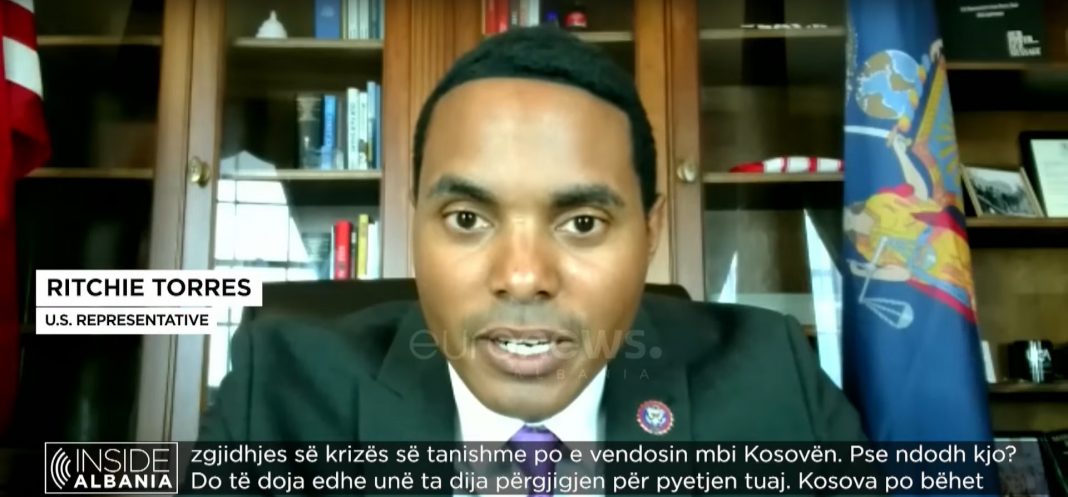
The EU-backed dialogue to normalize relations between Kosovo and Serbia has been weaponized and is being used as a sword to the detriment of Kosovo, rather than a shield to protect it from Serbia, U.S. Congressman for the Bronx told Euronews Albania.
Torres, a member of the Democratic Party, has been one of the few U.S. voices which has stood in support of Kosovo amid growing calls for Kosovo to de-escalate the situation in the north, under the threat of U.S. and EU sanctions.
Asked by Inside Albania moderator Alice Taylor whether the EU, counting five non-recognizers among its members, and with lead figures in the dialogue coming from non-recognizer countries, is fit to lead such a process, Torres was not convinced.
“Instead of operating as a shield that protects the independence of Kosovo, the dialogue has become a sword that Serbia weaponizes against Kosovo,” he said.
Torres added that basic local decisions like enforcing licenses and elections are subject to the dialogue.
“Serbia has managed to weaponize the dialogue process to infringe upon the sovereignty and the independence of Kosovo, which is the opposite of how the dialogue should be operating,” he explained.
The EU-backed dialogue between Serbia and Kosovo has been ongoing for over 13 years, yet little has been achieved during that time. A raft of agreements have been signed but very few of the provisions have ever actually been implemented.
Torres also favors the U.S. playing a stronger role in the bid to normalize relations, stating that the EU’s non-recognizers are part of the problem rather than the solution.
“I worry that the non-recognizers are part of the problem rather than part of the solution. And those non-recognizers should do the right thing and recognize the independence of Kosovo,” he told Euronews Albania.
The Congressman continued that he finds it strange the point person on foreign affairs and other stakeholders, for example, Josep Borrell (Spain) and Miroslav Lajčák (Slovakia) come from countries that refuse to recognize Kosovo’s independence.
“If you’re a Kosovar, you’re skeptical about the neutrality of the dialogue process, knowing that it’s being run partly by non-recognizers,” he said, pointing to some of the reasons why citizens of Kosovo may have started to lose faith in the process.




