

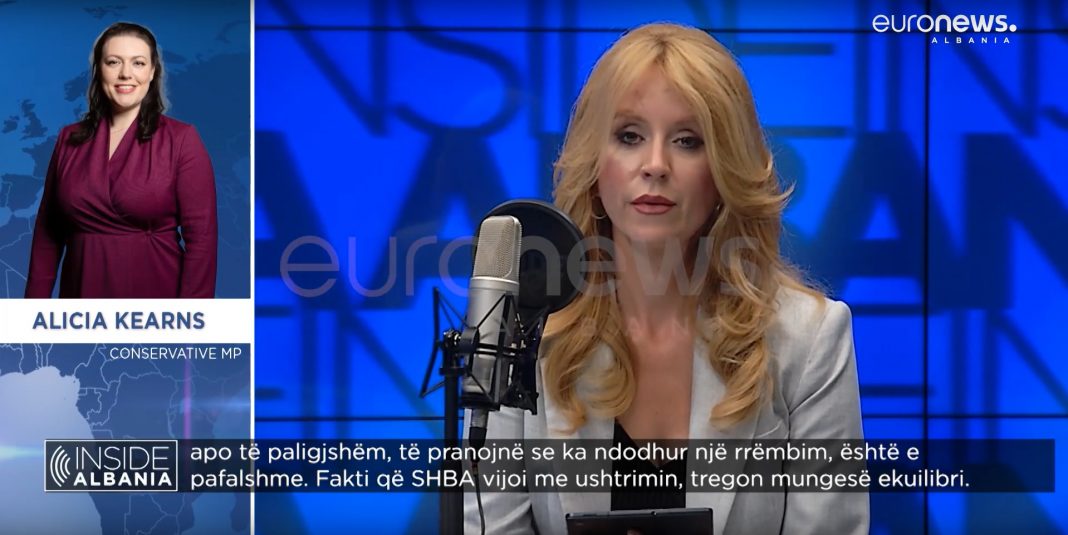
British Conservative Party politician and Chair of the Foreign Affairs Select Committee in the British House of Commons, Alicia Kearns raised concerns over the West’s imbalanced response to the recent Kosovo-Serbia crisis.
Exclusively speaking to “Inside Albania” host Alice Taylor and Euronews Albania, Kearns was clear in pointing out which side led to the tensions seen over the past few weeks.
“My concern comes down to balance and proportionality of the way in which, particularly the U.S. and the EU, are responding to heightened tensions in Kosovo. The reality is, if we go back to what has underpinned this crisis, it is the decision by Serbia to commit foreign interference in domestic elections within Kosovo.”
Tensions in northern Kosovo escalated in end of May, after newly elected Albanian mayors entered municipal buildings with the assistance of the Kosovo Police, amid opposition from local Serbs.
Since then, local Serbs have been protesting in front of municipal buildings in Zvečan, Zubin Potok, and Leposavić.
These mayors were chosen in the April 23 local elections in the four northern municipalities, a process largely boycotted by Serbs.
On June 14, tensions escalated further following the arrest of three Kosovo police officials. Serbia claimed that they were arrested “deep” within its territory, but Kosovo stated that they were patrolling in Kosovo territory near the border line with Serbia in Leposavić.
While the West is calling for de-escalation, it is also unwilling to call out on Serbia for illegally kidnapping three Kosovo Police officers, according to MP Kearns.
“What we have seen is our democratic partner [Kosovo] denigrated and punished, whilst an increasingly autocratic country [Serbia] has been embraced and there has been no meaningful repercussion, despite the fact that they have arbitrarily detained or kidnapped three Kosovo Police officers. The unwillingness of countries, well organizations like the EU to call it arbitrary or illegal detention, to recognize that kidnapping has taken place or for any punishment to be put in place, is unforgivable.”
Following heightened tensions, the European Union and the United States have presented three requests to the Prime Minister of Kosovo, Albin Kurti: calming the situation in northern Kosovo, holding new elections in the four municipalities in the north, and returning to the dialogue for the normalization of relations.
The U.S. has also encouraged Kurti to have the newly elected Albanian mayors in the north perform their duties from alternative locations.
PM Kurti, on the other hand, has presented a five-point plan, which also includes holding elections. However, Kurti has stated that in order to have free elections in the north, the rule of law is needed.
Kearns, a vocal supporter of Kosovo in the British House of Commons, slammed the West for failing to prevent Serbia from heightening tensions through their unbalanced policies, whilst Kosovo is always aligning its foreign policies with the international community.
“Ultimately, this is a failure of deterrence diplomacy, and what have we seen over the last few decades, a consistent failure to stand up to those who embrace autocracy, and who do not necessarily engage meaningfully in international processes. Kosovo here, is our democratic partner, is the one agreeing to participate in sanctions and to fully support what the international community and the EU when it comes to Ukraine. Whereas in contrast, you have [Serbian President Aleksandar] Vučić saying that his hand is broken and will be for four years, so he cannot sign an agreement to explicitly help de-escalate the situation, you have Vučić signing a foreign policy agreement with Russia, many months after the illegal invasion of Ukraine.”




