

North Macedonia will not face new vetoes or other conditions from Bulgaria in the European Union integration process, except those outlined in the agreement between the two countries based on what is known as the “French proposal”.
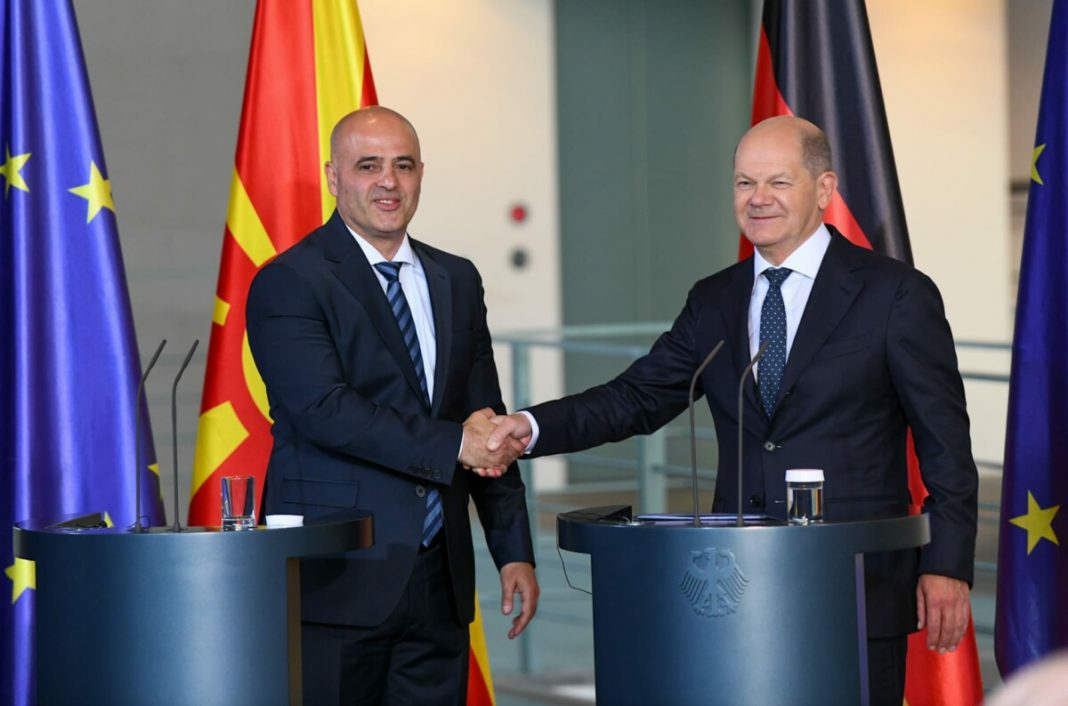
This was stated by the Prime Minister of North Macedonia Dimitar Kovačevski after a meeting in Berlin with German Chancellor Olaf Scholz on Wednesday evening.
He “guaranteed” that, apart from amending the Constitution to include the Bulgarian minority in its preamble, there would be no further conditions from Sofia.
“With this, the Federal Republic of Germany is encouraging North Macedonia to continue on the path to EU membership. It is of great importance to have the resolution passed in the German Bundestag supporting this process and guaranteeing respect for the Macedonian language, identity, and culture,” said Kovačevski.
The accession negotiations between North Macedonia and the EU should proceed according to the already established agenda and procedures, without additional demands regarding the bilateral situation between North Macedonia and Bulgaria, stated Scholz. He added that the membership talks should continue after the approval of constitutional changes.
“I will be clear; this issue is agreed upon and should remain so. It should be a regular membership process, according to the procedures managed by the EU. These are things that have already been put in writing, and there should be no further conditions regarding the bilateral situation. This is what I stand by, I guarantee,” declared the German Chancellor.
Prime Minister Kovačevski stated that North Macedonia no longer faces external blockades but only internal ones, referring to the opposition in North Macedonia refusing to support the constitutional changes.
“Now, the next step is ahead of us, the constitutional changes that will be sent for approval in the Parliament, and I expect all 120 deputies to show a state-oriented behavior and support them, as they guarantee a better future for the country and its citizens,” said Kovačevski.
However, more than two weeks after the expert group’s work concluded, the constitutional changes have not been presented to the government to be subsequently submitted for approval in the Parliament.
The constitutional amendments are supposed to be approved parallel to the completion of the screening process by mid-November. However, the delays were justified by Prime Minister Kovačevski with the need for what he called inclusive debate.
President Stevo Pendarovski called for expediting the process, as at least three months are needed to go through all the procedures until approval.
The President of the Assembly Talat Xhaferi stated that the deputies can work even in August, although this period is legally designated as a vacation for them.
The delays are mainly due to the lack of votes for their approval since a two-thirds majority is required in the Assembly, or 80 out of 120 votes from the deputies.
The parliamentary majority has only 64 votes, as some deputies from Albanian opposition parties have stated that they will not support the changes without their requests being approved. They demand a change in the definition of the Albanian language, which is recognized as a language spoken by more than 20% of the population in North Macedonia’s Constitution.
VMRO-DPMNE has stated it will support the changes at the end of the process or before North Macedonia becomes an EU member if the process is led by a new government.
This party suspects that in the event of the approval of constitutional changes before the conclusion of negotiations with the EU, the Bulgarian side may present other requests “harmful to Macedonian national and state interests”.
However, this request has been rejected by the EU Office in Skopje, which has called on the parties to adhere to the negotiation framework.




