

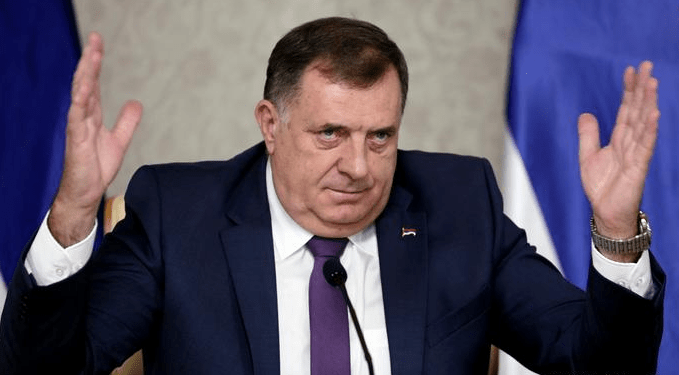
The leader of the Serbian entity in Bosnia has announced that he has filed a lawsuit against himself and several other high-ranking officials in his latest attempt to challenge the central authority of the state.
Milorad Dodik, president of the Republika Srpska entity, announced that he has filed criminal charges against himself, the Bosnian Parliament Speaker, and dozens of legislators related to legislation that regulates the competencies of officials.
Dodik’s move is part of his ongoing resistance against the central authorities of Bosnia and is part of a disagreement regarding the voting in the Republika Srpska Assembly to no longer recognize the decisions of the Constitutional Court of Bosnia.
On June 27, the Republika Srpska Assembly voted on a series of orchestrated steps by Dodik and his Serb allies aimed at rejecting the power-sharing structures that exist in Bosnia. These power-sharing arrangements were established in the Dayton Agreement that ended the war in Bosnia.
The agreement reached in 1995 divided governmental, administrative, and other functions along ethnic lines between the Bosnian, Serb, and Croat majority.
The legislation, which has received the support of the Lower House of the Republika Srpska Parliament, must also receive the support of the Upper House and the approval of the presidential level in this entity.
If it receives this support, the legislation could come into effect in August. If this happens, it would be a blow to the power controls in Bosnia.
The High Representative for Bosnia Christian Schmidt could also annul the legislation in order to ensure the functioning of civilian institutions in Bosnia and Herzegovina.
The Constitutional Court of Bosnia could also invalidate the legislation after it comes into effect, but Dodik and his allies are likely to challenge the authority of this institution.
The German Ministry of Foreign Affairs said on June 30 that the recent move by the Republika Srpska Assembly to ignore the decisions of the Bosnian Constitutional Court “violates the spirit of the state constitution and the 1995 Peace Agreement”.
The spokesperson of the ministry Christofer Burger warned that the voting “is a serious step towards a further dissociation from identification with the state as a whole” and said that it “threatens the unity and territorial integrity of the state”.
Burger added that these actions jeopardize the country’s candidate status for the European Union, which Bosnia obtained last December.
Earlier, Dodik had filed lawsuits against himself in an attempt to convey a broader political message. Eight years ago, he filed a criminal complaint against himself to mock the opposition’s accusations of corruption.
In 2017, his son, Igor, filed a criminal complaint against himself as an alleged “accomplice” with his father for organizing events on the Day of Republika Srpska, a holiday that is prohibited.