

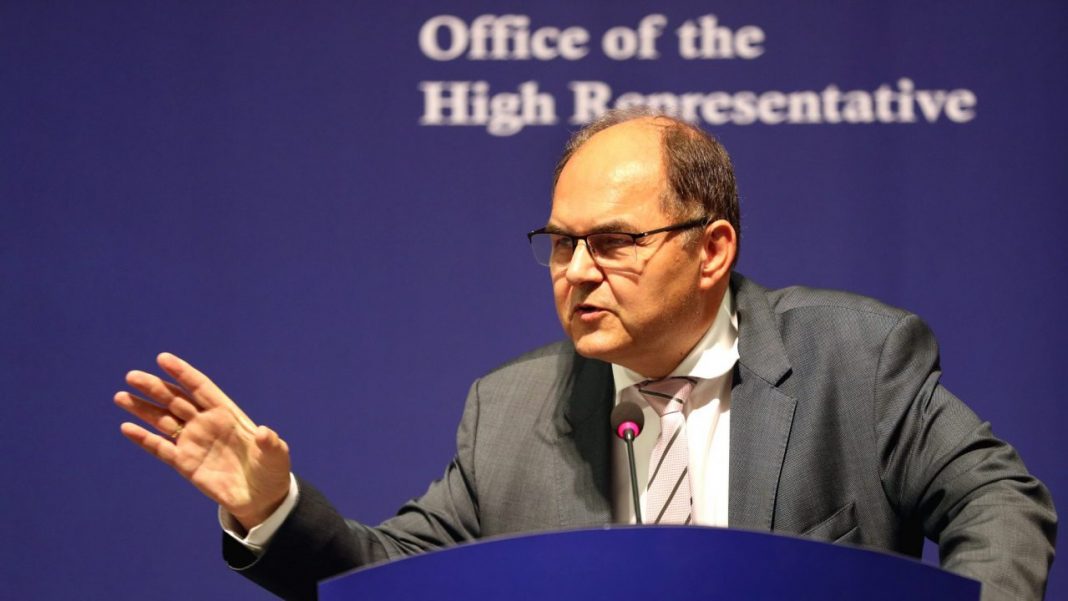
The High Representative of the International Community in Bosnia and Herzegovina Christian Schmidt annulled the anti-Dayton laws adopted by the National Assembly of the Republika Srpska entity, regarding the non-publication of decisions of the High Representative and the non-implementation of decisions of the Constitutional Court of Bosnia and Herzegovina.
Schmidt also made a decision to amend the Criminal Code of Bosnia and Herzegovina so that actions that violate the constitutional order are treated as criminal offenses.
“The entity parliaments do not have the authority to circumvent the provisions of Bosnia and Herzegovina and they do not have the right to evade the jurisdiction of key Dayton institutions,” Schmidt explained the decisions on 1 July.
“This is an attack on the Constitutional Court of Bosnia and Herzegovina and an attempt to undermine the law and the constitutional framework of the country and the key elements of Dayton, such as the decisions of the High Representative,” he added.
The U.S. Embassy in Bosnia and Herzegovina supported Schmidt’s decisions and warned that “there will be consequences” for the actions of the National Assembly of the Republika Srpska entity.
“The United States supports the sovereignty, territorial integrity, and multiethnic character of Bosnia and Herzegovina and will continue to hold individuals engaged in anti-Dayton behavior responsible for their actions,” the U.S. embassy’s reaction said.
The Republika Srpska National Assembly’s decisions to adopt legislation on Non-Enforcement of the Decisions of the BiH Constitutional Court and amend the RS Law on Publishing Laws and Other Regulations were unconstitutional and deliberate attacks on the Dayton Peace Agreement,…
— US Embassy Sarajevo (@USEmbassySJJ) July 1, 2023
The decisions of the High Representative followed after the National Assembly of the Republika Srpska entity voted to not implement the decisions of the Constitutional Court of Bosnia and Herzegovina.
According to the law, which was adopted by the National Assembly on 27 July, the decisions of the state Constitutional Court will not be applied and enforced in the territory of the Republika Srpska until the Parliamentary Assembly of Bosnia and Herzegovina adopts the Law on the Constitutional Court.
President of the Republika Srpska entity Milorad Dodik, who has long criticized the Constitutional Court for having foreign judges, started the voting after the court decided last week to change the rules so that sessions could be held and decisions could be made without Serb judges.
The Republika Srpska Assembly has previously also adopted legislative changes that imply that the decisions of the High Representative in Bosnia and Herzegovina will no longer be published in the official gazette, which is a requirement in the Republika Srpska entity for a law to come into force or a decision to become valid.
The Dayton Peace Agreement, officially signed on December 14, 1995, ended the war in Bosnia and Herzegovina. Annex 10 of that agreement assigns the High Representative, the “task of monitoring the implementation of the agreement”.
Schmidt stated that the law on the High Representative will not come into force and that all procedures related to this have been completed.
“I also decided that the law on non-implementation of decisions of the Constitutional Court of Bosnia and Herzegovina in the territory of the Republika Srpska will not come into force,” Schmidt emphasized and added that those who attempt to undermine the constitutional order should be held criminally accountable.
He also stressed that the law on the Constitutional Court of Bosnia and Herzegovina can be amended, but only as determined by the Constitution of Bosnia and Herzegovina.
“They will bear the consequences for their actions – all options are on the table. I hope that political actors will come to their senses, and they will… I have met many responsible politicians who work intensively to ensure that this country makes progress, takes concrete steps,” Schmidt said.
He added that the greatest consequences of the irresponsible behavior of some politicians are borne by the citizens of the Republika Srpska.
“I respect them, like all citizens of Bosnia and Herzegovina, and they should not have a life dominated by the ideas of individuals,” Schmidt said.




