

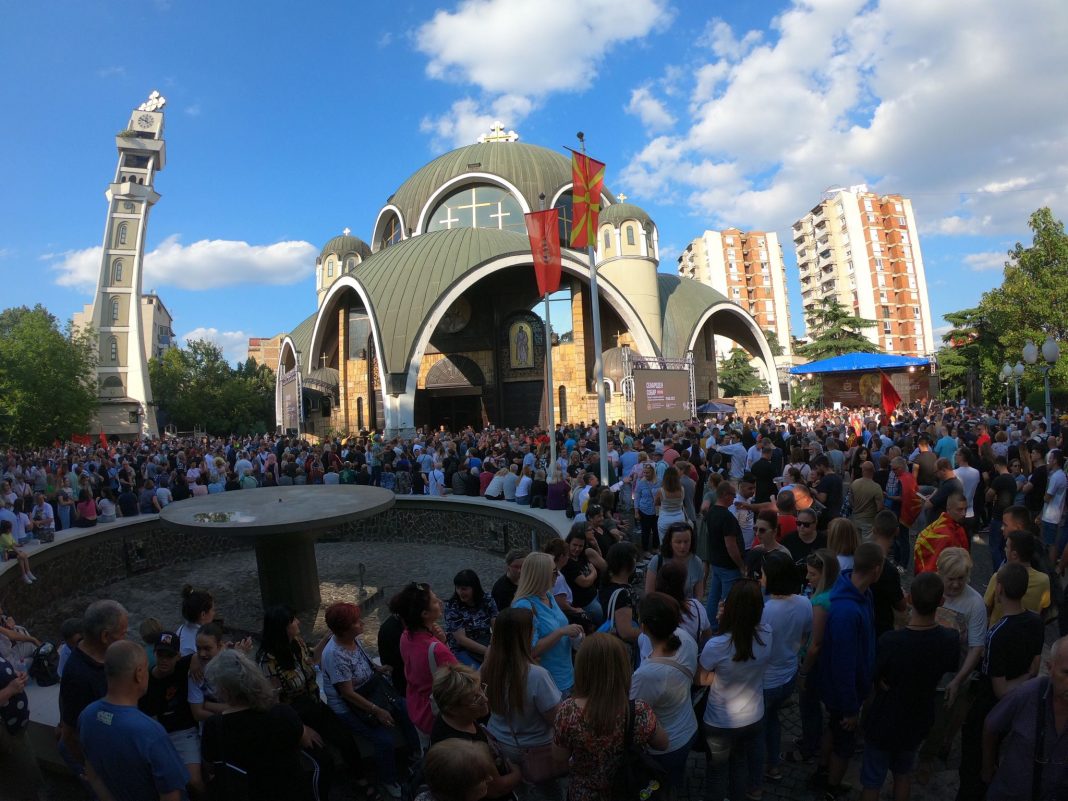
“Let us say YES to life and the sanctity of the family created by a man and a woman. Let us protect our loved ones – the children – from new unacceptable and destructive ideologies.”
This was the message of Archbishop Stefan, head of the Macedonian Orthodox Church, during the protest in Skopje against gender declaration laws.
Supporters of the church and believers from all over North Macedonia gathered in front of the Cathedral in Skopje to oppose the adoption of gender equality laws and birth data. They fear that these laws will destroy the family.
“When we speak something with the best intentions and with love, without impositions, they try to silence us by changing the narratives about the secular character, or rather the worldliness of the state, always as a rule, interpreting secularity in contradiction to the Constitution, while in it, the church and other religious communities have their place and guaranteed rights,” said Archbishop Stefan.
Writer and academic Katica Kulavkova stated that despite the argumentation of the gender equality law referring to the empowerment of women, it aims at the rights of transgender individuals, and anyone who opposes it is accused of violating human rights.
“The transgender history relativizes identity to the extent that it diminishes it. It creates dubious urban myths; it exploits gender identity and the right to the privacy of children and young people. Why parade with intimacy? Why should we pour salt on the wounds of families where gender change drama unfolds?”
The protest was also supported by the Catholic Church and the Islamic Religious Community but did not take to the streets due to the celebration of Eid.
The Platform for Gender Equality and the Network for Protection against Discrimination condemned the protest and accused it of aiming to exert public pressure for the withdrawal of two draft laws, considering it a direct interference with the secularism of the state, a disregard for the Constitution, and, above all, a disregard for women’s rights in the country and the ignorance of their actual situations.
On the other hand, any citizen of North Macedonia who has reached the age of 18, is capable, and is unmarried, has the right to legal gender recognition through a regulated procedure with the law.
Any person can change their gender designation in the civil registry, and in this way, their gender identity is recognized.
Changes in the law on civil status, with the condition that the person changes their gender, will only be made through a declaration by a notary.




