

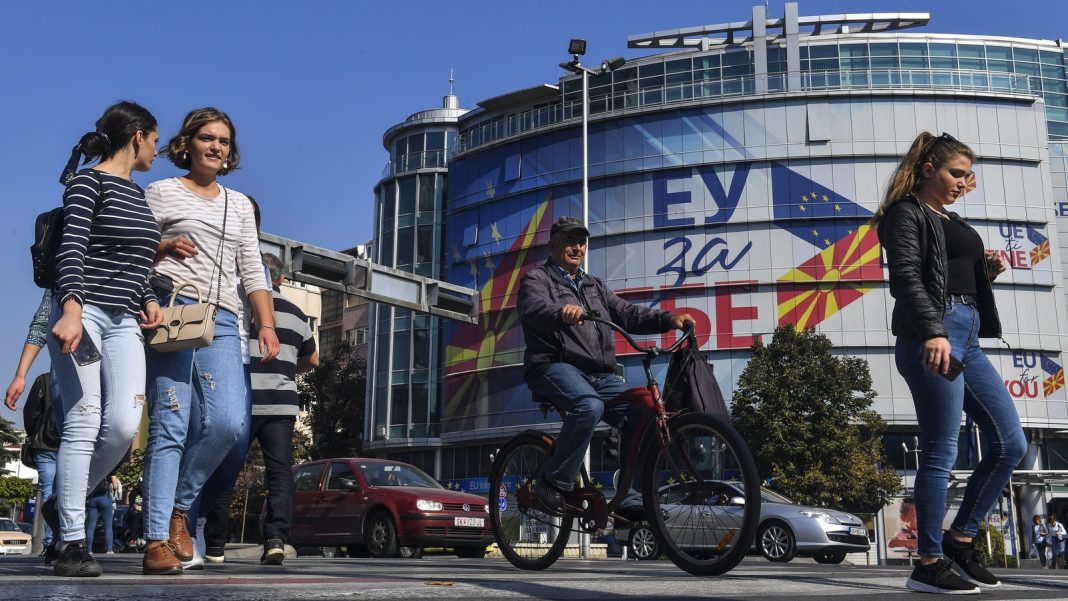
A recent public survey conducted by the American Republican Institute for North Macedonia shows an increase in support for the country’s membership in the European Union, but a low level of trust among citizens in the rule of law as well as divisions regarding the direction of the country both at the local and national level.
The issues that concern the citizens of this country the most are poverty, low living standards, daily problems, high prices, and the difficult economic situation.
Paul McCarthy, the Director of IRI for Europe, stated that “the increase in support for EU integration indicates that Western institutions offer hope for a successful future, and the citizens of North Macedonia see integration into the democratic bloc such as the EU as a key to peace and prosperity”.
According to the survey, 79% of respondents answered positively to the question of whether they “support North Macedonia’s integration into the EU”. This represents an increase of 6% compared to the survey conducted in October of last year.
However, trust in the rule of law remains low. Only 31% of respondents stated that the law is applied equally to all in North Macedonia, which is the lowest level of trust ever recorded, while 65% believe that the rule of law is not being applied.
“This should be examined by political leaders in Skopje if they want to increase trust in the government and political institutions,” stated Director McCarthy.
Regarding divisions on the direction of local and state governance, 28% of respondents feel that their municipality is moving in the right direction, while only 14% believe the same about the direction of the state.
The survey conducted by the Public Opinion Research Center – Gallup from 8 April to 4 May of this year, on behalf of the American IRI, highlights that despite the increase in support for EU membership, opinions are nearly the same among optimists and pessimists when asked about when North Macedonia can become an EU member. 49% hope that this will happen within ten years, while 45% believe it will take longer than ten years or that the country will never become an EU member.
Regarding the assistance provided to this country, one-fourth of respondents perceive that Turkey provides the most assistance, followed by the EU at 18%, while 13% think Germany provides the most assistance, and only 11% believe it comes from the United States.
The citizens of North Macedonia mostly trust banks (55%), followed by media and educational institutions at 48%, and then the police at 47%. Only 25% trust the government, while 32% trust the opposition. Only 1% have trust in the judiciary, while 18% partially trust it.
Among government members, the Minister of Interior Oliver Spasovski has the highest level of trust from respondents at 12%, while 51% believe that no minister is doing their job properly.
Among politicians, President Stevo Pendarovski is the most trusted at 38%, followed by former Prime Minister Nikola Gruevski at 30%, almost the same as the current opposition leader Hristijan Mickoski (29%). Prime Minister Dimitar Kovačevski has the support of 25% of respondents, while Ali Ahmeti of the Democratic Union for Integration has 16%.




