

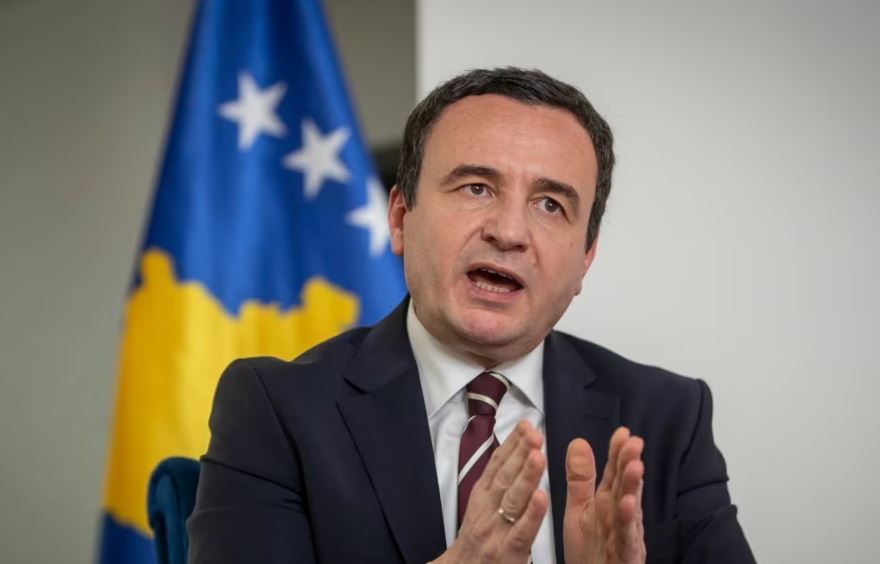
Kosovo’s Prime Minister Albin Kurti stated that the agreement between Kosovo and the EU on the points aimed at de-escalating the situation in the northern part of the country “will help strengthen the focus and establish equality between the parties”.
“Both parties [Kosovo and Serbia] should have the opportunity to negotiate from equal positions, which has been undermined by the imposition of temporary measures against Kosovo by the European Union,” said the Prime Minister.
Since the imposition of punitive measures by the EU against Kosovo, Kurti has repeatedly stated that they are unjust and make the dialogue asymmetrical.
The EU’s punitive measures against Kosovo include the temporary suspension of the work of the bodies established under the Stabilization and Association Agreement, the non-invitation of Kosovo to high-level meetings, and the suspension of bilateral visits, except those focused on addressing the crisis in northern Kosovo within the framework of the facilitated dialogue by the EU.
Other measures include the cessation of fund programming for Kosovo under IPA 2024 (Instrument for Pre-accession Assistance). Kosovo’s proposals within the Framework of Investments in the Western Balkans have not been submitted for review by the board on 29-30 June.
Listing the points agreed upon in Bratislava between Kosovo’s chief negotiator Besnik Bislimi, and EU envoy Miroslav Lajčák, the Kosovar Prime Minister said that this agreement aims to facilitate the full implementation of the Ohrid Agreement reached in March of this year, and reiterated that the agreement must be fully implemented.
“Both parties must publicly acknowledge that the agreement is legally binding, which has not yet happened from the Serbian side,” said Kurti, adding that “the implementation of the provisions of the agreement cannot be conditioned”.
Referring to the organization of new elections in the northern part of the country, the Prime Minister said that his government attaches importance to ensuring local representation that adequately represents the citizens of Kosovo, “but to achieve this, it is necessary to create an environment that enables a fair campaign, political pluralism, the participation of local communities, and guarantees the integrity of the vote”.
Earlier, state leaders in Kosovo expressed readiness to hold new elections in the municipalities in the north but requested adequate preparations to avoid boycotts.
The 23 April elections, which resulted in the election of Albanian mayors in four municipalities in the north, were boycotted by political parties and the Serbian population.
Earlier in the day, Serbian President Aleksandar Vučić did not comment on the agreement reached on 10 July between the European Union and Kosovo, but spoke about the demands imposed by the international community on Belgrade and Pristina to reduce tensions.
“Now you will see another trick that some people from the West are trying to implement. And that means [they will say] – come back and talk normally,” Vučić said, adding that the proposed way to ease tensions in the north is unreasonable for him.
“Is reducing something by 25 percent tension reduction? Only God knows what that means, but they are looking for a sufficient reason to blame Serbia,” Vučić said, referring to the decision of the Government of Kosovo to reduce the police presence in the northern part of the country.
On 11 July, the European Union confirmed that Kosovo had agreed to reduce the police presence in and around municipal buildings in Zvecan, Leposavic, and Zubin Potok – predominantly Serbian-populated municipalities in northern Kosovo – and that Kosovo would support holding new elections in four northern municipalities as part of efforts to de-escalate the situation.
The Government of Kosovo stated that all steps “will be finalized within a two-week period”.
This agreement was reached during an informal meeting held in Bratislava between Kosovo’s Deputy Prime Minister Besnik Bislimi, and the EU Special Representative for the Kosovo-Serbia Dialogue Miroslav Lajčák.
Furthermore, Kosovo and the EU have also agreed to undertake other steps.
Regarding the meeting between the negotiators of Kosovo and Serbia, it will reportedly take place next week.
The European Union had presented several requests to reduce tensions in the north, which began at the end of May after newly elected Albanian mayors in Zvecan, Leposavic, and Zubin Potok entered municipal buildings under the escort of the Kosovo Police.
Kosovo has continuously demanded the implementation of the Agreement towards the normalization of relations, reached in Brussels on 27 February. The parties also reached an Annex for the implementation of this agreement in Ohrid on 18 March.
The document, consisting of 11 points, does not include mutual recognition, which Kosovo insists on, but requires Kosovo and Serbia to accept each other’s documents and symbols, including passports, diplomats, and license plates.
The document calls on the parties to implement all agreements reached so far in the dialogue on the normalization of relations, including the one on the establishment of the Association of Serb-majority municipalities in Kosovo, which the Government in Pristina has rejected so far, arguing that it could jeopardize the functionality of the state.




