

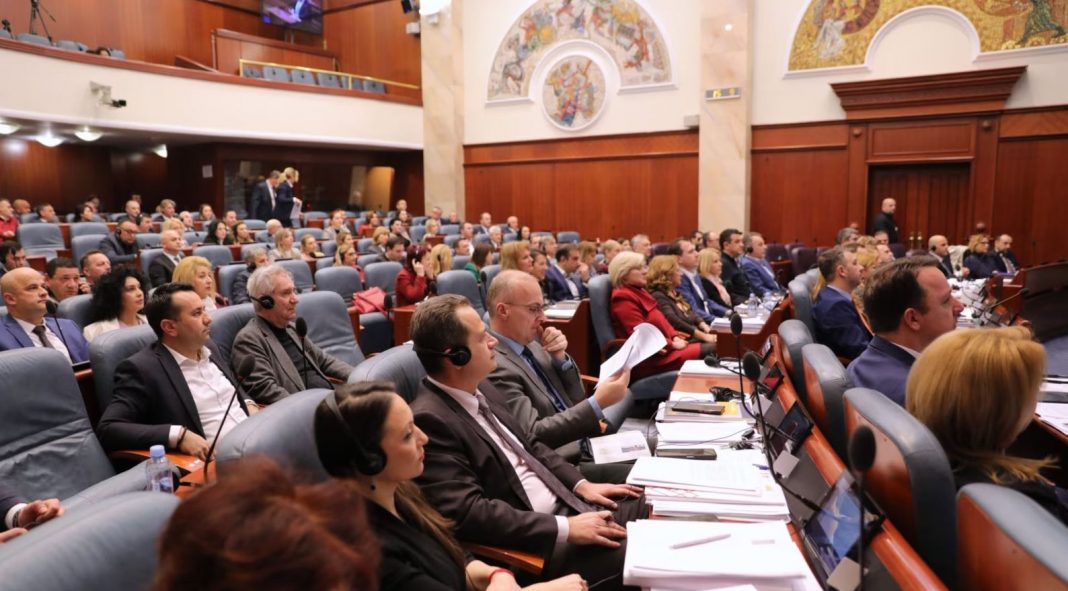
The majority in the Parliament of North Macedonia has lost three more deputies, jeopardizing not only the approval of constitutional changes but also risking the country heading to snap parliamentary elections.
Currently, the number of seats held by the ruling coalition in the Assembly has decreased from 64 to 61, meaning that the opposition only needs the removal of one more deputy to table a motion of no confidence against Prime Minister Dimitar Kovačevski’s government.
The Deputy Chairman of the Democratic Union for Integration (DUI), Izet Mexhiti, announced on Monday his departure from DUI and the formation of a new political movement. Another BDI deputy and an independent deputy who previously supported DUI’s policies also joined him.
“We declare that all possibilities of functioning within DUI have been exhausted; therefore, we resign from all positions within DUI. We are no longer members of DUI and now we open a new page, a new beginning,” stated Mexhiti.
He justified his departure due to dissatisfaction with the government’s work, as well as what he described as the party’s takeover by certain individuals, lack of diverse opinions, and other issues.
The departure of the three deputies occurred at a time when the parliamentary majority was doing everything to secure the support of two-thirds of the Assembly for the approval of the constitutional changes.
These changes, strongly urged by the European Union and the United States, are crucial for North Macedonia’s integration process into the EU.
The changes concern fulfilling an agreement with Bulgaria, which, as an EU member state, has threatened to veto North Macedonia’s accession if bilateral issues concerning the Macedonian language and identity, especially regarding the inclusion of the Bulgarian minority in the Macedonian Constitution as a constituent people, are not resolved.
The changes need to be approved by November when the screening process concludes, to pave the way for the start of negotiations on North Macedonia’s EU membership.
If this does not happen, North Macedonia risks being “isolated”, as declared by the foreign ministers of Austria, Germany, France, Slovakia, the Czech Republic, and Poland during their recent visits to Skopje.
The shrinking of the parliamentary majority was welcomed by the Macedonian opposition led by VMRO-DPMNE, which has long been demanding snap parliamentary elections, as it is convinced that the constitutional changes will not be approved.
VMRO-DPMNE is against the constitutional amendments, arguing that by including the Bulgarian minority in the Constitution, the supposed “Bulgarian dictate” against the Macedonian people will not end.
“With the change of this government, people will come, who know how to pull the country out of the current state it is in. Within a few months, we will have a new government led by VMRO-DPMNE,” said the party’s leader, Hristijan Mickoski.
He stated that no member of his party will support the constitutional amendments, and he believes that neither will the deputies of other parties, which is why he expects snap elections.
A few months ago, several small Macedonian parties, each with one deputy, left the parliamentary majority, including the Albanian party Alternativa with three deputies. However, the majority decided to include the Alliance for Albanians in the government, which has eight deputies.
Even this move did not increase the number of seats to 64, leaving it at 61 after the divisions within DUI.
Regardless, Prime Minister Kovačevski declared that there will be no snap elections.
“There should be no snap parliamentary elections. For the moment, we have a government that takes care of the national interests and the dignity of the citizens, without dividing them based on ethnic or religious grounds. We care equally for everyone. Therefore, next year we will have presidential elections first, and in the second half of July, parliamentary elections,” said Kovačevski.
The government is not interested in constitutional amendments since it is already aware that they are unlikely to be approved; therefore, it is focused on completing its mandate to avoid snap elections, said Fadil Zendeli, a deputy from the opposition movement Besa.
“The government is buying time to postpone snap elections as much as possible and extend the government’s mandate until the end. This is its primary concern, not how to pass constitutional amendments or work in the best interests of the country’s citizens,” Zendeli expressed.
The government, led by the President of the Social Democratic Union, Dimitar Kovačevski, was voted in on January 16, 2022, with 62 votes from deputies.
He replaced former Prime Minister Zoran Zaev, who resigned due to the deep defeat of the Social Democratic Union in the local elections.




