
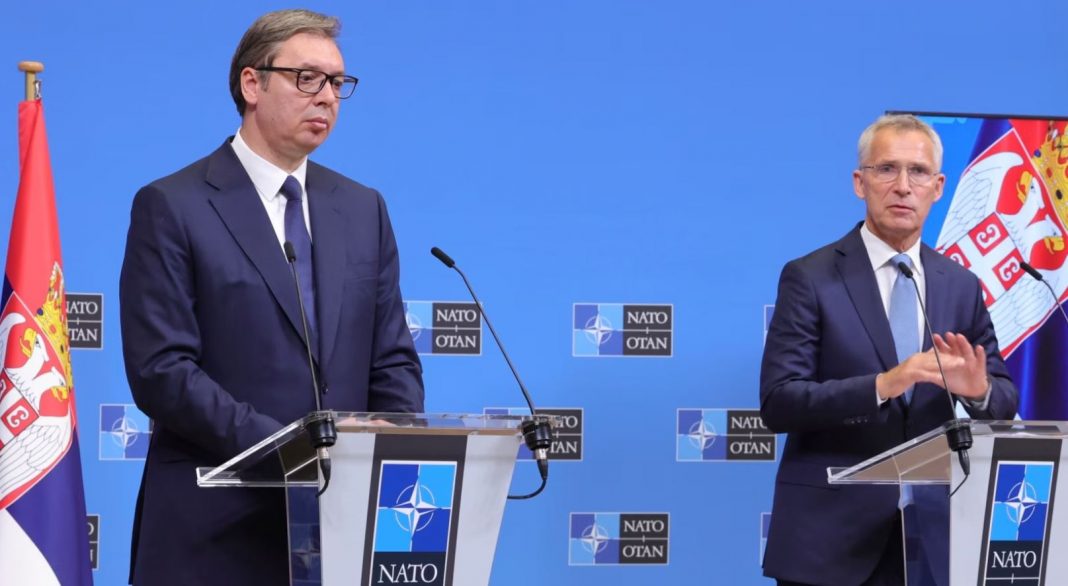
NATO Secretary-General Jens Stoltenberg said on Wednesday that it is very important to reduce tensions in Kosovo and that both parties should refrain from violence.
He made these statements after a meeting with Serbian President Aleksandar Vučić.
“We believe that the dialogue [between Kosovo and Serbia] should resume,” he added.
He reiterated that NATO has increased its presence of its mission in Kosovo, KFOR, due to recent tensions in the north.
“We will continue to maintain peace, as mandated,” said Stoltenberg, adding that NATO forces will be there to carry out the mandate provided by the United Nations.
Serbian President Aleksandar Vučić expressed great concern about recent developments in Kosovo and requested NATO, through KFOR, to provide security for the Serbs living there.
According to him, Belgrade believes that the “irresponsible actions of the Kosovo Government” are the main reason for recent developments.
The meeting between Stoltenberg and Vučić took place on the same day when the EU envoy for the Kosovo-Serbia dialogue Miroslav Lajčák met in Brussels with the chief negotiators of both countries, Besnik Bislimi and Petar Petković.
There was no trilateral meeting.
During the day, Lajčák was also reported to have met with Vučić.
The situation in northern Kosovo – an area predominantly inhabited by Serbs – has been tense since the end of May when the Kosovo Police assisted newly elected Albanian mayors in Zubin Potok, Zvecan, and Leposavic to enter municipal buildings, despite the resistance of local Serbian residents.
Tensions escalated into violence on May 29 when Serbian protesters in Zvecan clashed with KFOR troops.
Dozens of injuries were reported on both sides.
However, on July 11, the European Union confirmed that Kosovo had agreed to reduce the presence of the police in and around municipal buildings in Zubin Potok, Zvecan, and Leposavic, and that Kosovo will support the holding of new elections in the four northern municipalities, as part of actions to de-escalate the situation.
The Government of Kosovo stated that all steps would be “finalized within a two-week period”.
Due to the failure to heed international advice to end the crisis, Kosovo has faced punitive measures from the EU.
The EU’s punitive measures against Kosovo include: temporary suspension of the work of bodies established under the Stabilization and Association Agreement, non-invitation of Kosovo to high-level meetings, and suspension of bilateral visits, except those focused on addressing the crisis in northern Kosovo within the framework of the EU-facilitated dialogue.
Kosovo and Serbia are part of the dialogue mediated by the EU for the normalization of relations since 2011.
The parties have signed a series of agreements, but not all have been implemented.