

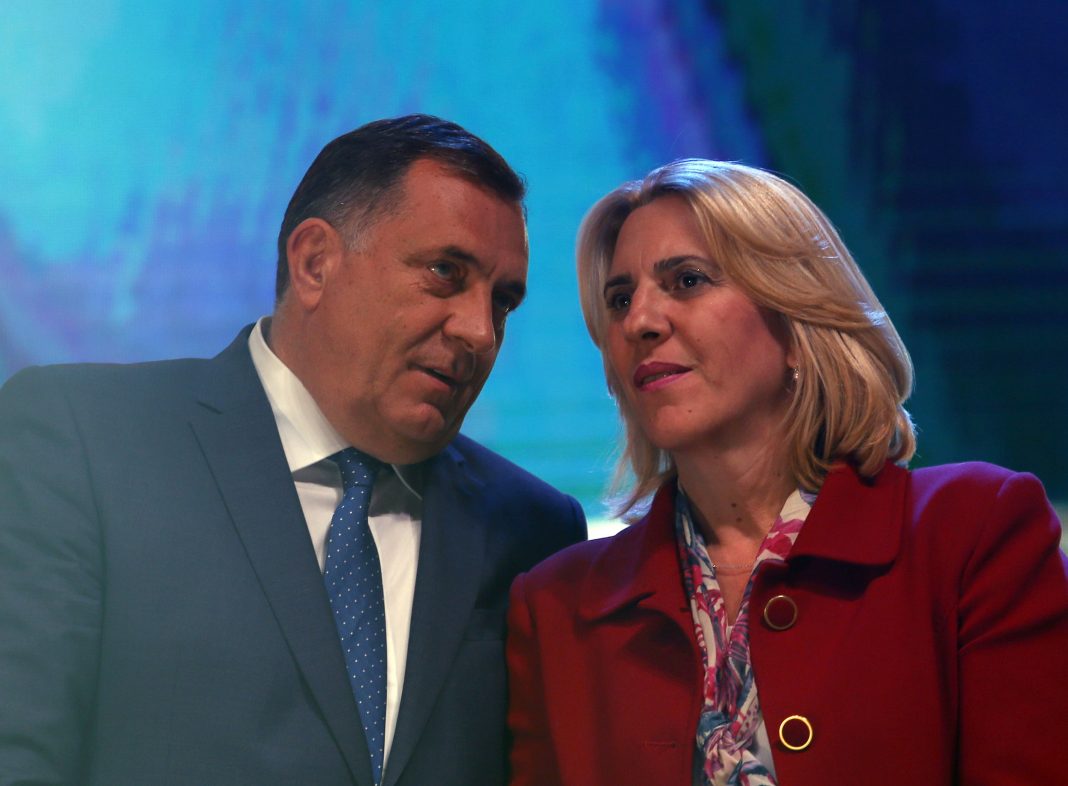
The United States has imposed sanctions on Serbian members of the Presidency of Bosnia and Herzegovina, Željka Cvijanović, and other high-ranking officials from Republika Srpska due to their actions undermining the implementation of the 1995 Dayton Peace Agreement.
The U.S. Department of the Treasury’s sanctions list also includes Nenad Stevandić, the Speaker of the Parliament of Republika Srpska; Radovan Višković, the Prime Minister of the entity; and Milorad Bukejlović, the Minister of Justice in Republika Srpska.
The Treasury stated that these officials are directly responsible for encouraging the National Assembly of Republika Srpska to declare decisions of the Constitutional Court of Bosnia invalid within the entity. According to the U.S., this threatens the fulfillment of the Dayton Agreement.
Brian E. Nelson, Under Secretary of the Treasury for Terrorism and Intelligence Finance, expressed concern that such actions endanger the stability, sovereignty, and territorial integrity of Bosnia and Herzegovina, and the hard-won peace achieved through the Dayton Agreement. He emphasized that this behavior also jeopardizes the state’s progress and its integration into Euro-Atlantic institutions.
Nelson further added that the U.S. will continue to support the people of Bosnia and Herzegovina in their pursuit of the rule of law and ensure that peace and prosperity prevail in the region.
Milorad Dodik, the President of Republika Srpska, sponsored a law declaring decisions of the Constitutional Court of Bosnia invalid within the entity’s territory.
Dodik himself has previously been subject to U.S. sanctions. On January 5, 2022, the U.S. accused him of directly or indirectly obstructing the implementation of the Dayton Agreement and involvement in corrupt activities.
The Treasury also accused Dodik of obstructing the Dayton Agreement’s implementation in July 2017.
On July 1, following the adoption of the law regarding the Constitutional Court’s decisions, Christian Schmidt, the High Representative for Bosnia, used his authority to repeal the legislation and publicly condemned it for undermining constitutional order, the rule of law, and the division of powers.
Despite Schmidt’s decision, Dodik signed the law on July 7.
Dodik has stated that he will not accept Schmidt’s decisions, and the Assembly of Republika Srpska has decided not to publish Schmidt’s decisions within the entity.
In July, Dodik filed a lawsuit against Schmidt, claiming that Schmidt is acting in Bosnia without authorization from the United Nations Security Council.
Leaders in Republika Srpska consistently assert that they do not recognize Schmidt, who was appointed as the High Representative in 2021. His appointment was not confirmed by the Security Council due to opposition from China and Russia. However, other member states of the Council stated that confirmation of Schmidt’s appointment was not required.
Regarding the effects of the sanctions, the Treasury stated that all properties owned by the sanctioned individuals in the U.S. or under the control of American citizens must be reported to the Office of Foreign Assets Control.
Additionally, any entity owned, directly or indirectly, by the sanctioned individuals will be blocked. The sanctions also include blocking transactions between U.S. nationals and the sanctioned individuals, unless licensed by the Office of Foreign Assets Control. Restrictions also apply to contributions or provisions of goods or services to the sanctioned individuals.




