

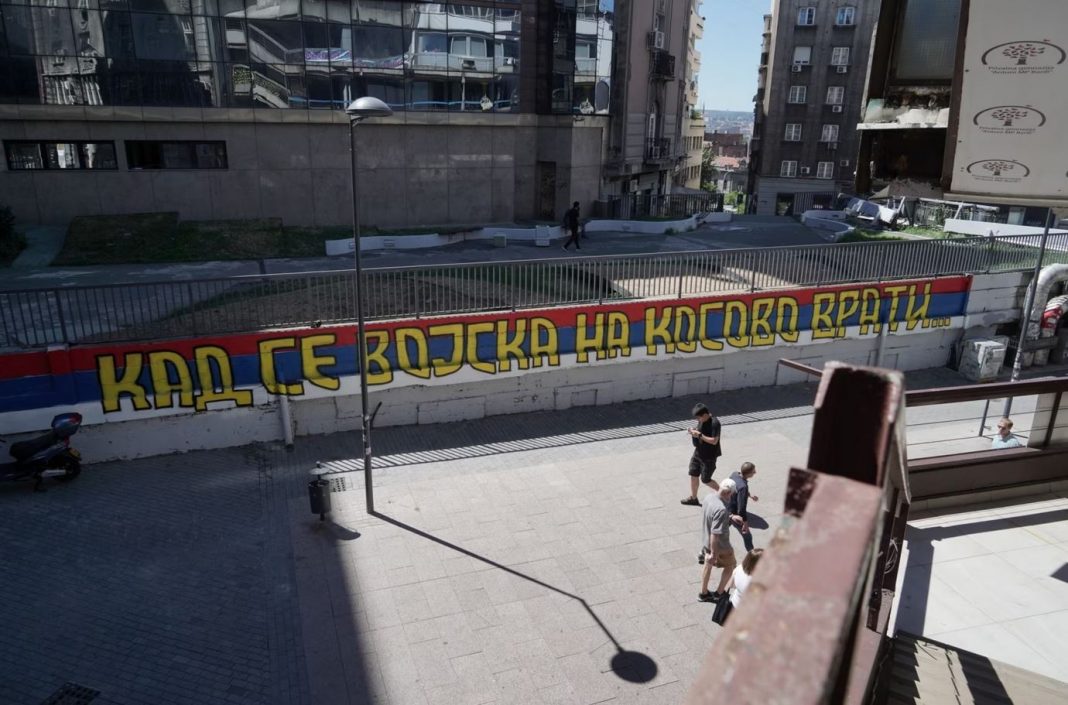
Serbian security expert residing in the United States, Ivana Stradner, has shared a video on the social media platform Twitter, showing graffiti drawn on a street in Serbia, demanding the return of the Serbian army to Kosovo.
Alongside the video, the expert stated that the increase in such graffiti is part of hybrid warfare, which is quite dangerous.
“This is how hybrid warfare works. It is dangerous,” she wrote on Twitter.
“When the army returns to Kosovo…”
Serbian government is setting informational conditions for more escalations in Kosovo. This is how hybrid warfare works. It’s dangerous. pic.twitter.com/W2LeUA98jl
— Ivana Stradner 🇺🇸🇺🇦 (@ivanastradner) August 1, 2023
Similarly, security expert Agim Musliu wrote in a Twitter post that all of Serbia is filled with graffiti demanding the return of the Serbian army to Kosovo.
He said that this is a result of Serbian President Aleksandar Vučić’s mindset, who likes to continue in the path of Slobodan Milošević, whom he served as a minister.
“All of Serbia is filled with this kind of graffiti. Vučić is specialized in this! As a minister of Milošević’s propaganda, he likes to continue his path, broken by NATO in 1999,” wrote Musliu.
All #Serbia is fullfield with this types of graffiti. This is what #Vucic is specialized for! As Milosevic's propaganda minister, he likes to countinue his way, broken by @NATO in 1999. https://t.co/LLMo4EX0gV
— Agim Musliu (@agim_musliu) August 2, 2023
Such slogans have sparked strong reactions not only in Serbia but also in Kosovo, as well as from some international personalities.
The slogan “When the army returns to Kosovo…” was first seen at a football match, where the current President of Serbia, Aleksandar Vučić, also participated.
A banner with the same message was also displayed by fans of the football club Crvena Zvezda during a friendly match with the Italian club Fiorentina on July 26 in Belgrade.
1/3 Crvena Zvezda ultras supporters "Delije" showed a banner citing "When the army will go back to Kosovo" during a friendly game against italian club Fiorentina. pic.twitter.com/jK86uQM2ke
— Besnik Bislimi (@BislimiBesnik) July 27, 2023
The Prime Minister of Kosovo, Albin Kurti, has regarded this action during the match as a call for violence, while there has been no official reaction from Belgrade.
In December 2022, Serbia sent a request to KFOR, the NATO peacekeeping mission in Kosovo, for the return of up to 1000 of its soldiers and police officers.
According to authorities in Belgrade, this request was made due to the increased presence of the Kosovo Police in northern Kosovo. Belgrade referred to United Nations Resolution 1244.
KFOR rejected this request in early January.
Similar to the graffiti “When the army returns to Kosovo” now appearing in Belgrade, since the end of 2021, the city has been flooded with drawings of Ratko Mladić, the convicted war criminal from The Hague for crimes in Bosnia and Herzegovina.
The Youth Initiative for Human Rights has confirmed 250 of these drawings and called on competent institutions to remove them.




