

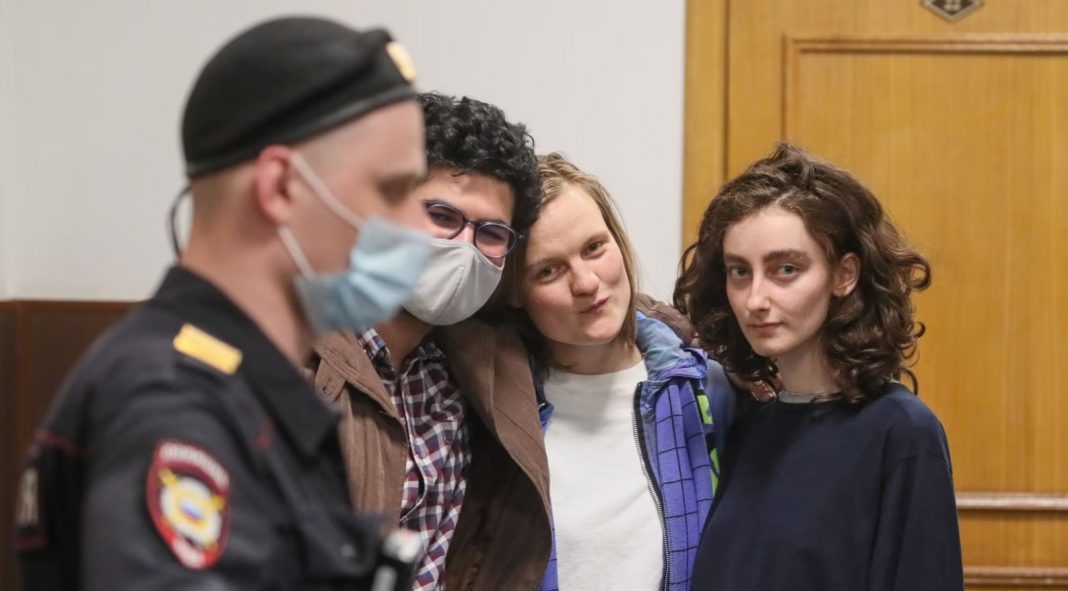
Former Russian journalist Natasha Tyshkevich, who worked for the student magazine “Doxa”, revealed that she underwent a 40-hour detention at Belgrade’s Nikola Tesla International Airport.
The Serbian Ministry of Internal Affairs has yet to respond to Radio Free Europe’s inquiry to corroborate the account of Tyshkevich’s detention or provide insight into the reasons behind it.
Tyshkevich recounted her experience to Radio Free Europe, stating that she arrived in Belgrade from Malta on August 7 using a “tourist passport” issued by Germany, her current country of residence. Nonetheless, her entry into Serbia was denied.
“I received this document a year ago from the German Ministry of Foreign Affairs after my Russian passport was seized by Russian authorities during a legal process,” she explained.
Tyshkevich is one of four students who contributed to Moscow’s independent student magazine “Doxa”. In 2021, they were handed two-year sentences of “corrective labor”. Their convictions stemmed from a video in which they advocated for the right of Russian youth to assemble.
According to The Guardian, the group endured over a year of house arrest after being apprehended in April 2021. Their arrest followed the posting of a three-minute video on YouTube, in which they protested the unfair exclusion and intimidation of students participating in rallies supporting Kremlin critic Alexei Navalny.
Tyshkevich deemed her detention at Belgrade Airport a violation of human rights.
“The detention was entirely baseless. I was left waiting at the airport. I experienced a panic attack when the police ushered me into a cell, yet they merely shouted and directed me to enter. They warned that otherwise, I’d be sent to an actual prison,” recounted the Russian journalist to Radio Free Europe.
Throughout her 40-hour airport confinement, she was provided meager sustenance.
“Friends attempted to bring me food through the airport’s information center, but the police refused,” she revealed.
Tyshkevich informed Radio Free Europe that she was deported to Malta on August 9 and intends to return to Germany.
Another incident of a Russian activist’s entry denial into Serbia occurred on July 13. Peter Nikitin, founder of the Russian Democratic Society, faced rejection at Belgrade Airport “without any explanation”.
Nikitin, an anti-war campaigner, orchestrated protests in solidarity with Ukraine and criticized Russian President Vladimir Putin’s administration.
Vladimir Volokhonski, another Russian activist, disclosed to Radio Free Europe that he received a notification on July 25 from the police rejecting his temporary residency permit in Serbia. Volokhonski, an opposition politician from St. Petersburg, relocated to Serbia in May 2022 due to mounting pressure and persecution in his homeland. His temporary residence permit in Belgrade, granted initially, was subsequently revoked.





