

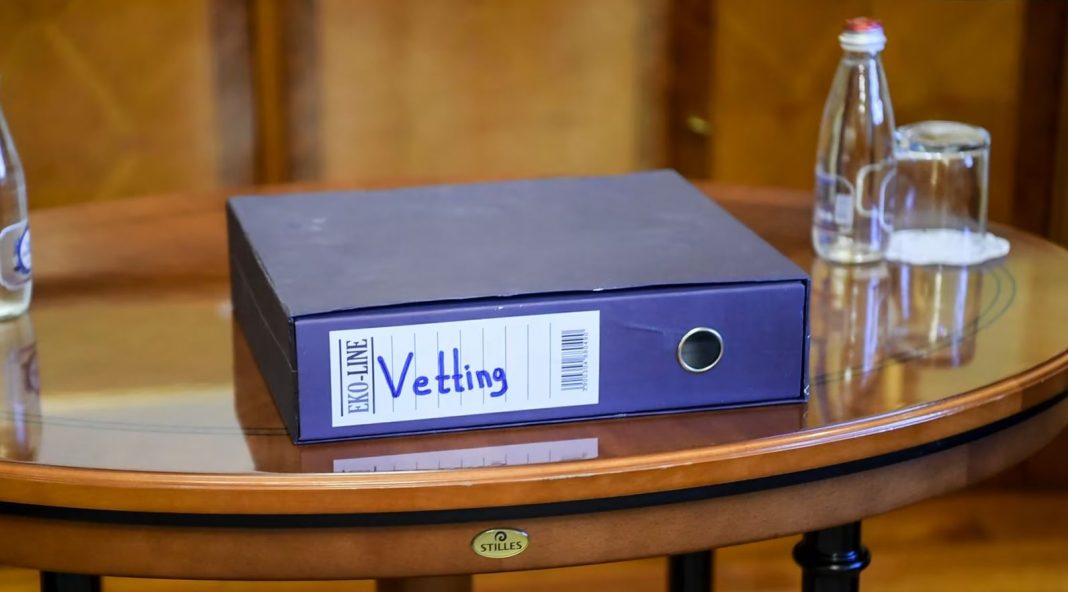
The vetting process within Kosovo’s justice system, initiated by the Albin Kurti-led Government at the start of its mandate, remains in its initial stages.
The process of re-evaluating the roles of prosecutors and judges aims to enhance their professionalism, combat corruption, and prevent political influence or other unlawful elements from affecting the administration of justice.
In its four-year program, the Kurti Government pledged to complete the necessary legal framework for the implementation of the vetting process. The legal groundwork began in 2021 when the Kosovar executive approved the concept document for the justice vetting process.
This concept document was also evaluated by the Venice Commission, an advisory body of the Council of Europe. The Commission acknowledged that for an effective vetting process in the context of Kosovo, a combination of various measures would be necessary to positively impact the integrity and efficiency of the justice system.
Initially, the Commission recommended the verification of senior levels within the judiciary and prosecution.
Following the Venice Commission’s opinion, which paved the way for justice vetting, the process in Kosovo bifurcated into two directions: vetting for higher levels and legislative reform – regular vetting – for all judges and prosecutors.
A special ad-hoc commission of the Kosovo Assembly, supported by the Ministry of Justice, finalized the constitutional amendments for the vetting of senior levels.
- Vetting in the Constitutional Court
At the beginning of this year, Kosovo Assembly Speaker Glauk Konjufca submitted the amendments for evaluation to the Constitutional Court, requesting clarification on whether the proposed changes were consistent with Chapter 2 of the Kosovo Constitution.
Although over five months have passed since the amendments were submitted to the Constitutional Court, the Ministry of Justice states that they have not received any notification regarding their consideration.
However, the Constitutional Court, in a written response to Radio Free Europe, stated that they are currently reviewing the request. They assured that all parties of interest and the public would be informed in a timely manner about their decision.
According to the Law on the Constitutional Court, in principle, this court should issue an assessment within six months from the acceptance of the request.
- Regular vetting in a faster lane
Regarding the legislative reform for regular vetting of all judges and prosecutors, the Ministry of Justice reports that working groups have submitted final reports and recommendations in May.
“In the second phase of this process, interventions and necessary legal changes are expected to be made, involving the strengthening of existing mechanisms for monitoring the integrity of judges and prosecutors, assessing their performance, reinforcing mechanisms for asset declaration, discipline, and other actions derived from common commitments,” says Genc Nimani, Senior Advisor to the Minister of Justice, Albulena Haxhiu.
The Kosovo Institute for Justice has continuously emphasized the importance of the vetting process since 2015.
Ehat Miftaraj, Executive Director of the organization, notes that vetting is a necessary avenue to cleanse the judicial and prosecutorial system from officials who, as he puts it, “do not deserve to be part of this system due to their lack of integrity”.
He assesses that “while the Government itself has faced delays in addressing this issue due to poor planning and administration, it is good news that the constitutional amendments have finally been submitted for assessment to the Constitutional Court”.
Miftaraj underscores the importance of the Constitutional Court expeditiously addressing this matter within a reasonable timeframe, considering the significance of this process for the rule of law in Kosovo.
- Kurti: Vetting is the solution
In the recent meeting of the Kosovo Government on August 9, Prime Minister Kurti, while discussing the inefficiency of the justice system, reiterated the need to initiate the vetting process as soon as possible.
He emphasized that reform is a necessity and vetting, in his view, is the solution.
Kurti called upon the Constitutional Court to expedite the implementation of this reform.
“Time is passing. Time that passes is time lost,” said the Kosovar Prime Minister.
Referring to the judiciary’s statistics, indicating that the Court of Appeals reconsidered 1,754 cases in 2022, Kurti highlighted that this weighs down the justice system, hinders it, and delays justice.
According to the United Nations Development Programme (UNDP) and the United States Agency for International Development (USAID) report, Public Pulse, published this year, only 29% of citizens are satisfied with the performance of the justice system in Kosovo.