

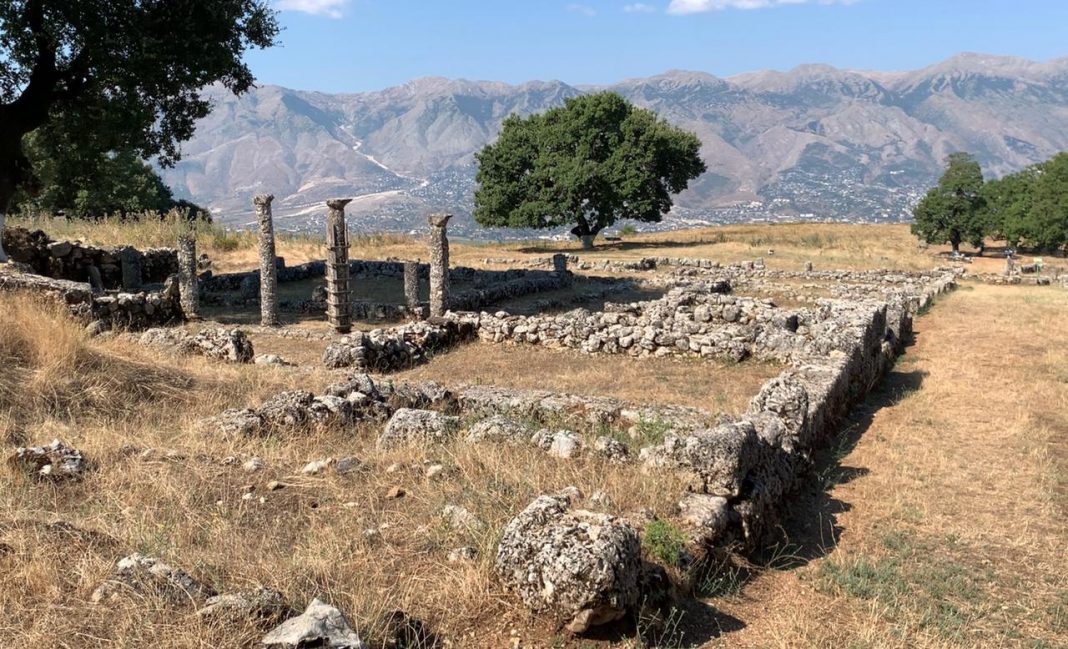
The ancient city of Antigonea has become a favored destination for both local and foreign visitors during the summer months. They explore the ancient city on guided tours, whether as part of organized groups or individually, in the southern part of the country. Thanks to its rich historical and archaeological heritage, ancient Antigonea continues to attract an increasing number of visitors. Throughout the summer season, this archaeological site has been visited by around 2,000 tourists, with this year showing a doubling of the number compared to 2022.
“The year 2023 stands out from previous years not only in terms of the number of visitors but also in terms of a wider inclusion of both local and foreign visitors, especially from Central European countries, who have shown great interest in the form, structure, geographical location, fauna, and flora present in Antigonea. As is known, Antigonea is situated at a dominant point in the Drino Valley and as such has sparked interest not only for its city layout, history, but also for the beautiful nature,” says Shkëlqim Guçe, Director of the Antigonea-Hadrianopolis Archaeological Park.
In addition to its historical, archaeological, and cultural values, tourist guides in Antigonea blend natural resources, cultural heritage monuments in the Lunxhëri area, and beyond.
“We have provided them with the conditions by promoting historical and cultural values not only of the ancient city of Antigonea but also of its surroundings, which offer rare history and culture, such as the Lunxhëria area, the rest of Libohova, the Dropull field, or the ancient city of Hadrianopolis and other parts of the valley, starting from Kardhiq Castle, Palokastër Castle, and many other tourist and historical destinations that surround Antigonea,” says Director Guçe.
The archaeological city of Antigonea is located on the hill of Jerma, on the right bank of the middle course of the Drino River, southwest of the village of Saraqinisht, in Gjirokastra. Archaeological excavations show that Antigonea was established as a large and important economic, social, cultural, and political center from the early 3rd century BC. This period coincided with the period of greatest political consolidation of the Epirote state. It continued its existence throughout the 3rd century BC and had intensive productive activity, especially from the end of this century to the beginning of the 2nd century BC. Data obtained from excavations indicate that olive oil production and trade played a significant role in the city’s economy. The cultural layer covering the discovered residences clearly shows the traces of a destruction caused by a powerful fire. This destruction must have occurred in 167 BC when the Roman consul Aemilius Paulus burned and razed to the ground 70 Epirote cities, marking the complete destruction of ancient Antigonea.