

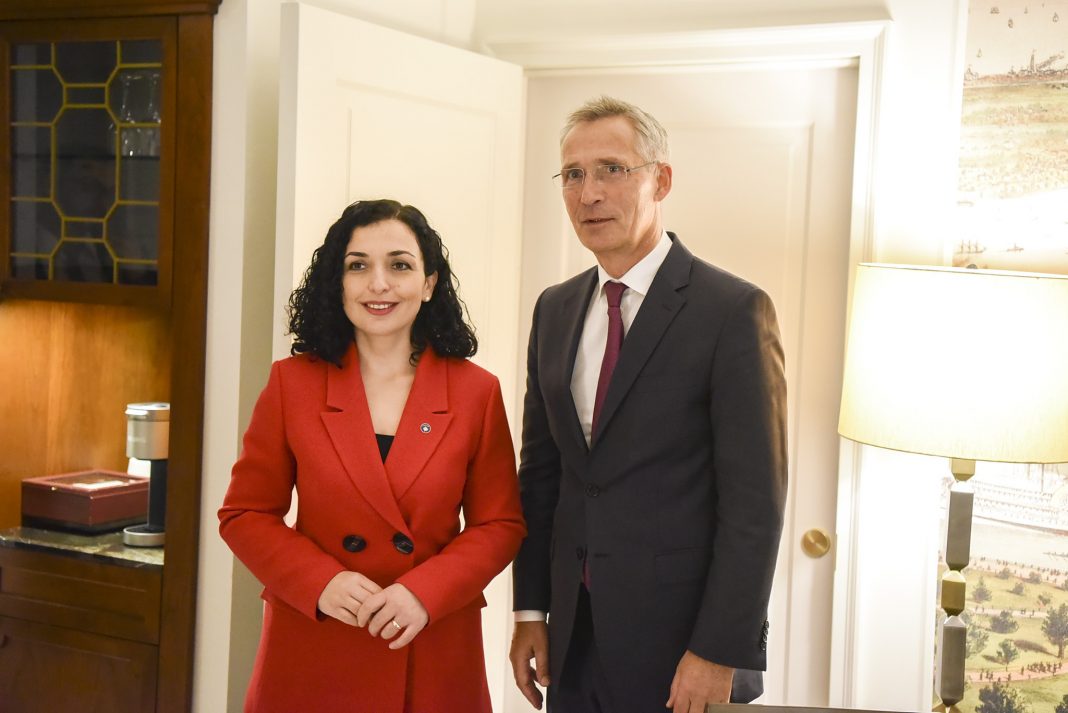
NATO’s Secretary-General Jens Stoltenberg is scheduled to meet with Kosovo’s President Vjosa Osmani in Brussels on September 7.
The primary focus of this meeting is expected to be the security situation in Kosovo, with particular attention to the predominantly Serbian-inhabited northern region. Additionally, discussions between Osmani and Stoltenberg will likely cover the involvement of NATO’s peacekeeping mission in Kosovo, known as KFOR, as well as the ongoing dialogue process aimed at normalizing relations with Serbia.
During her visit to NATO headquarters, President Osmani will engage in various meetings, including one with Admiral Rob Bauer, the Chairman of NATO’s Military Committee. She will also meet with Julianne Smith, the Chief US Mission to NATO, and representatives from other member states of the Western alliance.
Since tensions escalated in northern Kosovo in late May, NATO has consistently called upon all stakeholders in the region to refrain from actions that could exacerbate the situation and encouraged efforts to de-escalate tensions. NATO remains committed to ensuring peace and security for all in Kosovo through its KFOR mission.
Following the heightened tensions, NATO bolstered its troop presence in KFOR. Secretary-General Stoltenberg has previously stated that the Alliance possesses the necessary resources to fulfill its mission in Kosovo.
Kosovo has expressed its aspirations for closer integration with NATO, initially through participation in the Partnership for Peace Program and ultimately seeking full membership in the alliance.
However, it is essential to note that NATO’s expansion requires unanimous approval from all its member states. Within NATO, four out of the 31 member nations do not formally recognize Kosovo’s independence; these countries are Spain, Greece, Romania, and Slovakia.
In a recent debate before the European Parliament, Secretary-General Stoltenberg underscored the significance of cooperation between NATO and the European Union, particularly in the context of Kosovo and the Western Balkans.
He emphasized that, while the two organizations are distinct entities, they share common values and the necessity for increased collaboration and coordination in addressing regional challenges.




