

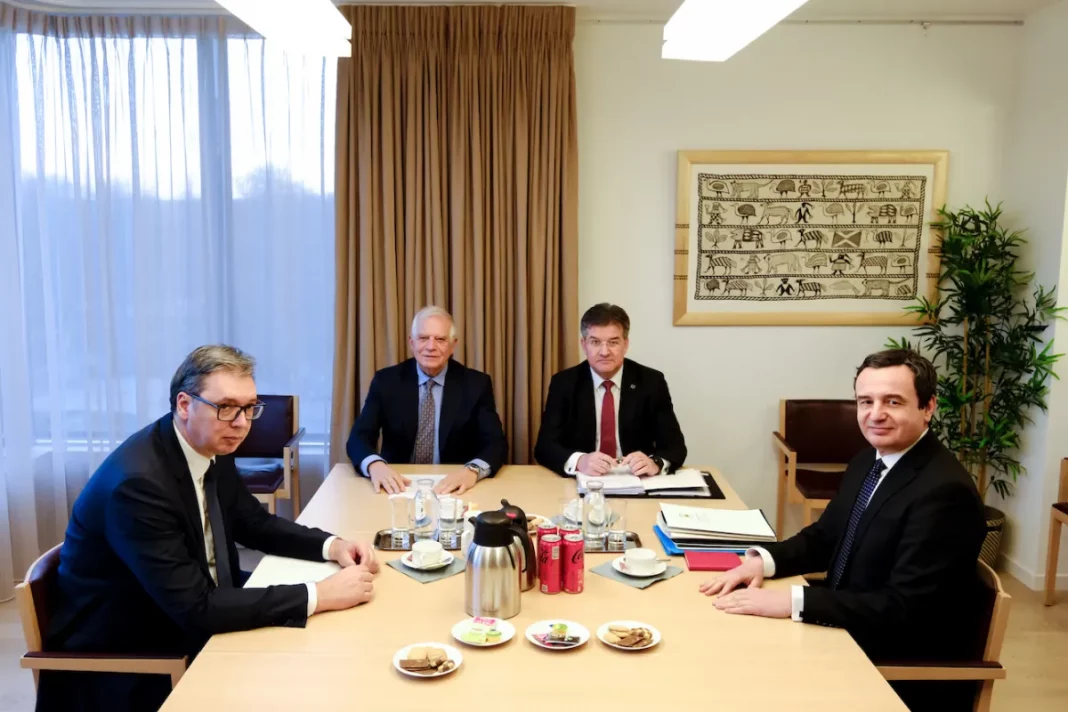
The European Union has officially announced that meetings between European diplomats and the leaders of Kosovo and Serbia will commence this Thursday, starting at 9:00 AM.
Initially, diplomats will hold separate meetings with the Prime Minister of Kosovo, Albin Kurti, and the President of Serbia, Aleksandar Vučić.
Subsequently, a trilateral meeting is anticipated, involving Kurti, Vučić, and senior EU officials, namely Josep Borrell, the EU High Representative for Foreign Affairs and Security Policy, and Miroslav Lajčák, the EU Special Representative for the Belgrade-Pristina Dialogue.
This meeting scheduled for September 14 marks a critical juncture as tensions in northern Kosovo have escalated.
The last time these two leaders convened in Brussels for dialogue was on May 2.
A day before this announcement, Prime Minister Kurti disclosed his discussions about the Thursday meeting with Gabriel Escobar, the U.S. Special Envoy for the Western Balkans, expressing his willingness to actively participate in the high-level political meeting in Brussels. He also expressed gratitude to the United States for its continuous support of Kosovo.
Had a phone call w/ @StateDept DAS Escobar. Discussed the importance of ensuring smooth & quick implementation of the Basic Agreement and its Annex. Confirmed my readiness to engage in active negotiations during the dialogue meeting in Brussels & thanked him for U.S. support.
— Albin Kurti (@albinkurti) September 11, 2023
Germany has also emphasized the importance of commitment to the dialogue.
German Ambassador to Kosovo Jörn Rohde noted on September 11 that the September 14 round of talks is taking place at a pivotal moment.
He stressed the necessity of complete commitment from both parties to de-escalate tensions, engage in EU-mediated dialogue, and foster participatory democracy. Ambassador Rohde emphasized the urgent need to implement the Ohrid Agreement and urged an end to the blame game, advocating for the removal of obstacles hindering progress. Rohde underscored the imperative to act in the best interests of all stakeholders.
High-level meeting on 9/14 comes at a critical moment. We need both sides' full commitment to de-escalation, 🇪🇺-mediated dialogue & participative democracy. Ohrid Agreement must be implemented NOW.
No more blame games. Remove obstacles for progress. Time to act for all's benefit— Ambassador Jörn Rohde (@GermanAmbKOS) September 11, 2023
Kosovo and Serbia achieved a significant agreement in February, known as the Agreement on the Normalization of Relations, though it does not include mutual recognition – a key demand from Kosovo. Instead, the agreement obliges both Kosovo and Serbia to accept each other’s documents and symbols, encompassing items such as passports, diplomats, and license plates.
The EU-mediated dialogue for the normalization of relations between Kosovo and Serbia commenced in 2011.
While the parties have inked numerous agreements, not all of them have been fully implemented.




