

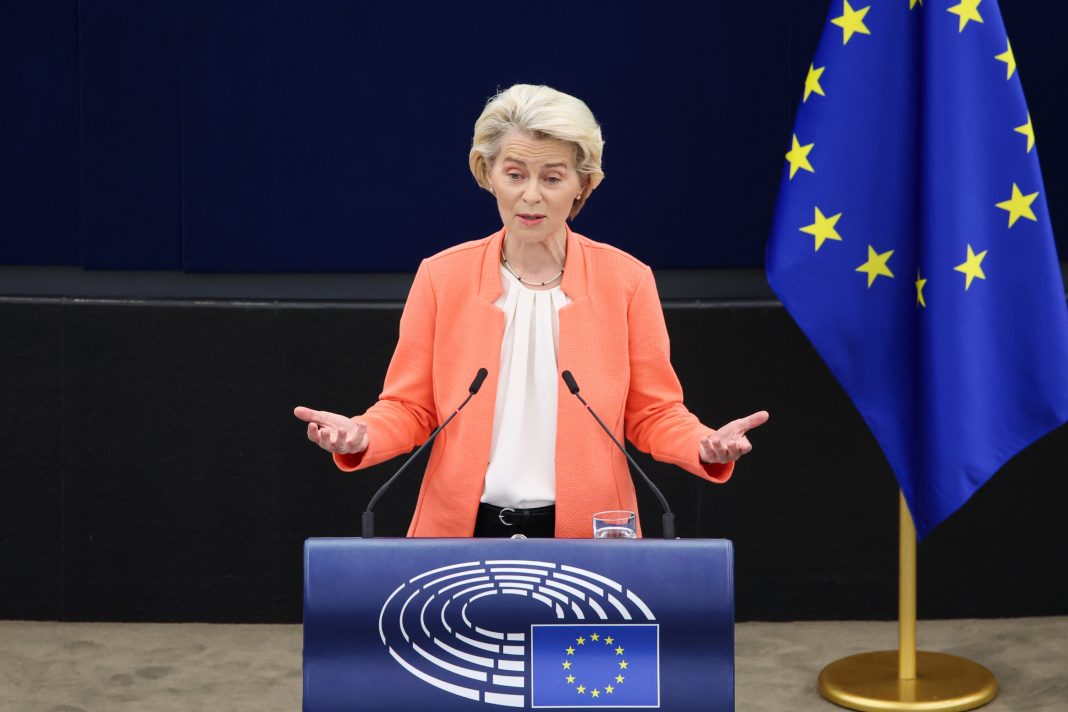
In her annual State of the European Union (SOTEU) speech, European Commission President Ursula von der Leyen outlined her vision for the future of the European Union, including that of enlargement while steering clear of any firm commitments.
The speech focused on several areas, including migration, enlargement, reform, and various policy initiatives.
“The future of the Western Balkans is in our Union. The future of Moldova is in our Union. And I know how important the EU perspective is for many residents of Georgia… In a world where some are trying to pick off countries one by one, we cannot afford to leave our fellow Europeans behind,” Von der Leyen said, adding, “In a world where size and weight matters, it is clearly in Europe’s strategic and security interests to complete our Union.”
However, she did not address the recent statement from Council Chief Charles Michel, who said the next bloc enlargement should occur by 2030.
“The next enlargement should be a catalyst for progress,” she said.
On migration, von der Leyen discussed efforts to create a new pact for migration and asylum. Migration needs to be managed, balancing the protection of borders and the protection of people, adding that this can be achieved by working with key partners to find a compromise “between sovereignty and solidarity, between security and humanity”.
This balance is the “spirit of the new pact on migration and asylum” she added, about the package of legislative files that the EU institutions aim to approve before the end of the legislative mandate in June 2024.
“An agreement on the pact has never been so close,” she said regarding the pact that, if approved, will give the 27 member states the same rules on dealing with immigrants.
She also pushed a more prominent role for EU agencies, specifically Europol, Eurojust, and Frontex, the EU’s border guard agency. She emphasized the need for enhanced law enforcement cooperation and border security, particularly in the face of global challenges such as human trafficking.
But von der Leyen steered clear of talking about democracy, despite backsliding across the bloc and candidate countries.
This was called out by Renew chief Stephane Séjourné, who criticized the “feet dragging” of some member states in condemning declining democracy and the “unanimity poison” that often blocks EU Council decisions.
On labor and the workforce, von der Leyen noted the current shortages in Europe.
“Labor and skills shortages are reaching record levels,” von der Leyen said, pointing to how hospitals, manufacturing, and hospitality businesses struggle to find employees.
“Instead of millions of people looking for jobs, millions of jobs are looking for people,” she said.
Von der Leyen stated that together with the other members of the European Commission, they have achieved over 90 percent of the goals she had outlined at the beginning of her mandate in 2019.
This was von der Leyen’s final address on the state of the EU, but also an indirect start to her pre-election campaign. Specifically, next year in June, European elections will be held, which will result in a new structure in all European institutions.




