

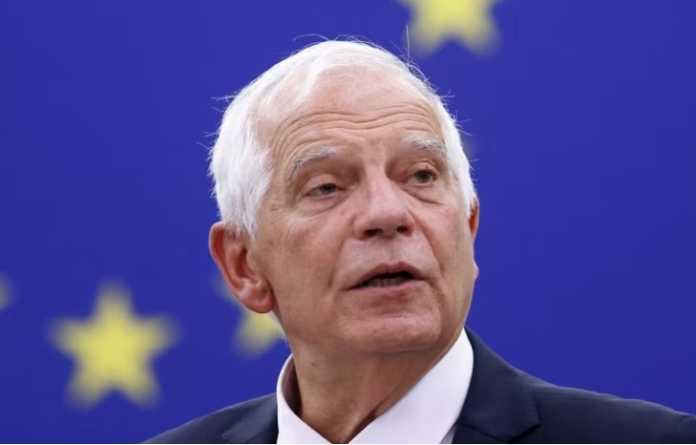
The European Union’s Chief Diplomat, Josep Borrell, has emphasized the EU’s desire for Kosovo and Serbia to promptly commence the implementation of their normalization agreement.
Speaking at a media conference in New York after an informal meeting with EU Foreign Ministers, Borrell urged both parties to fulfill their commitments under the existing agreements reached during the dialogue process.
The European Union had brokered an agreement earlier this year, consisting of the Basic Agreement and its Implementation Annex, which both Kosovo and Serbia had agreed to. However, the EU has expressed concern that the agreement has yet to be put into action.
According to EU sources, the EU’s proposal outlines a step-by-step approach to implementation. It suggests starting with negotiations for the Statute of instruments for self-governance for Serbs in Kosovo, including the Association of Serb-majority municipalities.
Simultaneously, Belgrade would cease to insist on using footnotes or involving UNMIK in regional forums.
Negotiations for the “Statute of self-governance instruments for Serbs in Kosovo” would follow, along with commitments by both parties not to interfere in each other’s internal affairs and to refrain from violence or incitement.
The proposal also includes establishing self-governance instruments for Serbs in Kosovo, transforming structures administered by Serbia in Kosovo under self-governance instruments, and recognizing state documents and symbols.
Subsequently, an agreement for a binding implementation roadmap for obligations arising from past agreements in the dialogue would be pursued.
Further steps in the proposal involve formalizing the status of the Serbian Orthodox Church in Kosovo, practical arrangements for the exchange of permanent missions, and no opposition from Serbia to Kosovo’s membership in international organizations. Kosovo would also complete internal procedures for protecting Serbian cultural and religious sites.
Additionally, the proposal outlines the creation of a special working group, led by the European Union, for implementing the agreement’s provisions. It envisions organizing a donors’ conference and preparing projects.
Ultimately, negotiations would commence for a legally binding agreement for comprehensive normalization of relations, dated July 19 of this year.
Following a meeting on September 14, the EU stated that Kosovo’s Prime Minister Albin Kurti was not inclined to move forward, while Serbia’s President Aleksandar Vučić had accepted the EU’s proposal for implementing the Basic Agreement on Kosovo-Serbia relations.
Kurti expressed concerns about Serbia’s conditions for the formation of the Association of Serb-majority municipalities and criticized the EU envoys’ stance. He presented his own plan for implementing the agreement during the meeting, which was rejected by the EU and Belgrade.
On September 18, Kurti accused the EU’s Special Envoy, Miroslav Lajčák, of positioning himself against Kosovo and not prioritizing the full, immediate, and unconditional implementation of the Basic Agreement and its Annex.
This high-level dialogue was the first meeting between Kurti and Vučić since tensions flared up in northern Kosovo in May.
Local Serbs opposed the newly elected Albanian mayors from the April elections, which were boycotted by Serbian parties and the Serb population.
The US and the EU have called for reduced tensions and new elections in Kosovo and have welcomed Kosovo’s efforts to reduce police presence and enable the removal of mayors through petitions. However, the EU has urged both parties to do more to de-escalate the situation.