

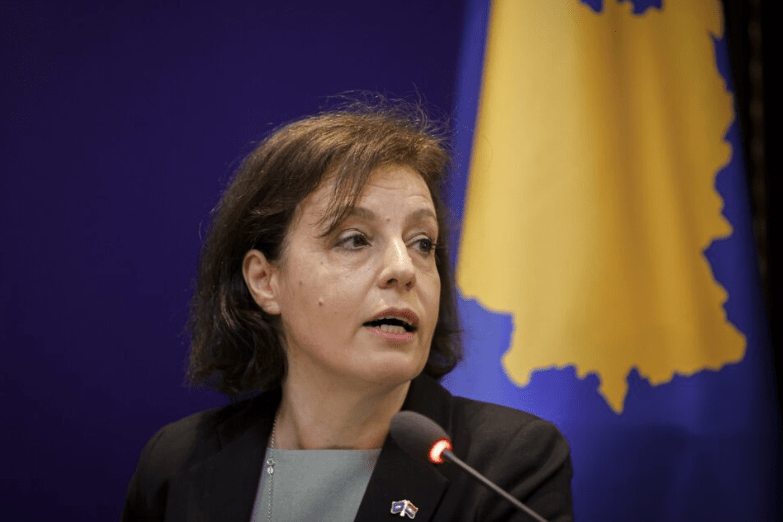
Kosovo’s Minister of Foreign Affairs and Diaspora Donika Gërvalla strongly criticized Serbian President Aleksandar Vučić’s speech at the United Nations General Assembly, denouncing it as an “attempt to distort history” regarding Kosovo.
Gërvalla dismissed Vučić’s assertions that “the roots of Russian aggression in Ukraine can be traced back to Kosovo’s independence” and rebuked the comparison between Serbia in 2008 and Ukraine today as inappropriate.
She emphasized that Kosovo’s declaration of independence does not violate international law, UN resolutions, or the UN Charter, citing the International Court of Justice’s ruling in favor of Kosovo’s independence in 2010, following Serbia’s request.
Vučić accused Western nations of “blatantly violating” the UN Charter and Resolution 1244 by recognizing Kosovo’s independence while disregarding the principles they currently advocate.
UN Resolution 1244, referred to by Vučić, marked the conclusion of the Kosovo conflict and established the mandate of the NATO peacekeeping mission, KFOR, to protect all Kosovo citizens.
Gërvalla contended that Vučić’s remarks constituted an abuse of the UN General Assembly platform, and she highlighted that the only similarity between Russian aggression in Ukraine and the Kosovo case is that Russia is now targeting Ukraine, akin to Serbia’s targeting of Kosovo and Albanians in 1999. She affirmed Kosovo’s support for Ukraine against Russia.
In contrast, Belgrade, a Moscow ally, did not impose sanctions on Russia after its unprovoked invasion of Ukraine in February.
Russian officials had previously drawn parallels between Kosovo and Ukraine, with Russian President Vladimir Putin likening Kosovo to Ukraine’s two separatist regions, Donetsk and Luhansk, known collectively as Donbas, in April 2022.
These comparisons were criticized as being misinformed by Kosovo officials.
Gërvalla also accused Vučić of violating commitments made in the Agreement on the normalization of relations between Kosovo and Serbia earlier this year. According to the agreement, Serbia agreed not to represent Kosovo in international forums and not to oppose Kosovo’s membership in any international organization, including the UN.
She called on the international community, particularly the United States and the European Union, to condemn Vučić’s rhetoric and remind him of the obligations he undertook under the Brussels and Ohrid agreements.
The normalization agreement, comprising 11 points, stipulates that the parties shall not hinder each other’s accession to international organizations, grants a high level of self-governance for the Serbian community in Kosovo, and requires mutual recognition of state symbols, along with the implementation of all previous dialogue agreements by both Pristina and Belgrade.




