

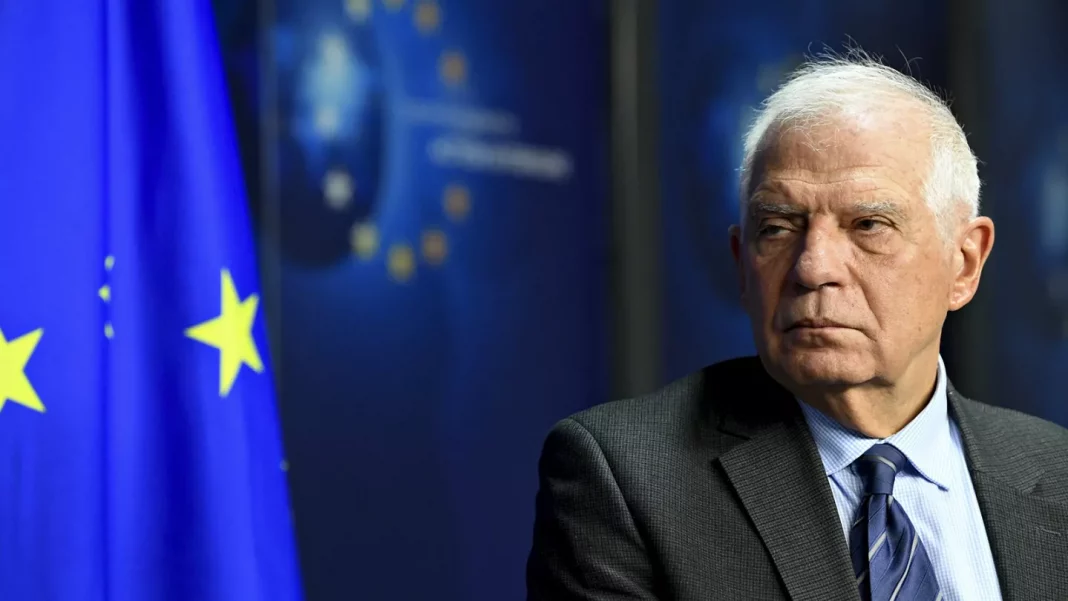
Josep Borrell, the European Union’s Chief of Foreign Policy, revealed that he has engaged in discussions with Kosovo’s Prime Minister Albin Kurti and Serbia’s President Aleksandar Vučić, concerning the events that unfolded in northern Kosovo on Sunday.
In a statement posted on the EU’s official website, Borrell strongly “denounced the aggression that occurred”.
“The High Representative, Borrell, reiterated his call for the aggressors to surrender immediately, and also called for the release of pilgrims at the Banjska Monastery. He emphasized the need to restore calm and stability,” the statement declared.
Earlier, the European Union vehemently condemned the assault carried out by an “armed gang” against Kosovo Police officials in the northern region.
“All the facts pertaining to the attack must be verified, and those responsible must be brought to justice,” affirmed Borrell.
The EU’s response expressed deep concern that additional innocent lives were endangered due to hostilities surrounding the Banjska Monastery.
“These attacks must cease immediately”.
A Kosovo Police officer tragically lost his life in the early hours of Sunday in the village of Banjska, situated in northern Kosovo, as reported by the Kosovo Police.
Additionally, according to the police, another police officer sustained injuries as a consequence of the attack.
Kosovo’s Prime Minister Albin Kurti characterized the assault as an act of terrorism and asserted that organized crime, backed by “political, financial, and logistical support from official Belgrade”, was targeting their state.
The U.S. Ambassador to Kosovo, Jeffrey Hovenier, vehemently condemned the “violent and coordinated” attacks against the Kosovo Police.
Ambassador Hovenier affirmed, “The Kosovo Police possesses full legitimacy to enforce the rule of law, as per the Constitution and laws of Kosovo. We acknowledge and respect its role as the primary responder to emergencies and crisis situations”.
Tensions have remained high in northern Kosovo since May when residents of predominantly Serbian-majority municipalities in the north refused to acknowledge the newly elected Albanian leaders, who had won elections they boycotted.
At times, these tensions have escalated into violent incidents.
The international community has called upon Kosovo to coordinate its actions moving forward and to actively work towards de-escalating the situation.