

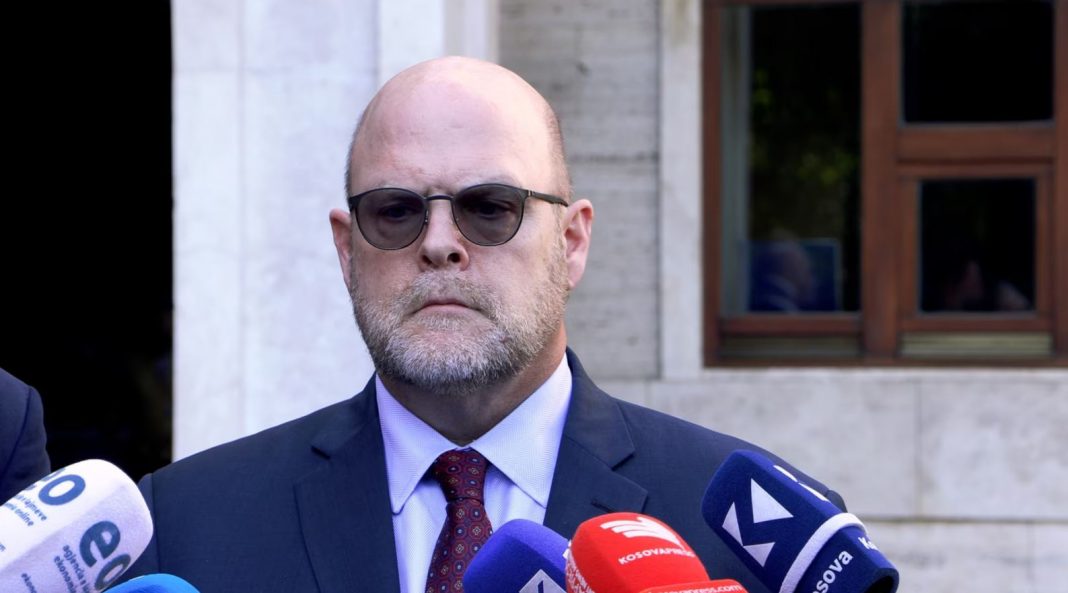
The United States Ambassador to Kosovo, Jeff Hovenier, stated that there are still unknowns regarding the attack on September 24 against the Kosovo Police but emphasized that the group that attacked the police was not made up of citizens who spontaneously gathered “to express their concerns”.
“We are still working to understand how and who is responsible and why. But I want to say, you have seen the images of the military equipment and plans that were developed. This was not a group of citizens who spontaneously came together to express their concerns. This was a trained and organized group. This implies that there is some kind of structure behind them, considering the training and equipment. We want this incident to be clarified, and they should be held accountable,” Hovenier said to journalists after meeting with Kosovo’s President Vjosa Osmani on September 26.
Serbian President Aleksandar Vučić had declared on September 24 that the armed individuals were local Serbs in Kosovo, “who could no longer endure the terror of [Kosovo Prime Minister] Albin Kurti”.
When asked by journalists where the local Serbs obtained the uniforms seen in photographs, Vučić stated that those “are not Serbian army or police uniforms”. He claimed that uniforms like those can be bought anywhere in the market.
“The only culprit for what happened in Kosovo is Albin Kurti,” Vučić said, criticizing the West and what he described as its “hypocrisy” when it comes to Kosovo.
As a result of the attack on the Kosovo Police, officer Afrim Bunjaku was killed. Kosovo authorities reported that three suspected attackers were also killed in the armed clashes.
Kosovo’s Minister of Internal Affairs Xhelal Sveçla accused Milan Radoičić, the deputy leader of the Serb List – the largest Serbian party in Kosovo – of organizing and participating in the attack.
On September 26, Sveçla released a drone-recorded video allegedly showing Radoičić armed in Banjska.
The Serb List – a party with support from Belgrade – and Serbian institutions have not responded to Kosovo’s accusations regarding Radoičić’s alleged involvement.
When asked about the video published by Sveçla, Ambassador Hovenier stated that he had seen it but could neither confirm nor refute its authenticity.
He said that regarding the events of September 24, there was good coordination between Kosovo and representatives of the international community.
“This was a threat to Kosovo, to the people of Kosovo, and had tragic consequences,” Hovenier said.
When asked about his expectations for the dialogue between Kosovo and Serbia, mediated by the European Union, following the attack on the Kosovo Police, Hovenier said he expects the implementation of the Agreement on the normalization of relations.
“You said the situation is entirely different. I disagree. As long as the situation has shown how sensitive the circumstances are and how fragile peace is, I think it reflects to some extent the important work that has been done to normalize relations between Kosovo and Serbia. The U.S. continues to call on Kosovo and Serbia to actively engage in the EU-mediated dialogue, not to negotiate new promises and agreements because we have a good agreement and a good implementation annex, but to achieve full implementation – by both sides – of this agreement… We want to see the Ohrid Agreement fully implemented by both parties,” Hovenier said.
Kosovo and Serbia reached an agreement on the normalization of relations earlier this year, along with its implementation annex.
This agreement, from June 11, among other things, provides for a level of self-governance for the Serbian community in Kosovo and mutual recognition of state symbols while also requiring Pristina and Belgrade to implement all previous dialogue agreements.




