

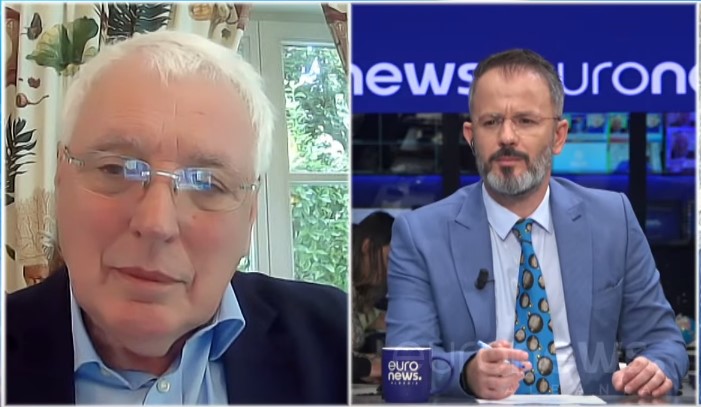
NATO spokesperson during the wartime in Kosovo, Jamie Shea, was interviewed this Saturday by Euronews Albania regarding the situation in north Kosovo, where a terrorist group led by Milan Radojičić attacked the Kosovo Police on September 24, resulting in the death of officer Afrim Bunjaku.
Shea expressed condolences for the slain police officer and, when asked about Serbia’s rhetoric regarding the slain Serb terrorists in Kosovo, he stated that it was not a reasonable stance.
According to Shea, these individuals did not go to the north for a just cause, or to be called heroes; rather, they went there to kill and stir up trouble.
“We must be clear that this is not a reasonable behavior; these people are not martyrs, they are not fighting for any justifiable cause. No, they were there to kill people; they were there to cause turmoil. The idea of calling them martyrs or heroes is wrong. This kind of rhetoric is the last thing we need,” Shea stated.
The former NATO spokesperson added that the criminal group did not come out of nowhere but was paid and armed by someone.
He also mentioned that although Milan Radojičić is not the person in charge of Kosovo’s state affairs, he may have had connections with intelligence services or paramilitary groups that could have provided financial support and arms to the terrorist group that attacked Kosovo Police near the Banjska Monastery.
Shea emphasized that this issue requires a thorough international investigation and suggested that it would be good for Serbian President Aleksandar Vučić to cooperate in the investigations and take concrete actions against criminal groups that may be in Serbia.
“I hope that President Vučić will cooperate in an international investigation to understand where these 30 paramilitary soldiers came from and whether the Serbian Government and intelligence services or the Serbian army were involved in financing such an operation. Belgrade can take actions to eliminate these specific groups, and I hope this investigation will reveal this.
I think President Vučić has a good opportunity to demonstrate his goodwill, to participate in such an investigation, and if there is evidence of paramilitary groups in Serbia trafficking these weapons, he can take measures to dismantle this organization. However, personally, I don’t believe that Serbia will join the EU before normalizing relations with Kosovo. This certainly implies recognition. I don’t see that happening,” said Shea.
When asked if it would be the right move for KFOR to take control of north Kosovo, Shea disagreed, as he believed it would send the wrong message to Belgrade.
“I don’t agree with that. I think KFOR forces should continue patrolling and patrol even more. However, we must remember that north Kosovo belongs to Kosovo. It is Kosovo’s territory as an independent and sovereign state.
It is very important for the national police to operate in the national territory and build trust, especially with the Serbs living there. They need to build trust with the local community and cooperate with KFOR.
In my opinion, having KFOR take control of security would send a message to Belgrade that the north is not a part of Kosovo but rather a neutrally administered international zone, and I think this would increase pressure from Serbia to withdraw that part and take it over. Kosovo’s Police should work together with KFOR to gradually calm the situation,” concluded Shea.




