
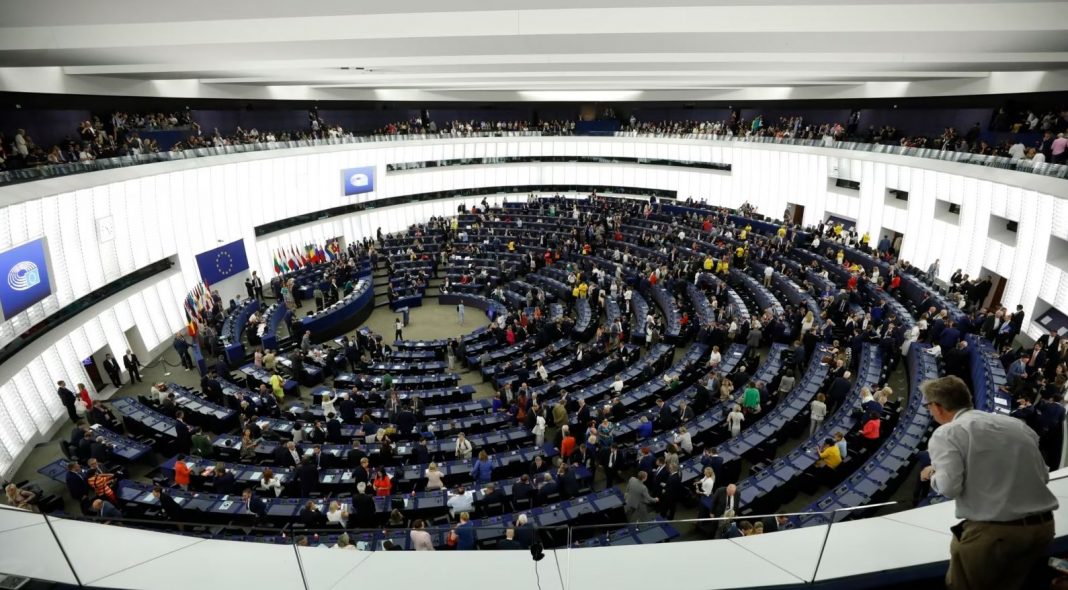
During a session in the European Parliament on Tuesday focused on Kosovo, several Members of the European Parliament called for sanctions against Serbia. The discussion centered on a deadly attack that took place a week earlier when an armed group of Serbs targeted Kosovo Police in the northern part of the country.
Tonino Picula, a Croatian MEP representing the Socialist group, led the call for measures against Serbia, categorizing the September 24 attack in Banjska, Zvecan, as a terrorist act.
Picula emphasized the dangerous nature of recent events and expressed concerns about Serbia’s behavior even after the attack.
Milan Radojičić, the former vice-chairman of the Serb List, a political party representing Kosovo Serbs with official support from Belgrade, claimed responsibility for the attack. However, Kosovo maintains that the Serbian state was behind the assault.
Picula urged the European Union to impose sanctions on Serbia similar to those levied against Kosovo earlier this year when the EU determined that Kosovo had not taken sufficient steps to reduce tensions in the northern region.
German MEP Viola von Cramon, who also serves as the rapporteur for Kosovo in the European Parliament, stressed that the “brutal attack serves as evidence that we cannot take freedom for granted in Europe”.
She pointed out Radojičić’s evident ties to Belgrade and called on Serbia to immediately withdraw all troops from the Kosovo border.
Von Cramon also urged the EU and NATO to develop a new plan for Kosovo and suggested that Germany should follow the UK’s example by increasing its military presence in Kosovo. This reference was to the UK’s recent decision to send an additional 200 troops to the NATO peacekeeping mission in Kosovo, known as KFOR.
Dutch MEP Thijs Reuten called for decisive action to stop Serbian President Aleksandar Vučić. He argued that if Vučić is not halted now, he will continue unchecked, and the situation will worsen. Reuten criticized the EU for sanctioning Kosovo while demanding measures against Serbia.
The debate also witnessed criticism of the EU’s policy towards Serbia and its perceived disregard for Russia’s influence in the region. Some MEPs called for international investigations and the prosecution of those responsible for the attack on Kosovo Police in the north.
Certain MEPs even proposed withholding funds from Serbia until investigations are concluded. They criticized the EU for its “soft” approach towards Serbia and its treatment of Vučić as a friendly leader, providing financial support while hesitating to condemn his government.
Janez Lenarčič, the Commissioner for Humanitarian Aid, represented the European Commission in the absence of the EU’s High Representative, Josep Borrell.
Lenarčič criticized Serbia for its actions following the September 24 attack, including the glorification of the three Serbian attackers killed after assaulting Kosovo Police and the declaration of mourning for them.
The debate also saw criticism directed at Kosovo, with Slovak MEP Vladimir Bilčík, who is also the rapporteur for Serbia, blaming Kosovo’s Prime Minister Albin Kurti for the situation in the north.
Bilčík argued that the dialogue process had stalled since Kurti came to power and called for compromise to find a solution.
MEPs who criticized Kosovo mainly argued that the country was reluctant to establish the Association of Serb-majority Municipalities, a key point in previous negotiations.
Right-wing MEPs blamed Kosovo for provoking Serbs into feeling the need to defend themselves.
The European Parliament is set to approve a special resolution on the situation in Kosovo during its upcoming session in October.