

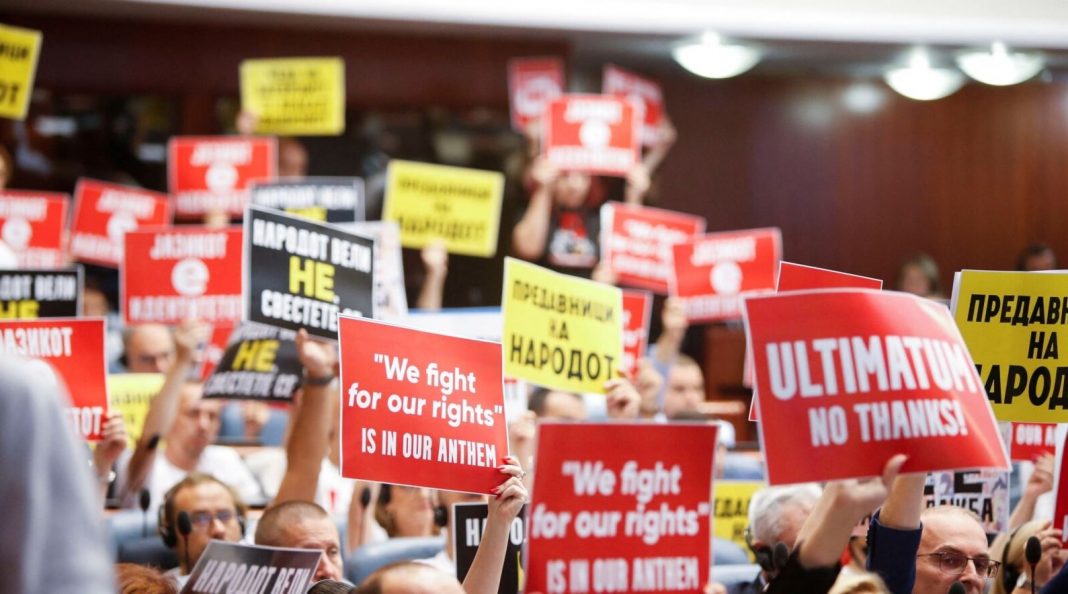
The opposition in North Macedonia is urging Prime Minister Dimitar Kovačevski and the Speaker of Parliament, Talat Xhaferi, to convene a meeting of political party leaders to discuss setting a date for early parliamentary elections.
Hristijan Mickoski, the leader of VMRO-DPMNE, insists that elections are necessary due to the parliamentary majority’s failure to approve constitutional changes related to the inclusion of the Bulgarian minority in the Constitution’s preamble as a constitutive people, a requirement for the European integration process.
In 2024, regular presidential and parliamentary elections are scheduled.
The president’s term ends on May 12, while the deputies’ mandate concludes on August 4. If these elections are held within the regular timelines, the difference between them in terms of legal timing would only be a few days.
Mickoski asserts, “When I call for a leaders’ meeting, I envision a discussion of specific dates to prevent constitutional crises, deadline breaches, and constitutional violations. Therefore, we should sit down a few months before the elections and determine possible election dates. The meeting could be initiated by the Speaker of Parliament, and together we could set the date for early elections”.
According to Mickoski, the government has failed in its attempts to pass constitutional amendments, necessitating elections not only as a consequence of this failure but also because of the severe economic and social challenges facing the country.
Conversely, the Albanian opposition is advocating for its involvement in discussions to set the election date and is expressing its readiness to participate on any date agreed upon by political parties.
Bilall Kasami, a representative of the United Albanian Opposition, emphasizes, “We are ready to contribute to ensuring that the electoral process is fair, democratic, and acceptable to citizens. We insist that the government promptly initiate a leaders’ meeting and announce early elections”.
Kasami proposes that both election cycles – presidential and parliamentary – be synchronized to minimize costs, especially amid a significant economic crisis.
However, Prime Minister Dimitar Kovačevski maintains that there is no need for a leaders’ meeting. He asserts that the offer to the opposition leader remains unchanged: early elections can only occur if the opposition supports the constitutional changes.
“We have an offer for the opposition leader. If we vote on constitutional changes on Monday or any other day, we will simultaneously dissolve the Parliament and set the election date. We are also willing to establish an expanded government, reserving half of the cabinet positions for VMRO, and until the regular elections, we will approve all necessary laws and criteria for European integration,” declared Kovačevski.
Even the Democratic Union for Integration, a part of the government, opposes early elections. This party suggests that if the opposition supports the constitutional changes, it will withdraw its request for an Albanian Prime Minister in the last 100 days of the government, as stipulated in its agreement with SDSM.
Efforts to call for new elections in North Macedonia were also made in January 2022, but the opposition fell just one vote short of ousting the current Prime Minister, Dimitar Kovačevski’s government.




