

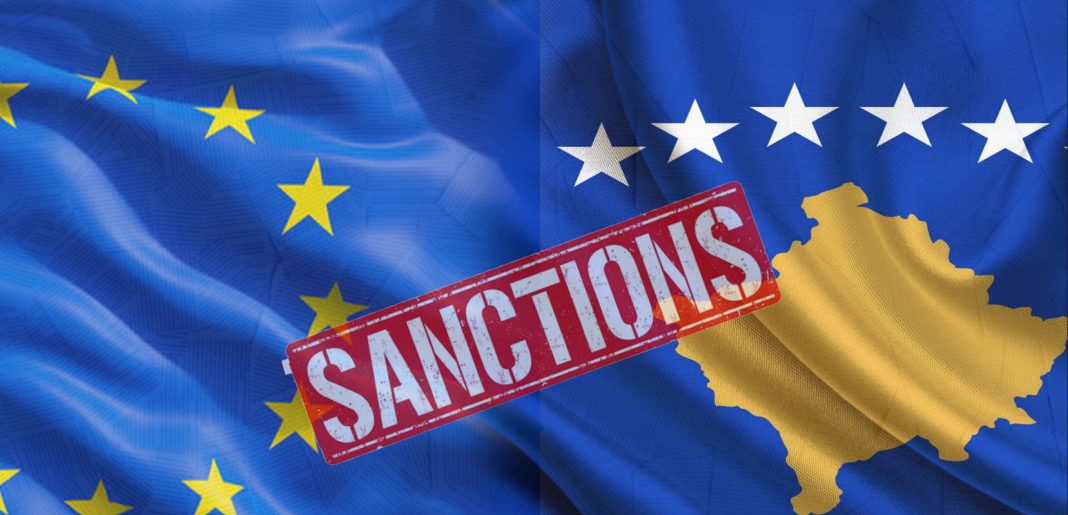
Ongoing tensions in north Kosovo have prompted several international partners to implement temporary punitive measures.
While these measures are not expected to have an immediate impact on the economic outlook, they could potentially affect performance if they are prolonged.
A mission led by Gabriel Di Bella from the International Monetary Fund (IMF) assessed that sanctions imposed by the European Union against Kosovo may have performance implications if they persist.
During their visit to Pristina from September 25 to October 6, 2023, to discuss the initial reviews of the Stand-By Arrangement (SBA) and the Resilience and Sustainability Facility (RSF)-supported arrangements, the team led by Di Bella also projected that the economy in 2023 is expected to grow by 3.5-4%.
The IMF team and Kosovo authorities have reached staff-level agreement to complete the initial reviews of the SBA and RSF-supported arrangements. Upon approval by the IMF Executive Board, the completion of these reviews, expected in November, will make available SDR approximately 24.6 million euros under the SBA and SDR about 38 million euros under the RSF-supported arrangements.
The authorities have conveyed that, at this stage, they do not plan to draw on the resources available under the SBA.
“The economy is projected to expand by 3.5-4 percent in 2023, driven by increased investments and external demand, particularly in services. With slowing food and energy prices, average inflation this year is expected to be in the range of 4-5 percent, while the current account deficit is expected to narrow. Staff expects the growth momentum to continue into 2024, with inflation gradually moderating”.
The IMF has acknowledged that ongoing tensions in north Kosovo have led to some international partners applying temporary punitive and reversible measures to encourage de-escalation. While these measures are not anticipated to have an immediate economic impact, they could influence performance if sustained over a longer duration.
The authorities have remained committed to prudent fiscal and financial policies and have made significant strides in implementing their policy agenda as supported by the IMF.
Fiscal balance and government deposits in the Central Bank have remained well above program levels throughout 2023, and the absorption of public investment has substantially increased compared to 2022; IMF staff expects that two end-September 2023 performance criteria will be met.
“The authorities aim to present the 2024 budget to the Assembly in line with the SBA and RSF objectives, including a substantial reduction in budgetary contingencies – below the program ceiling. All structural benchmarks for the review have been met, and good progress has been made toward meeting the expected structural benchmarks for the coming months”.
“In this regard, the appointment of the new Central Bank Governor and the normalization of the Central Bank’s governance structures have provided fresh impetus for the reform process. Staff expects that the new working regulation, which clarifies the responsibilities of the Central Bank’s supervisory board vis-à-vis executive boards, will soon be approved, and the new banking law to be delivered to the Assembly in early 2024”.
Additionally, the authorities have initiated programs to enhance energy efficiency in residential buildings and have taken steps to promote regional cooperation, market competition, and functioning through the implementation of favorable actions for the launch of the day-ahead electricity market for Kosovo within the framework of the Albania-Kosovo Regional Electricity Market (ALPEX).
To protect vulnerable energy consumers, the authorities have prepared a comprehensive plan with financing to be included in the 2024 budget.
Finally, Di Bella reported that the Kosovo Energy Corporation (KEK) has completed the necessary technical work for the installation of filters at the Kosovo B power plant.
Furthermore, KEK’s budget plan for 2024 includes a contingency allocation of 12.5 million euros as a supplement to EU financing for the installation of these initial filters in Block B-2, which, once completed, will significantly reduce pollution in Pristina and surrounding areas.
“We would like to thank the authorities for their candid discussions and warm welcome during the mission. We look forward to continuing our engagement in support of Kosovo and its people,” the IMF statement concludes.




