

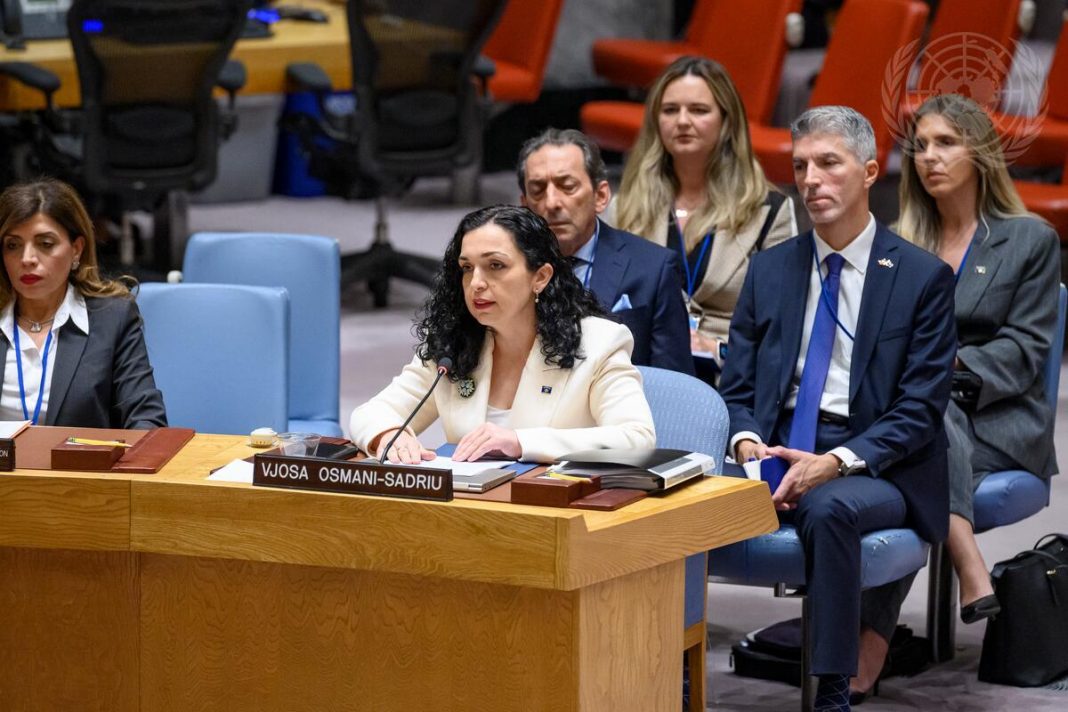
Kosovo and Serbia engaged in a heated exchange of accusations during a United Nations Security Council meeting where Secretary-General Antonio Guterres’ report on Kosovo was discussed.
Serbia vehemently denied any involvement in the attack on the Kosovo Police in Banjska and insisted that the events were a logical consequence of “terrorism” directed against Serbs. Meanwhile, Kosovo asserted that it had been the target of aggression by Serbia on September 24.
Kosovo’s President Vjosa Osmani addressed the UN Security Council, declaring that Serbia’s ultimate goal was to claim Kosovo’s territory, but she firmly stated that they “would never succeed in this endeavor”.
She emphasized Kosovo’s desire for peace, contrasting it with Serbia’s demonstrated willingness to engage in warfare. President Osmani asserted that Kosovo would not allow such aggression to go unchecked.
Osmani also alleged that the primary source of funding, arming, and training for the armed group in Banjska could be traced back to the Republic of Serbia. She accused Serbia of downplaying the act of aggression against Kosovo during the Security Council meeting.
The attack on September 24 involved an armed group of Serbs who targeted the Kosovo Police, leading to the death of police officer Afrim Bunjaku and three Serb attackers.
President Osmani conveyed a message to the Serbs living in Kosovo, reassuring them that Kosovo is their home and expressing the commitment to improve conditions for Serbs in Kosovo while preventing Serbia from undermining Kosovo’s sovereignty and territorial integrity.
President Osmani reiterated Kosovo’s dedication to peace and its commitment to the dialogue for normalizing relations with Serbia. She emphasized that Kosovo would never abandon dialogue as a means of resolving differences.
Serbia’s Prime Minister Ana Brnabić strongly asserted that Serbia had no involvement in the attack on the Kosovo Police in Banjska of Zvecan.
She maintained that investigations would reveal that two out of the three Serbian attackers had surrendered, implying that they were not directly linked to the Serbian Government or its security forces.
Brnabić accused Kosovo of disregarding the implementation of agreements reached within the European Union-mediated dialogue.
According to Brnabić, the establishment of the Association of Serb-majority municipalities was a crucial condition for implementing other agreements by Serbia.
Kosovo and Serbia had reached agreements on the Association in 2013 and 2015. However, the Constitutional Court found that the 2015 agreement needed further harmonization through sub-legal acts. The Kosovar Government was concerned that the Association could undermine the functionality of the state.
Brnabić further claimed that since Albin Kurti took office as Kosovo’s Prime Minister two years ago, “11 percent of Serbs had left municipalities” in north Kosovo.
She accused Kosovo of conducting a “violent campaign” against Serbs and cited over 400 ethnic incidents in the past year.
The United States’ representative at the UN, Robert Wood, called for full accountability under the law for those involved in the attack.
He urged that individuals who had fled to a third country should be extradited and prosecuted. The U.S. underscored its commitment to working closely with the European Union and NATO partners to ensure stability in north Kosovo.
The U.S. encouraged both parties to return to dialogue and take concrete steps forward.
Russia’s Ambassador to the UN Vasily Nebenzya accused Kosovo of “suppressing” Serbs, suggesting that this could lead to an armed conflict.
He questioned why international representatives were not involved in the events in Banjska, comparing it to past incidents where EULEX and KFOR had taken a more active role.
China’s representative at the UN expressed support for a sustainable solution between Kosovo and Serbia but accused Pristina of escalating tensions in the north.
China urged both parties to return to dialogue and called for the immediate establishment of the Association of Serb-majority municipalities.
Caroline Ziadeh, head of the UN Mission in Kosovo (UNMIK), despite not being part of the six-month report, discussed the “security incident” in Banjska of Zvecan on September 24.
She emphasized the need for ongoing investigations to provide a factual account of events and hold perpetrators accountable.
Ziadeh called for both parties to return to dialogue, implement de-escalation measures, and seek a political compromise within the EU-mediated dialogue.
“Dialogue is the only way forward,” she said.
Ziadeh hoped that the meeting of international diplomats in Kosovo and Serbia on October 21 would lead the parties back to the dialogue for normalizing relations.
The head of UNMIK stated that all agreements reached in dialogue, including the Association of Serb-majority municipalities, should be implemented.
Secretary-General Antonio Guterres’ UN report covers the six-month period from March 19 to September 18.
During the meeting, the U.S. reiterated its stance that UNMIK has no role in Kosovo and once again called for the end of the mission’s mandate. In the past, Kosovo has also sought the termination of UNMIK’s mandate.




