

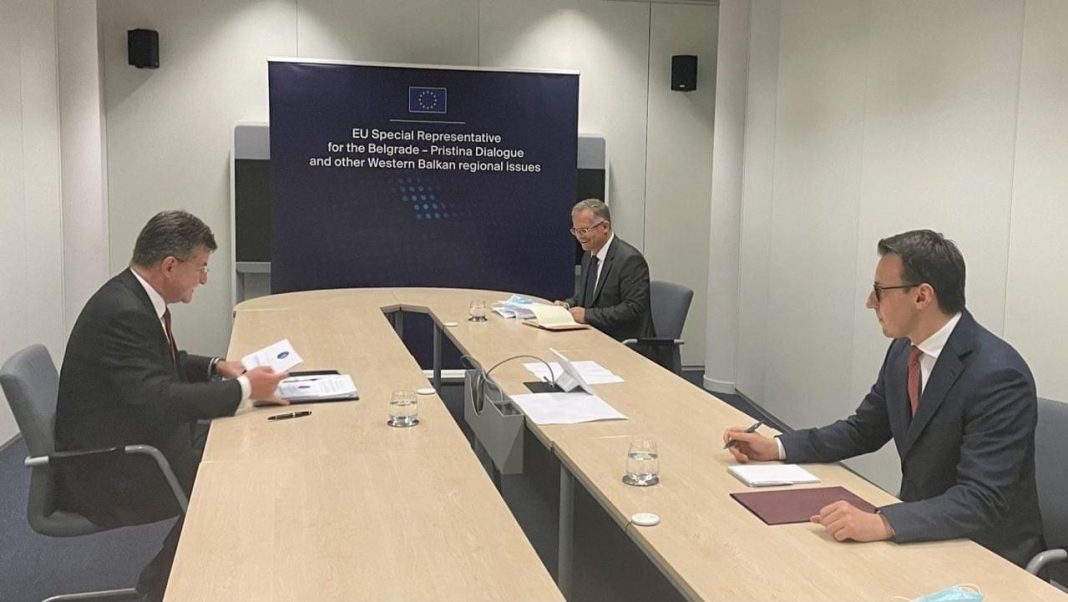
Chief negotiators from Kosovo and Serbia are expected to meet next week under the mediation of the European Union, as reported by unofficial sources in Brussels.
According to insiders, November 16 is the potential date for the meeting between Kosovo’s chief negotiator Besnik Bislimi and Serbia’s chief negotiator Petar Petković.
The possibility of a chief negotiator-level meeting during this week had previously been announced by Serbia’s chief negotiator Petar Petković. However, Kosovo had purportedly declined this meeting.
Nonetheless, Petković’s claim was contradicted by the European Union’s Special Envoy for the Kosovo-Serbia dialogue, Miroslav Lajčák.
In a written response to Radio Free Europe, Lajčák’s office clarified that all meetings within the dialogue framework are arranged on dates mutually convenient for both parties, and announcements about meetings are made only after both sides confirm their participation.
Lajčák confirmed to RFE that there was an initial idea for the chief negotiators of Kosovo and Serbia to meet on November 7.
“The Kosovo side presented a valid and significant request to postpone the meeting, which was accepted by the EU facilitator. It is the responsibility of the EU facilitator to determine which requests and reasons provided by the parties regarding the organization of meetings are valid and significant,” the response stated.
Lajčák confirmed that there is already an agreement between the parties for the organization of the next meeting, although no specific dates were mentioned in the response. Nevertheless, it is anticipated that this meeting will address the next steps in the normalization process and the parties’ obligations in the dialogue.
The news of the new round of talks at the chief negotiator level comes following separate meetings on October 26 in Brussels between the dialogue facilitators, Kosovo’s Prime Minister Albin Kurti and Serbia’s President Aleksandar Vučić, and leaders from the EU, France, Germany, and Italy.
The leaders of France, Germany, and Italy called on Kosovo to establish the Association of Serb-majority Municipalities and for Serbia to recognize Kosovo’s de facto independence.
Kurti stated that he had accepted a draft statute proposal for the Association, which the EU has described as a modern European model.
However, the draft statute has not been made public, but Prime Minister Kurti stated that it has been drafted carefully in accordance with Kosovo’s Constitution. He mentioned that the draft is expected to be submitted for review to the Constitutional Court of Kosovo.
“In my political assessment, the draft interrupts the legacy of non-recognition of the Republic of Kosovo, as established in the 2013 and 2015 agreements. Therefore, in my political judgment, the draft provides clarity regarding the recognition of the Republic of Kosovo as an independent state in which Serbs will live in accordance with the multi-ethnic aspirations of the Constitution and without any other harmful undermining intentions for the Republic’s sovereignty and territorial integrity,” Kurti stated during a report on the dialogue before the Kosovo Assembly on November 3.
Lajčák previously noted that the proposal is a modern European approach to resolving the sensitive issue of minority protection in line with the best European standards, “and it does not cross the red lines presented by the parties”.
He added that the implementation of not only the Association, Kosovo’s obligation, but also all previous dialogue agreements by Serbia is required.
On February 27, Kurti and Vučić reached the Agreement on Normalization. On March 18, the parties agreed on the Implementation Annex. However, the agreement was not signed by the parties, as the Serbian President refused, arguing that “Serbia is internationally recognized, while Kosovo is not”.
Among other things, this agreement calls for a level of self-governance for the Serb community in Kosovo and mutual recognition of state symbols. It also requires Pristina and Belgrade to implement all previous dialogue agreements.
Kosovo and Serbia reached agreements on the Association in 2013 and later in 2015 on its principles.
In 2015, the Constitutional Court of Kosovo found that the agreement was not fully in line with the Constitution.
Kosovo has so far declined to establish the Association of Serb-majority Municipalities, citing concerns that it may undermine the state’s functionality. In contrast, Serbia insists on its establishment.




