

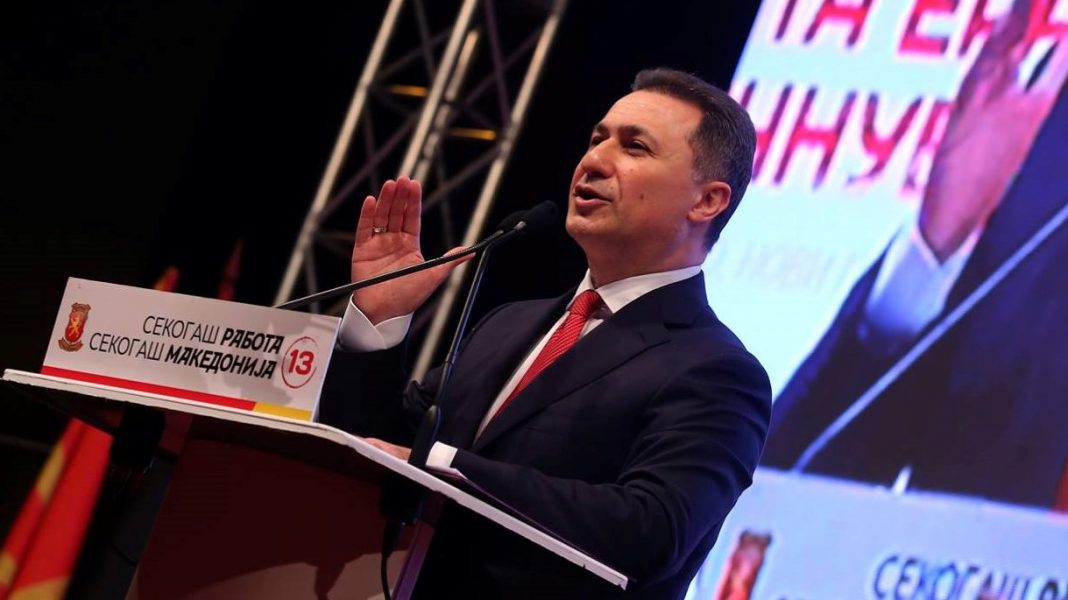
Former Macedonian Prime Minister Nikola Gruevski has had his prison sentence significantly reduced to just three and a half years, down from the original 25 and a half years he was initially sentenced to for various criminal offenses committed during his time in office from 2006 to 2016.
Gruevski fled to Hungary in 2018 to avoid legal proceedings in Macedonia related to allegations of abusing his official powers.
On Monday, the Court of Appeals decided to halt all legal proceedings in the “TNT” case, which revolved around the demolition of a commercial property in 2011, citing the expiration of the statute of limitations.
Gruevski was initially convicted of this act and was sentenced to nine years in prison on charges of abuse of power and destruction of property, which was seen as politically motivated retribution. The estimated damage from the demolition was approximately 11 million euros.
Fijat Canoski, the property owner, accused the judiciary of manipulating records to protect Gruevski.
“Gruevski and his associates bear the main responsibility for the destruction of the property. The court has abused its responsibilities by falsifying the judicial record. This has left loopholes, which could result in the trial being annulled or time-barred during the appeal process. This abuse occurred at multiple stages, from the initial trial to the Court of Appeals,” Canoski said.
Gruevski had also received a seven-year prison sentence for multiple land parcels in a prime area on Vodno Mountain in Skopje. This case is also under review in the Appeals Court, and it is expected to be time-barred due to changes in the Penal Code.
In addition, he was sentenced to six years in prison for abuses related to the construction of the VMRO-DPMNE headquarters in the center of Skopje. This case is also under evaluation in the Court of Appeals.
Prime Minister Dimitar Kovačevski dismissed allegations that the decisions of the courts were influenced by political parties in power with the intention of returning Nikola Gruevski to North Macedonia for political purposes, specifically his involvement with VMRO-DPMNE to secure support for constitutional changes.
Kovačevski declined to comment on the court’s decisions but pointed out that Gruevski should return to Skopje to face charges of abuse of office.
“In terms of the current topic of the return of former Prime Minister Nikola Gruevski, I think it is a settled issue. From a legal point of view, there is an order for his return, and he must come back to face justice, in line with Macedonian laws and what has been approved by independent judicial authorities,” Kovačevski said.
However, the opposition parties of the European Union for Change claim that all the court decisions are aimed at returning Nikola Gruevski to North Macedonia and saving his former associates.
“You don’t have to be an analyst or a politician to understand that these changes to the Penal Code have been made only to serve Gruevski, Mijalkov, Jankuloska, and others like them. The result is obvious. They are trying to justify everything with European integration, while the citizens get nothing except the amnesty of criminals,” said Fatmir Sabriu of the European Union for Change.
Previously, the Court of Appeals also dismissed a case against Gruevski for abuse of office in connection to the construction of the Kicevo-Ohrid motorway.
For this offense, he was expected to be sentenced to at least seven years in prison for damaging the state budget by 155 million euros.
However, the verdict for abuse of office in the procurement of a luxury car worth 600,000 euros remained in effect, for which Gruevski had been sentenced to two years in prison.
He is also facing two other trials for the violence committed in the North Macedonian Assembly on April 27, 2017, and his interference in election processes.
These offenses are not included in the changes to the Penal Code, but he is seeking to be “saved” from all convictions with the potential return of the pardon decision approved by former President Gjorge Ivanov on April 12, 2016, in which he pardoned all officials accused of various criminal offenses.
In addition to prison sentences, several million euros of his property have been seized to compensate for the damages he caused to the state budget.
However, the Agency for Managing Seized Property of North Macedonia has not yet started the procedure to sell his property.
Legal experts have warned that institutions should be cautious about the seizure of property because if he is acquitted from all trials, Gruevski may seek the return of his assets.




