

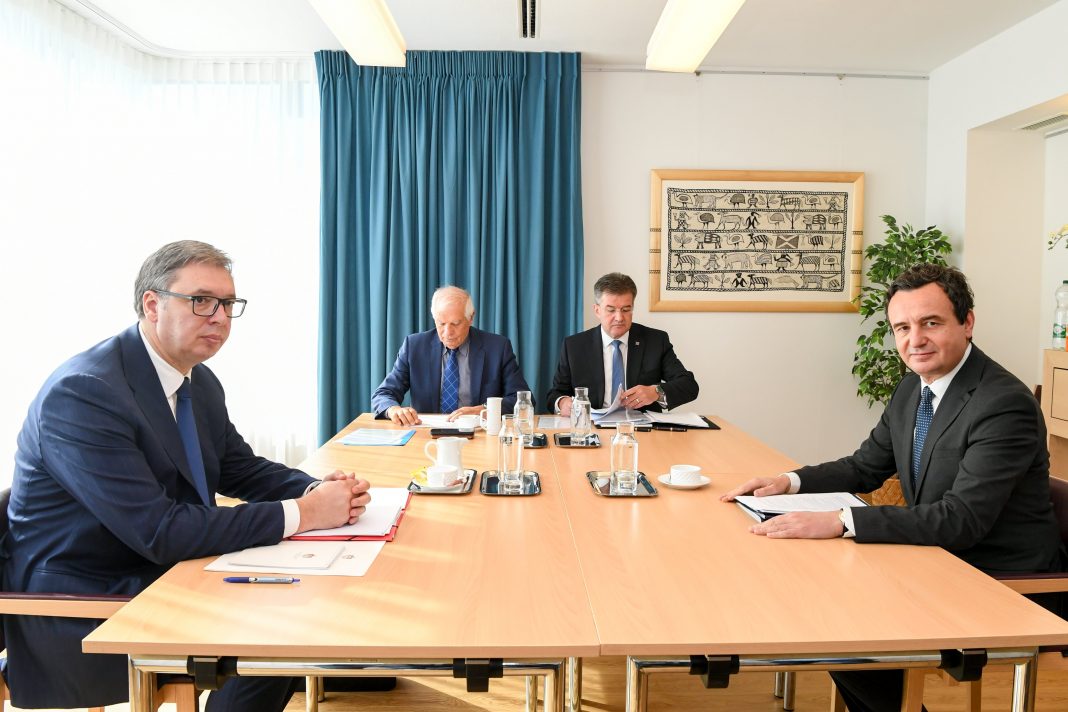
In the lead-up to a new round of talks between negotiators from Kosovo and Serbia this week in Brussels, observers of developments between the two countries see several shortcomings in the approach of the EU and the United States and their efforts to encourage Kosovo and Serbia towards implementing an agreement based on the model presented by international negotiators.
Jolyon Naegele, former UN official in Kosovo and the first coordinator of the dialogue between Kosovo and Serbia during the UNMIK mandate in 2003, criticized the international community in an interview with Voice of America, stating that in the past 20 years, they have failed to offer long-term solutions.
“There is a double standard in the policy of the United States as well as in the policy of some European Union states regarding Kosovo and Serbia… The international community, including those present in Kosovo in the last 20 years, has consistently failed to make long-term predictions and understand that the issues they are facing will not disappear but will only worsen if left unresolved,” says Naegele.
Aidan Hehir, an expert in international relations at the University of Westminster, also considers the region unclear about the EU’s objectives in the Western Balkans.
According to him, in the changing geopolitical situation, the European Union and the United States have focused their efforts on bringing Serbia closer to the West.
“This implies asking Kosovo to make a series of concessions to Serbia… The entire negotiation process has become an attempt to give something to [Serbia’s President] Vučić to bring him closer to the West and move away from Russia,” he says.
“This strategy is based on the idea that this contributes to order and stability in the region. ‘If we curb Russia’s intervention, then we will be able to have a quieter region closer to our interests’. This idea has failed. In the past five years, Serbia has become more assertive, more authoritarian internally, and to destabilize Bosnia, Kosovo, Montenegro, and to a lesser extent, North Macedonia,” adds Hehir.
Naegele believes that over a decade of dialogue, Serbia’s position has only hardened in relation to Kosovo.
“Things have only worsened. There is no will for progress – Serbia, assured by Moscow, is playing to gain time, believing that by dragging this issue, the international situation over time will be in their favor and in the interests of Moscow,” says Naegele.
The recent public stance of the leaders of France, Germany, and Britain, urging Kosovo’s Prime Minister Albin Kurti to initiate the process of forming an Association, and Serbia’s President Aleksandar Vučić to practically recognize Kosovo’s independence, Hehir considers as a demand that should have been made a decade ago.
“I think the Government of Kosovo has shown a willingness to compromise. In opposition, Kurti was a vocal opponent of the Association, and now, from the position in government, he has shown openness to the idea of creating the Association, although not in the same form as the previous version that was in conflict with the Constitution,” says the University of Westminster expert.
However, Hehir argues that Kurti is right not to accept the implementation of the Association before receiving some guarantees about Kosovo’s status.
“We cannot have a situation where Kosovo is expected to implement all these policies that may be very risky for it, giving Serbia significant influence in Kosovo, encouraging Kosovo Serbs to break away from the central Government of Kosovo. It would be insane to implement them before Serbia clearly demonstrates that it accepts Kosovo’s right to exist,” he says.
Naegele says that the recent statement of the three European leaders is a positive development, but the chances are slim that it will influence the positions of the parties.
“Nothing will change unless the two parties decide to do something concrete. (The statement) is positive in the sense that it clearly states what needs to be done, instead of non-engagement or statements that urge the parties to take some action with the common language of the EU that, as we see in Kosovo’s case, should be read between the lines… But the process will not progress if EU representatives do not bring the parties together in the same room. They need to be more assertive with them,” says Naegele.
Naegele believes that it is the last chance for EU countries to discuss Belgrade’s behavior and condition Serbia’s progress toward European integration with its stance on Kosovo.
For Hehir, if the goal of the dialogue is only to create stability between Kosovo and Serbia, this future goal will be unsustainable.
“In the case of the dialogue process, if the goal is only to create stability between these two countries, in the long run, it will be unsustainable because it will encourage Serbian nationalism and make people in Kosovo dissatisfied… It will create dissatisfaction, turmoil, and become a source of destabilization… An independent Kosovo is not a threat to anyone. A belligerent Serbia is a threat to all,” he added.
But the lack of progress in the EU-mediated dialogue, Naegele also attributes to the actors involved in the normalization dialogue – Vučić, a minister under Slobodan Milošević and currently an ally of radical Serbian parties in Serbia, and Kurti, a political prisoner under Milošević’s regime and then a leader who has used dramatic actions in the last 16 years.
“You have to be very optimistic, not to say naive, to believe that these two individuals will be willing to reach an agreement, adhere to it, and then expect them to implement it,” said Naegele.
In conditions where internal politics in both countries is fueled by debates about disagreements in the normalization process, analysts believe that a clear vision and strategy for sustainable solutions from Western negotiators, including the recognition of Kosovo, are necessary to avoid further failure.




