

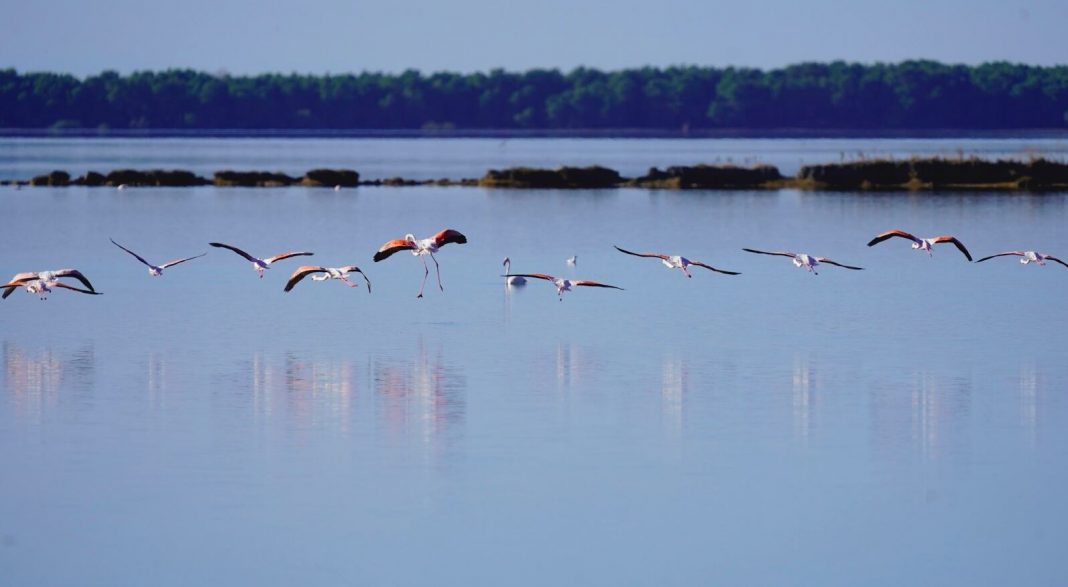
The review of Protected Areas is raising concerns among researchers and nature activists in Albania.
They say they see a new threat to constructions, especially in coastal areas, and an escalation of destruction in protected areas.
Albanian Prime Minister Edi Rama said that the review is related to a persistent request from a considerable number of mayors.
Environmental researchers and activists strongly oppose the Government’s plans to review protected natural areas in Albania. An initiative by 12 deputies from the Socialist majority aims to introduce new changes to the law on Protected Areas, fundamentally creating legal spaces for development projects in the service of municipalities.
“Interventions in protected areas are a novelty that brings even more consequences when done for purposes said to be in the name of development, in the name of tourism,” says Aleko Miho, a professor of natural sciences at the University of Tirana.
“Now, interventions are taking place in Protected Areas as they are the only ones left untouched. We are even wrinkling them to a minimum, and in this way, we are creating an image of an overly urbanized country, which is harmful to nature but also to overall development,” Miho explains.
The professor says that these new changes result from what happened a year ago at the borders of the Protected Areas, which had consequences.
“The Government’s decisions that led to the reduction of Protected Areas, mainly in coastal areas, in Butrint, in the Vjosa-Narta area, in the Karavasta area, etc. It was known that these legal changes were not aimed at strengthening the protection system but, on the contrary, allowing the development of businesses within them. As soon as the Government decisions came out in these areas, interventions were made to build, to invest. It is said for tourist purposes, but this type of tourism does not protect nature; it is unsustainable. On the contrary, it creates concerns in the surrounding area, in the disruption of biodiversity, habitats, but also for humans, for the zone itself, this way of investment, especially what we see in the Manastiri area, but not only, is in contradiction with the rules of nature protection”.
Zydjon Vorpsi of the nature protection organization PPNEA, which has sued the change of boundaries of Protected Areas that happened a year ago, says that a new review has quite serious consequences.
“Now, it is expected that other areas will also be disrupted. In practice, an attempt is being made to legitimize what started illegally in Narta with Vlora Airport being built within the Protected Area. The new law paves the way for these types of developments to happen in every Protected Area, destroying once and for all the value of these areas”.
The expected legal changes legitimize interventions that contradict European directives for nature protection, says Vorpsi.
Tourism in Albania, especially this year, recorded high tourist influx with over 9.5 million visitors, and Miho appreciates the development of this sector. But, he says chaotic development models should not continue.
“None of us opposes all efforts, whether by the Government or all actors in the country, to develop tourism because it is a great potential that we as a country can offer to ensure prosperity, employment, etc. But this cannot be done without managing tourism in such directions, from which the entire society benefits. Not individuals who invest, who sell villas, and who build as on ‘their father’s property’. This is not tourism, especially when this is done at the expense of Protected Areas. We have created a large infrastructure from Velipoja to Ksamil all these years that has been done chaotically, not with well-thought-out urban plans. To intervene again in this coastal line with constructions is beyond the possible capacities that the coastal line itself approaches”.
Institutions, he further says, are little questioned about these changes, and academic and scientific circles are somewhat uninvolved.
“In general, little is discussed about these decision-making processes institutionally. Here institutions need to be questioned about these changes, but the institutions themselves need to be more active”.
Albanian Prime Minister Edi Rama stated a few days ago that the Government is in the process of reviewing Protected Areas.
In a speech given at the ceremony for an information center for the Vjosa River, Rama said that “the review is related to the persistent request of a considerable number of mayors, who are aware of the need to consolidate nature but are naturally ambitious and under great pressure for economic and social development. And the combination of these two is a necessity”.
Views of Ksamil and many areas on the southern coast are speaking of the spread of intensive constructions that endanger natural landscapes and millennia-old rocky landscapes.
Several mayors have been sentenced or are under investigation in the last two years related to decision-making on construction in coastal areas.
Only in Saranda, over 20 officials from the administration, mostly from urban planning, mortgages, and building inspectorates, have been arrested under suspicion of abuse of duty by the order of the Saranda Prosecutor’s Office and the Special Prosecution Office (SPAK).




