

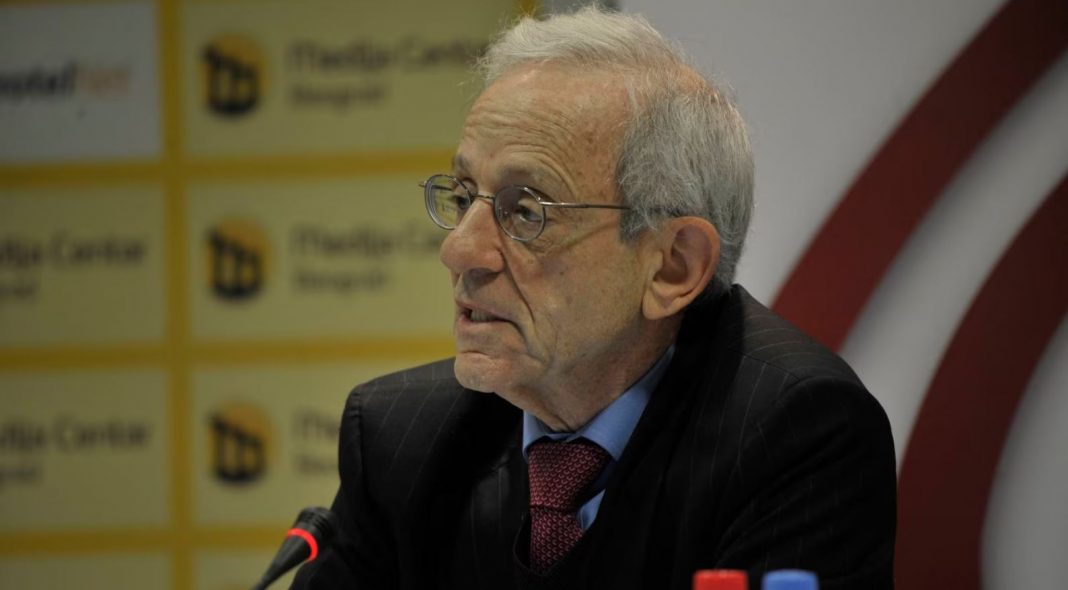
Serbia’s President Aleksandar Vučić has created an unfair electoral system that favors him, says Daniel Serwer, a professor at Johns Hopkins University, in an interview with Radio Free Europe.
Preliminary data from the December 17 elections indicate that the Serbian Progressive Party, led until recently by Vučić, has won the majority.
Meanwhile, the opposition list “Serbia against violence” has called for the annulment of the elections in Belgrade, claiming irregularities.
Commenting on Vučić’s victory in relation to Kosovo, Serwer says that the result “is not a good sign” for relations between the two countries.
“I see no sign that Vučić is ready for a serious change regarding relations with Kosovo. On the contrary, he is heading in the opposite direction. He again calls for the establishment of Serbia’s sovereignty. He opposes the importance of the March and February agreements [Ohrid Agreement and its annex], which the United States and the EU say are legally binding,” says Serwer to RFE.
Radio Free Europe: Both domestic and international opinion has described the elections in Serbia as a referendum on the leadership of President Aleksandar Vučić. So, what does their result indicate? Vučić’s Serbian Progressive Party, even after ten years in power, has won the majority in Parliament.
Daniel Serwer: Well, he has won his referendum. There is no doubt about that.
Radio Free Europe: Did you expect this result?
Daniel Serwer: Yes, I expected it. I don’t think he would have called early elections if he didn’t expect to win. He has shifted himself and the party to the right. He has absorbed many forces from the right-wing. He has used the Government as a cover to strengthen his voice. He has created an electoral system that is free but not fair – something that favors him.
Radio Free Europe: Does this result change anything in Serbia, not only internally but also in terms of foreign policy relations with Russia and the EU?
Daniel Serwer: I don’t expect it to change anything. In recent months, Vučić has been extremely supportive of Moscow and Beijing. His best friends these days are autocrats. He also wants to be one. He is an autocrat, elected in elections, with no serious competition on the horizon.
Radio Free Europe: When you say that Serbia is an electoral autocracy, would Western governments agree with you? We haven’t heard them say that Serbia is an electoral autocracy.
Daniel Serwer: To be clear, these are not the first free but unfair elections in Serbia. They were held under strict media control by the ruling party, using state resources, transporting people – whom I hope had the right to vote – by buses from Bosnia and Herzegovina.
This is not the way fair elections are conducted. There are many abuses that have already been documented, and I expect even more. But, I don’t know anyone in Washington today who would call Serbia a democracy.
“Serbia is not close to the EU”
Radio Free Europe: However, Vučić also says that his party is very committed to the European path, that Serbia is a serious candidate for EU membership. How do you interpret these messages?
Daniel Serwer: First of all, I think these messages are worth very, very little. He [Vučić] has been in power for a long time and has not brought Serbia closer to the European Union.
In fact, he has challenged the European Union – not only by opposing sanctions against Russia but also on many other issues, including the recently reached agreements with Kosovo, which Prime Minister Ana Brnabić denies that Serbia is respecting.
So, you can say you are for the EU, but you also have to act that way, and Vučić is not doing that.
Radio Free Europe: Can we expect any kind of signal, pressure from Brussels on the future government to clearly orient itself towards the EU?
Daniel Serwer: I don’t expect much from Brussels because Serbia and Hungary – which is in the EU and whose leader [Viktor] Orbán, Vučić is friends with – have something in common: they are led by autocrats. I don’t expect the EU to reach a consensus on anything that could put pressure on Serbia.
I hope the United States will be different. If we turn to the events of September 24 – the rebellion in north Kosovo, which seems to have been orchestrated by Belgrade – I would expect the United States to react to this.
However, so far, they haven’t, and I’m not sure they will. They don’t see an alternative to Vučić.
There is no immediate alternative to Vučić, but I think the U.S. would benefit much more from Serbia if it took a tougher stance rather than continuing to indulge it.
How will the West react to the elections?
Radio Free Europe: What reaction do you expect from Washington?
Daniel Serwer: I don’t know what to expect. You know that these are certainly not fair elections, and he should say that.
He should be much tougher on Serbia when it comes to the events of September 24 [in Banjska]. He should tell Vučić that if he wants [former deputy leader of the Serb List] Milan Radojičić to be responsible for those events, then he should surrender him in Kosovo for trial.
He should be much, much tougher on Serbia, but so far, he hasn’t been. And I don’t see any sign that he will change his mind. I think he’ll just continue to pretend.
Radio Free Europe: In recent days, Belgrade was determined not to extradite Radojičić to Kosovo under any circumstances…
Daniel Serwer: If you [Serbia] claim that Kosovo is your territory, and the crime happened in Kosovo, then you should be willing to send Radojičić to Kosovo. It wouldn’t be extradition for Serbia.
The point is for him to be sent to the competent judicial authorities. Kosovo’s authorities have existed even before [independence]. It’s not that Kosovo didn’t have a parliament, judiciary, and police in the past. These institutions should be treated with respect. And, therefore, the trial should be held there. But no one insists on this.
Everyone is afraid that he [Vučić] will fall into the arms of [Chinese President] Xi Jinping and [Russian President] Vladimir Putin. But the fact is that he is already in their arms.
What is the first challenge for the new Government?
Radio Free Europe: Do you see this extradition request as the first challenge for the future Government of Serbia?
Daniel Serwer: I wouldn’t know that. But, for me, this is a simple matter. The crime happened in the territory of Kosovo. In Kosovo, there are authorities recognized by Serbia through the Brussels Agreement of 2013, which also calls for the formation of the Association of Serb-majority municipalities.
So, if you want the Association, you must fulfill your obligations according to the 2013 agreement. And, that means Radojičić should be judged by the competent authorities in Kosovo.
The agreement is absolutely clear that the judicial system of the authorities in Pristina is valid throughout the territory of Kosovo.
Radio Free Europe: Speaking of relations between Serbia and Kosovo – in your opinion, will the final agreement between them be expedited by this result of the Serbian Progressive Party, or will the current trend continue?
Daniel Sewer: I see no sign that Vučić is ready for a serious change in terms of relations with Kosovo. On the contrary, he is moving in the opposite direction. He again calls for the establishment of Serbia’s sovereignty. He opposes the importance of the agreements of March and February [Ohrid Agreement and its Annex], which the United States and the EU say are legally binding.
It is true that Brussels is adding provisions of those agreements as conditions for Serbia’s accession to the EU, but Vučić is not serious about EU membership. So, it won’t change much. I think this [result] is not a good sign for relations with Kosovo.
A “shameful” pro-European opposition
Radio Free Europe: The second-largest force in the Serbian Parliament is expected to be the pro-European opposition list “Serbia against Violence”. According to early estimates, they will have 64 seats in Parliament. To what extent can they be corrective against the Serbian Progressive Party?
Daniel Serwer: I think it’s very important for them to be in Parliament. Let me be absolutely clear: they did not boycott the elections. Boycott is almost always a mistake.
They understood that the elections would be free but not fair, and they did quite well in these circumstances. I don’t think it would be reasonable to expect them to perform better.
The opposition in Parliament plays a crucial role and often prepares the way for the future Government.
Therefore, they need to seriously understand their opposition role and start thinking about what they want to impose as the program of the future Government. Honestly, they have been shameful so far. They haven’t had many new ideas. The pro-European platform is not that new anymore.
Radio Free Europe: Why do you consider it a shameful political option?
Daniel Serwer: They are certainly very shameful regarding Kosovo. They don’t want to say anything that would suggest a softer relationship with Kosovo and that they want real agreements with Kosovo.
They need to think about whether it is really wise to do this or not.
They are also shameful when it comes to economic issues, international harmonization, the problem of violence – what would they actually do about the issue of violence and the culture of violence in Serbia?
Today’s Serbia is an autocracy. It wasn’t ten years ago, but today it is – an electoral autocracy. But, it still offers some opportunities for the effectiveness of the opposition. I would like to see if they are utilized or not.
Vučić has the right to celebrate, to be happy about a strong result. But the opposition can be proud of what it has achieved. And now, it needs to prove that it is capable of presenting a platform that would be attractive to citizens in the upcoming elections.
“Strong lean towards Russia”
Radio Free Europe: The biggest surprise of the elections is the list led by Dr. Branimir Nestorović, known for his conspiracy theories. He will be in Parliament for the first time. Representing an ideology of the far right, pro-Russian, his list includes Dragan Stanojević – little known in Serbia but described as an extremely pro-Russian player, who is under sanctions from Ukraine. How important do you consider the entry of this list into Parliament?
Daniel Serwer: I think it reflects the right-wing sentiments of a good part of the citizens. And not only because of historical and cultural ties with Russia but also because of the media environment that blames NATO for the war in Ukraine, favoring Vladimir Putin at every step.
This is what you gain when you lean towards Russia: people who love Russia, even after it occupies another country.
The logic in this situation would be entirely the opposite – that Serbia would be offended by the Russian occupation of Ukraine, but it is not the case.
Perhaps Serbia has voted against Russia in some unimportant resolutions of the United Nations General Assembly, but we know very well that, fundamentally, Aleksandar Vučić is aligned with Putin and Chinese President Xi.
“Vučić has gained space both pro-Russian and pro-European”
Radio Free Europe: Did you expect a better result from pro-European forces in Serbia?
Daniel Serwer: I don’t think I expected much better results. I knew Vučić would win. He has managed to gain space both pro-Russian and pro-European, although he is much closer to the pro-Russian direction than the pro-European one.
No one should be deceived. Serbia will not join the EU soon because Vučić has done nothing to prepare the country for EU membership. And as long as the current policy for Kosovo is in place, Serbia will not join the EU – that is very clear.
Vučić understands this and knows that EU membership will not happen soon. He simply wants to occupy that political space. He doesn’t want to give it to anyone else. So, he makes a lot of pro-European statements and then does nothing about it.
“Dačić is not politically independent”
Radio Free Europe: Is the weak result of the Socialist Party of Serbia – the former partner of the coalition with the Serbian Progressive Party – led by Serbian Foreign Minister Ivica Dačić, a surprise?
Daniel Serwer: I think the success of this second pro-Russian option is part of the explanation. He [Ivica Dačić], in my opinion, is not a serious political force in Serbia. He invests in the party in power. His party has a historical background but not true political independence. He really is like Vučić, just with another mask, another face.




