

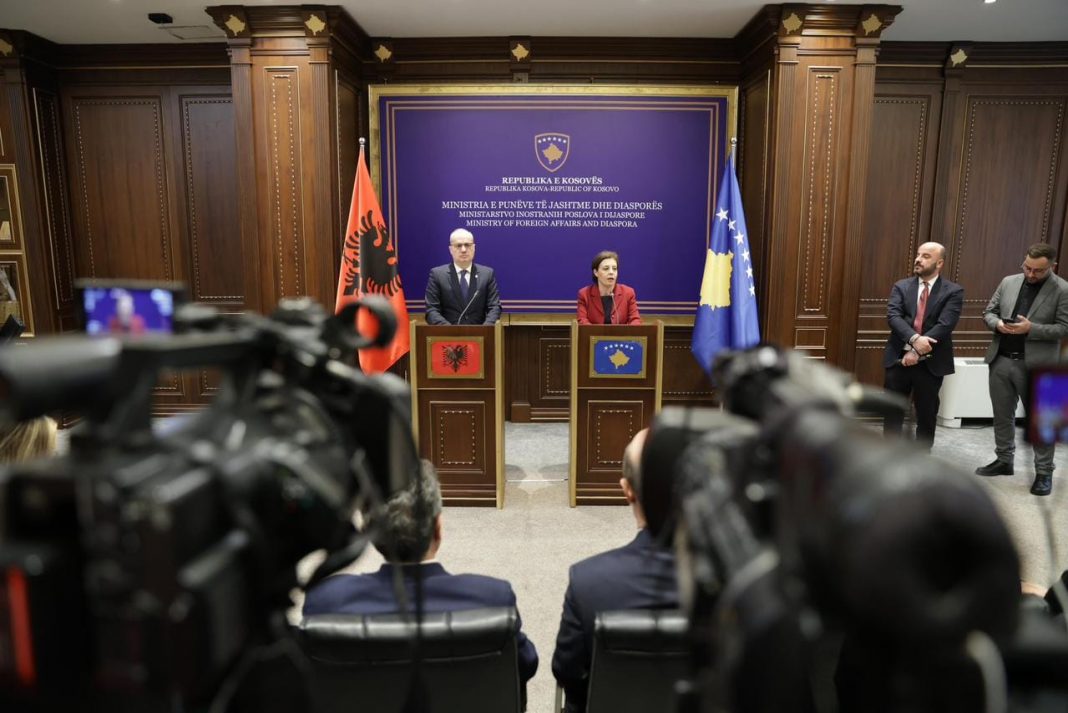
Describing it as a “ridiculous game”, Albania’s Minister for Europe and Foreign Affairs, Igli Hasani, called on Serbia to stop sending its army to the border with Kosovo.
During a joint press conference in Pristina with his Kosovar counterpart, Donika Gërvalla, Hasani stated that Kosovo’s security is guaranteed by NATO.
“We call on all actors and factors living in the 21st century not to send the neighboring army to the border. No one should play this ridiculous game because we are all clear that NATO, to which Albania belongs, is the greatest guarantee for the integrity and sovereignty of Kosovo,” said Hasani.
Last year, after the increased tensions between Kosovo and Serbia, Belgrade officially sent its army several times near the border with Kosovo, prompting the United States to call for the withdrawal of Serbian troops.
Hasani, who is on his first official visit to Kosovo, spoke about the September 24 attack in Banjska, Zvecan. On that day, an armed group of Serbs attacked the Kosovo Police, killing one officer. In the subsequent clashes, three Serbian attackers were also killed.
Milan Radojičić, the former vice chairman of the Serb List, the main party of Serbs in Kosovo, claimed responsibility for the attack.
Kosovo blamed Serbia, but Belgrade denied involvement in the events in Banjska.
The Albanian Foreign Minister called for those responsible for the attack, which he described as terrorism, to face justice, as he believes it is necessary “to prevent an escalation with potentially irreversible consequences”.
His Kosovar counterpart, Donika Gërvalla, addressing the events in Banjska, once again called on the international community to sanction Serbia.
“The lack of punishment carries the risk of repetition. Therefore, not only for the sake of peace and security in Kosovo and its citizens but especially for the sake of long-term peace and stability in our entire region, the international community should not remain silent but should severely punish any attempt to destabilize neighboring countries,” she said.
According to Minister Hasani, security and stability in the Western Balkans are “more threatened than at any other time in the last decade”.
Both diplomats also touched on the dialogue between Kosovo and Serbia, mediated by the European Union.
Hasani said that on October 26 in Brussels, Albin Kurti “unconditionally” agreed to sign the Agreement on the normalization of relations.
“We call on our international partners to preserve this moment and move forward towards a final progress,” said Hasani.
On October 26, in separate meetings, Kurti and Serbian President Aleksandar Vučić met with representatives of the EU, France, Germany, and Italy. The Prime Minister of Kosovo declared that in this meeting, he accepted the proposal to establish the Association of Serb-majority Municipalities and was ready to sign agreements for the normalization of relations, but this was opposed by the Serbian leader.
Gërvalla said that with the meeting on October 26, the ball is now in the EU’s court.
“… the ball is now in the EU’s court, and it is the turn of the mediators to bring Serbia to the table with a constructive approach to signing the agreements that were agreed upon last year. Neither measures [EU sanctions against Kosovo], nor justifications can overshadow the fact that the ball at the EU should move,” said Gërvalla.
The Agreement on the path to the normalization of relations was reached at the beginning of last year, but the parties have not signed it.
The normalization agreement, consisting of 11 articles, envisages, among other things, a level of self-government for the Serbian community in Kosovo and mutual recognition of state symbols, while requiring Pristina and Belgrade to implement all previous agreements reached during the dialogue.
Serbia insists that Kosovo establishes the Association of municipalities with a Serbian majority, but the Government in Kosovo has expressed opposition to an ethnically based association.




