

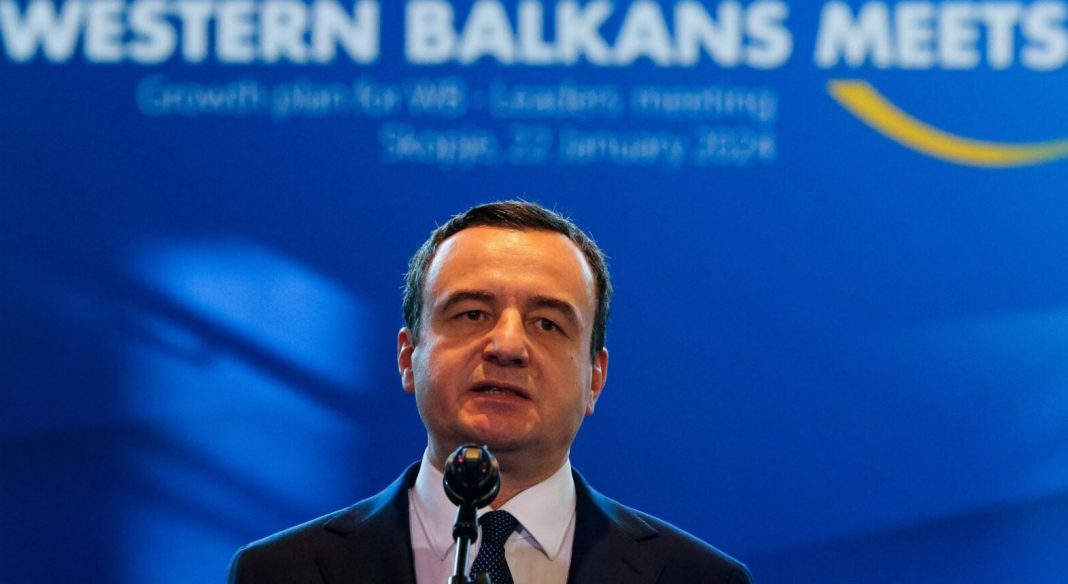
The Prime Minister of Kosovo, Albin Kurti, stated on Monday in Skopje that European Union values should be translated into reforms in the Western Balkans, and EU support should also include financial assistance.
He made these statements at the start of the conference “The Western Balkans Growth Plan and Faster Integration into the EU”, held in the capital of North Macedonia.
The EU plan for the Western Balkans aims at the economic growth of the region, speeding up necessary reforms, and making investments that can advance the EU enlargement process with these countries.
The amount allocated by the EU for this plan, in the period 2024-2027, is 6 billion euros.
“Today, the Republic of Kosovo will submit the list of discussed reforms, and in the coming days, we will also submit the list of indicative projects. Regarding reforms, the focus is on the reform of public administration and public finance management, while for projects, we have those related to the green agenda, digitalization, investments in the private sector, and closing the infrastructure gap,” Kurti said.
Kurti mentioned that this plan accelerates the path of the Balkans towards the EU, something that, according to Kurti, is “both the goal and fate for us”.
The host of the meeting is the Prime Minister of North Macedonia, Dimitar Kovačevski, while participating in it are the Prime Minister of Albania, Edi Rama, that of Montenegro, Milojko Spajić, and the President of Serbia, Aleksandar Vučić.
In addition to them, the United States will be represented by the U.S. Assistant Secretary of State for Europe and Eurasia, James O’Brien. Among the European officials is the Director of the European Commission for Neighborhood, Gert Jan Kopman, and other officials.
Prime Minister Kovačevski has announced the approval of a declaration at the end.
The President of Serbia, Aleksandar Vučić, has stated that such meetings are important for the development of the region.
Vučić mentioned that in Monday’s meeting in Skopje, discussions are, for the first time, solely focused on economic issues, emphasizing significant differences in political matters.
According to him, Serbia has already presented projects related to economic initiatives within the European plan for economic growth.
“As for Serbia, we have presented our plan for economic growth for the next three years, and it aligns with what we are doing with the EU. We will do everything to carry out the reforms to have access to financial resources as quickly as possible, together with everyone else. I believe that all together, working on this plan, we will make significant progress,” said Vučić.
In December of last year, the European Union urged the Western Balkan countries that there is no more time to wait for them to normalize their relations but that it must happen quickly as a condition to benefit from funds allocated in the economic growth plan.
Currently, Kosovo and Serbia, under the European Union’s mediation, are conducting a dialogue in Brussels for the normalization of relations.
Their progress in the dialogue has been mentioned as a condition to have access to these EU funds.
What is the plan for economic growth in the Western Balkans?
The new plan for economic growth in the Western Balkan countries, approved by the European Commission on November 8, 2023, is based on four pillars.
The first pillar is “strengthening economic integration into the EU single market”.
This will depend on the adaptation of the region’s countries to the rules of the single market and simultaneously opening their market in the relevant sectors to neighboring countries.
The second pillar of this plan is “strengthening economic integration within the Western Balkans through the common regional market”.
This, according to the EU experience, will affect a potential economic growth of 10 percent.
The third pillar of this plan is “accelerating fundamental reforms”. This also includes the rule of law, which helps attract foreign direct investments and strengthens regional stability.
The fourth pillar of the European Commission’s new plan for economic growth in the Western Balkans is “increasing financial assistance to support reforms”. This includes the proposal for 6 billion euros in aid.
As the region’s countries, in their trade relations with the European Union, also benefit from the respective Stabilization and Association Agreements, the European Commission proposes going beyond this, making changes to these agreements to ensure equal conditions in the market between countries in the enlargement process and EU member states.
All these objectives are in line with the ideas being implemented through the Berlin Process, as well as the creation of the “common regional market”.




