
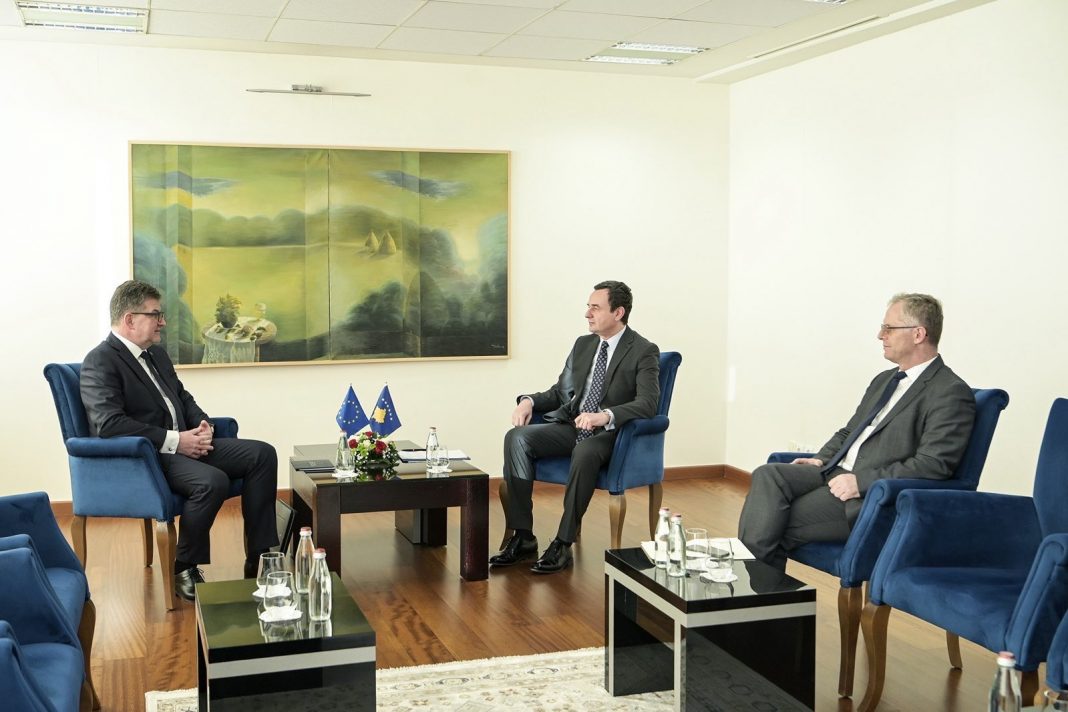
The European Union’s Special Representative for the dialogue between Kosovo and Serbia, Miroslav Lajčák, said on Tuesday that he had discussed with Kosovo’s Prime Minister, Albin Kurti, about Kosovo’s decision to prohibit the use of the dinar in cash payments within the country.
The Central Bank of Kosovo issued a new regulation a week ago, requiring all cash payments anywhere in Kosovo to be made only in euros starting from February 1, putting an end to the use of the Serbian dinar in the country.
When asked if he discussed with Kurti the postponement of the decision of the Central Bank of Kosovo, Lajčák told reporters: “We mentioned this issue of the decision of the Central Bank of Kosovo, but I do not want to act as a substitute for the Kosovo Government, but you will be informed”.
“You will learn more about this,” he added.
The Kosovo Government has argued that the decision of the Central Bank of Kosovo is in line with the Constitution of Kosovo, but the United States and other QUINT countries have said that this decision “raises concerns regarding its particular impact on Serb-majority communities”.
In Kosovo, in all Serbian-majority settlements, the population uses the Serbian dinar for payments, and those working in Serbian institutions in Kosovo also receive their salaries in dinars. Pensions are paid in dinars according to the Serbian system, as well as child allowances and social benefits.
In a press conference after the meeting in Pristina, Lajčák said that the attack on September 24 against the Kosovo Police by a group of armed Serbs in the village of Banjska in the northern part of the country was also discussed.
The attack in Banjska, where one police officer and three assailants were killed, was also discussed during the meeting with Serbian President Aleksandar Vučić earlier in Belgrade, he emphasized.
“The attack in Banjska is discussed every time in every meeting since it happened,” said Lajčák.
He said that the EU expects those involved in the attack in Banjska to be held accountable.
“The European public and EU member states expect those involved to be held accountable. As for the investigation, I am not the right person to speak because there is no investigation led by the EU, but individual countries have investigated or are investigating. We are receiving data from member states and European partners”.
Responsibility for the attack was claimed by Milan Radoičić, the former vice president of the Serb List – the main party of Serbs in Kosovo, which enjoys the support of official Belgrade.
Kosovo blamed Serbia for the attack, which denied any involvement but left Radoičić free, with the condition not to travel to Kosovo.
Little progress on normalization of relations
Lajčák mentioned the lack of progress in the normalization of relations between Kosovo and Serbia, despite the neighboring countries agreeing to it at the beginning of last year.
They reached the Agreement on the normalization of relations in February 2023 and the Annex for its implementation a month later that year, but they failed to implement them, despite international pressure.
Last year, Serbia stated through a document that it did not intend to implement parts of the Agreement on the road to normalization of relations with Kosovo, worrying the European bloc, which said that the agreement and the Ohrid Annex are legally binding for the parties.
After the meeting, Prime Minister Kurti said that Kosovo “remains committed to full normalization of relations with Serbia and mutual recognition, through a fair, balanced, and equal dialogue process for the parties”.
Lajčák urged both countries to do so immediately.
“There has been little progress in terms of the broader perspective on the normalization of relations. We have had the agreement since February and March of last year, which means we do not need to ask what needs to be done or even ask ourselves how to do this, the question is when to do it. I say immediately,” said Lajčák.
Last October, representatives of the EU, the USA, Germany, France, and Italy presented the parties with a draft statute for the formation of the Association, which Kosovo Prime Minister Albin Kurti and Serbian President Vučić accepted in principle.
However, after the statement of the EU’s Special Representative for the dialogue, Miroslav Lajčák, that the issue of the statute is an internal matter of Kosovo, Kurti said that then Kosovo must also be the author of that document.
Lajčák did not want to call the lack of progress in the normalization of relations between Kosovo and Serbia a failure but warned that this could be a missed opportunity for them, as attention will soon turn to the elections in the European Parliament in June and the presidential elections in the USA at the end of the year.
He warned that “concrete steps” will be taken and that he will prepare a series of recommendations for European leaders and member states of the bloc.
“A decision will be made on what steps to take in the coming weeks,” he added.