
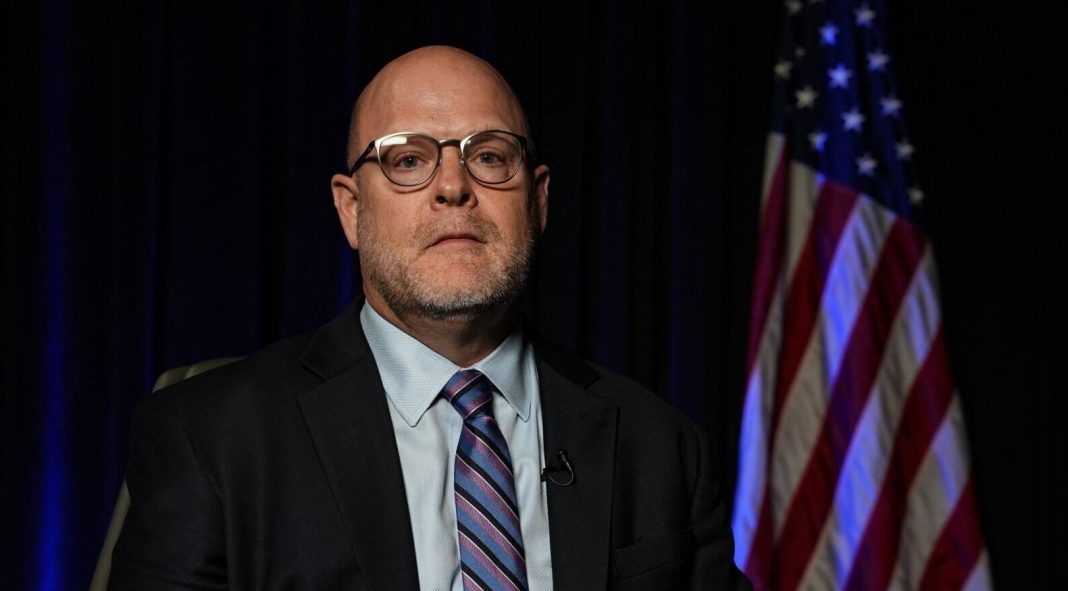
The United States Ambassador to Kosovo, Jeffrey Hovenier, has said that the recent actions of the Kosovo Government regarding the Serbian dinar and the closure of parallel Serbian municipalities are unnecessarily escalating ethnic tensions and as a result, limiting the United States’ ability to support Kosovo in the international arena.
“The United States is deeply concerned about the recent actions of the authorities of the Government of Kosovo, which have a direct and negative impact on members of the Serbian minority and other minorities in Kosovo,” Hovenier said in a statement released late Saturday.
In recent weeks, Kosovar authorities closed four parallel Serbian municipalities in Dragash, Peja, Istog, and Klina.
Kosovo’s Interior Minister, Xhelal Sveçla, said on February 2 after their closure that “the time of lawlessness is over, and Serbia’s only institution within the Republic of Kosovo will be its embassy in Pristina”.
In late January, Sveçla also announced the raiding of a Serbian non-governmental organization located in an annex of the Police Station Center in Pristina for what he described as illegal activities and endangerment of Kosovo’s security.
In Kosovo, there are municipalities, public companies, and enterprises, kindergartens, primary, secondary, and public universities financed directly by the Government of Serbia, which are located in cities and settlements where the Serbian community lives.
These institutions are illegal according to Kosovo laws. In 2013, Kosovo and Serbia reached an agreement to abolish parallel institutions, in the Brussels dialogue for the normalization of relations, but this agreement has not yet been fully implemented.
Meanwhile, Hovenier urged Kosovo again to postpone the implementation of a regulation by the Central Bank of Kosovo banning the use of the Serbian dinar in cash transactions until a satisfactory procedure is established in line with European standards and until people are well informed about how to benefit from it.
The regulation of the Central Bank of Kosovo came into force on February 1, despite significant pressure from the international community to delay its implementation.
Hovenier expressed his concern about the “confiscation of Serbian dinars and a vehicle transporting them from Serbia for social payments” by the Kosovo Police on Saturday.
“We hope that the Kosovo authorities ensure that those payments reach the individuals for whom they were intended without delay,” he said.
The Government of Kosovo says that the implementation of the regulation on cash transactions will be through an easy transition and that there will be no fines for the possession of currencies of other countries.
The leader of the Serb List, the largest party of Serbs in Kosovo, Zlatan Elek, said on Saturday that the ban on the use of the dinar “implies the expulsion of Serbs and all Serbian institutions” from the territory of Kosovo.
Speaking at a media conference in North Mitrovica, Elek emphasized that all those who receive income from Serbia are at risk and that about 100,000 Serbs in Kosovo will be directly affected by the decision of the Kosovo authorities to stop the use of the Serbian dinar.
“This applies to all institutions operating in the Serbian system, pensioners, recipients of social benefits, students, scholarship holders. So, the entire Serbian population,” Elek said.
The U.S. ambassador reiterated the call for Kosovo to resolve issues related to structures supported by Serbia in talks with Serbia in the dialogue mediated by the European Union.