

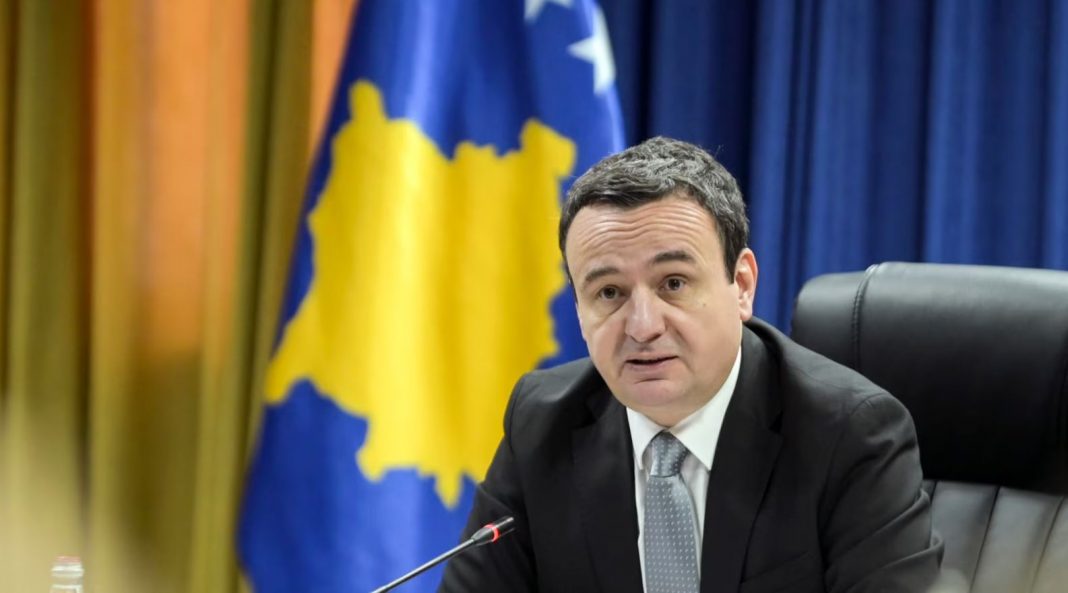
The Prime Minister of Kosovo, Albin Kurti, said that the Government he leads and other institutions are ready to “rapidly” address “any concerns” raised regarding the regulation of the Central Bank of Kosovo (CBK), which prohibits the use of the Serbian dinar for payments in Kosovo.
During a meeting with accredited ambassadors in Kosovo on February 5, Kurti said that during the transitional period of implementing the regulation of the CBK, the focus will be on “informing businesses that operate with dinars and informally”, according to a media statement.
The regulation for cash operations of the CBK came into force on February 1, amidst criticism and demands from the international community for the Government of Kosovo to postpone the implementation of this regulation. The United States and the European Union have expressed concerns about the impact of this regulation on the Serbian community in Kosovo.
Kurti emphasized that since the regulation came into force, no business owned by Serbs in Kosovo or in majority Serb-inhabited municipalities “has been penalized or fined”, adding that “this is not the goal of the institutions”.
According to the Kosovar Prime Minister, around 40,000 Serbs have bank accounts in licensed banks in Kosovo, where they receive pensions, salaries, and allowances from Kosovo. The CBK regulation, as Kurti said, will enable the acceptance of funds, salaries, and pensions from abroad “as a form of transfers to these bank accounts”, and, according to him, the Serbian dinar can serve as a means for physical saving, savings in bank accounts, and be exchanged in licensed exchanges.
“So, it does not hinder access to finance, while physical access is provided through banks and non-bank financial institutions throughout the country – only in four municipalities in the north of the country, there are a total of 15 non-bank financial institutions and four branches of commercial banks,” Kurti said, according to a statement issued by his office.
After this meeting, the U.S. Ambassador to Kosovo, Jeff Hovenier, reiterated Washington’s request for Kosovo to postpone the implementation of the CBK regulation.
He said that the U.S. has “deep concerns about the way this regulation is being implemented, as we believe it does not take into account some community concerns”.
When asked if the U.S. Government could take action against Kosovo if it does not respond to the request to postpone the implementation of the CBK decision, Hovenier said, “We hope the Government will partner with us”, adding that if the opposite happens, it “will affect the quality of our partnership”.
Earlier, the European Union and other mechanisms have also criticized the Government of Kosovo for not postponing the implementation of the regulation.
The Government of Kosovo insists that the decision of the CBK, published last month, does not aim to prohibit the dinar or any other currency but aims to regulate banking and finance in Kosovo. The executive in Pristina also argues that the regulation is in line with the Constitution of Kosovo.
In settlements where Serbs live in Kosovo, the Serbian dinar has been circulating since after the war. The Serbian state pays salaries, pensions, social assistance, and other benefits to Kosovo Serbs – through a parallel system.
The Serb List, the largest party of Serbs in Kosovo enjoying the support of official Belgrade, has criticized the decision of the CBK, and the head of this party, Zlatan Elek, said on February 3 that the ban on the use of the dinar “implies the expulsion of Serbs and all Serbian institutions” from the territory of Kosovo.
According to Elek, nearly 100,000 Serbs will be directly affected by the CBK’s decision to ban the use of the dinar.




