
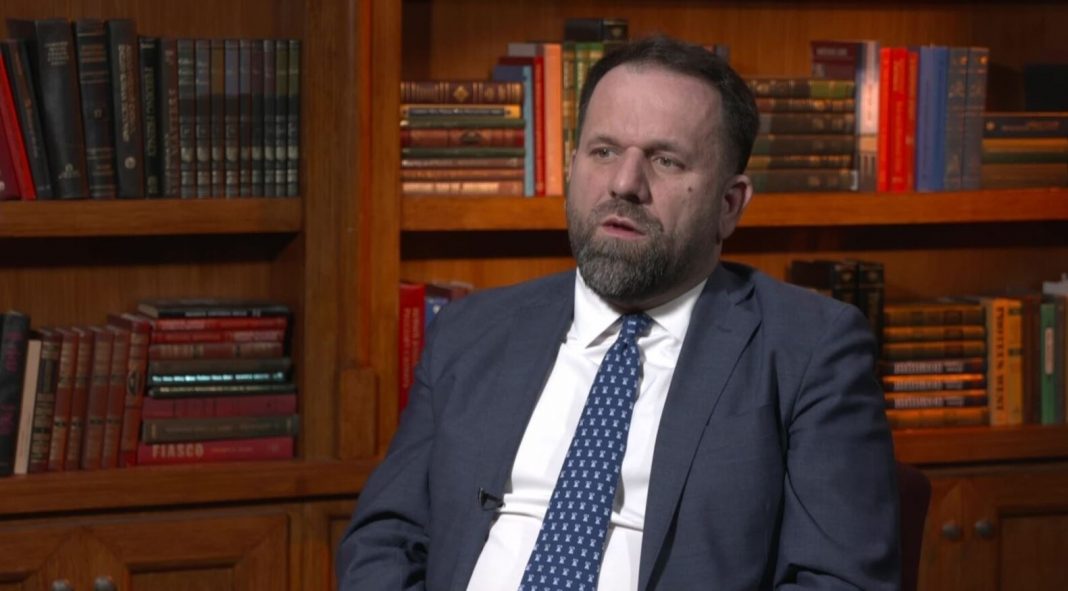
Member of the Presidency of the Democratic League of Kosovo, Berat Rukiqi, warns that the actions, which he called unilateral, of Albin Kurti’s Government, risk leaving Kosovo without the support of allies.
During an interview with Voice of America journalist Artan Haraqija last week while participating in Morning Prayers, Rukiqi said that the lack of coordination with allies on a range of issues, such as the establishment of the Association of Serb-majority Municipalities and now the decision to phase out the Serbian dinar from use in Kosovo, risks leaving the country without support even in cases where Kosovo might face similar risks, such as the terrorist attack in Banjska.
Voice of America: The decision of the Central Bank in Kosovo regarding the use of the Serbian dinar has prompted a diplomatic pressure campaign to postpone the implementation of this decision. How should Pristina act in this case?
Berat Rukiqi: This is a decision from 2012 and is also part of the Constitution of Kosovo. Kosovo has a single currency, not a multi-currency system. Kosovo decided to accept the German mark for the post-war period and then its transition to the eurozone, to European monetary systems in the eurozone, naturally imposed the use of the euro as the single currency, and this is more than clear. Meanwhile, there has been flexibility regarding payments made to Serbian citizens, mainly payments coming from the Government of Serbia. It is widely known that they receive, especially the healthcare and educational systems in the northern part of Kosovo but also in areas where there is a Serbian community, an additional salary, which has been in dinars, which is the official currency of another country that does not recognize Kosovo. As a party, we do not comment on the decisions of independent institutions, the Central Bank is an independent institution, it is supposed to be independent of various influences, including political influences. What we have heard also in meetings with American officials is a friendly request for flexibility in terms of implementation, coming from a country that has done a lot for the sovereignty of Kosovo and naturally is not interested in undermining any sovereign decision and any action that guarantees the sovereignty of the country in any field, including the part of the monetary system related to the use of currency. It was their decision and of course, we have not commented on it because it is something that has reiterated and brought back to attention something that is necessary to be implemented, today or tomorrow, that should be the monetary policy in this case.
Voice of America: What does flexibility imply?
Berat Rukiqi: Temporal flexibility, meaning a transitional period that then enables the extension of financial institutions of Kosovo in the northern part and in the part where there is a Serbian community and naturally creates the space for payments to be made in the official currency of Kosovo in financial institutions licensed by the Republic of Kosovo, namely by the Central Bank.
Voice of America: Your party has requested that Kurti’s Government coordinate with the international community, especially with Washington. If this request is made now, for flexibility as you say, do you think this decision should be postponed? How would you act if you were in power?
Berat Rukiqi: There is growing concern about unilateral decisions in Kosovo in general. We are at a moment when we have all our allies behind us, especially after the situation created by the terrorist attack in Banjska, we have had a lineup of all allies in support of Kosovo, in support of the sovereignty of Kosovo and territorial integrity, and especially in support in terms of security for Kosovo. So, the part where we are very sensitive, in safeguarding borders and in the part related to any confrontation we might have with aggression or with an attack that could be of large terrorist dimensions, and not having the other part that followed the attack, coordination with allies, of course, the consequences for the security and integrity of the country would be very serious and of course, these kinds of coordination as in terms of security are then sought in other parts and this is the concern, that there is no coordination before decisions are made that affect a segment where attention is then focused, where the spotlights turn, which is the northern part of the country and the rights of the Serbian community. We believe that we as Kosovo should take advantage of this attention, however limited it may be, of allies in this geopolitical context and turn it to the benefit of our processes, to the benefit of the security of our country, to the benefit of integration, to the benefit of foreign policy, not only recognition which is imperative and membership in international organizations, but also the lifting of sanctions since we must not forget that Kosovo is under sanctions and the damages continue and damages can multiply if we are not included in new financial packages or in new packages of European Union growth as well as there are warnings. All these, as a political party, we take them as serious concerns of allies and of course, we openly say that Kosovo can take every step to defend territorial integrity and sovereignty only in coordination with allies. We were extremely enthusiastic and happy that the United States pre-approved because, of course, congressional approval is required for the “Javelin” systems, but of course, we also have to be communicative and open to other requests they may have. We must also read this as direct support, regardless that we buy them, without direct two-party support in the United States, we would not have this opportunity that many other countries do not have. We must read this as a signal that sometimes when they come with a request that is not to violate the Constitution or the law, but just a modality of implementation that actually then understands the accommodation of the interests of the Serbian community and allies and others in this new situation that has been created.
Voice of America: The greatest pressure on Kosovo is exerted around the establishment of the Association of municipalities with a Serbian majority, the draft-statute of which has been written by the international community. It has not been accepted by your party because it has been deemed harmful. How can Pristina react in coordination with the international community if you disagree with something that has been written by the International Community itself?
Berat Rukiqi: We naturally had pressure in the past as well. Before the status, then during the status discussion in Vienna and other processes we went through, Kosovo’s institutions and political representatives have received various documents and have commented on them. So, the basic thing that needs to happen in these processes is to have communication and have observations and disagreements.
Voice of America: You continue to be against the draft-statute of the Association?
Berat Rukiqi: Let me clarify, first the basic problem is why the Government of Kosovo did not manage to draft its own project-statute, which then would be the basic document on the negotiation table. A failure to listen to the request of friends and a failure to listen to our continuous recommendations, that we must go prepared with our option and our alternative of how the Association might look, which is an international obligation, which is no longer a question of whether it should be created or not, led to a ready document in the take-it-or-leave-it format. This document that came after the Ohrid Agreement included elements of the Ohrid Agreement that completely changed the nature of previous agreements.
Voice of America: Despite the assurances of the international community that what they have offered does not violate Kosovo’s sovereignty, do you think it is harmful?
Berat Rukiqi: I can say with full responsibility from the meetings we have had here and from other meetings we have had in Pristina and elsewhere, what is very clear is that this constitutional guarantee can only be provided by the Constitutional Court itself. There may be assurances that in terms of implementation and political approach in the future, this will not be a Republika Srpska, it will not be a third level of power, however, whether there is or is not a violation of the constitution, this can only be given by the Constitutional Court.
Voice of America: Earlier you mentioned the punitive measures of the European Union towards Kosovo. What is the damage of these measures to Kosovo’s economy?
Berat Rukiqi: We have the direct part of the impact. There are 300 million euros of financial package support from the European Union for important projects in Kosovo, so let’s not forget they are a part of important projects in the energy field and in the digitalization field, which then affect the youth sector, or include various projects that the youth of Kosovo could benefit from. So, it is quite important as a financial value. For a small and developing economy, it causes considerable damage, especially in parts where we do not have investment capacities. This is the first part: the second part is the indirect consequences. This has affected the loss of confidence in Kosovo’s market. We have highlighted in our recent media presentations the element of the decrease in exports and there are indications that a part of the decrease in exports in 2023 compared to 2022, in total value is approximately 101 million euros.
Voice of America: The World Bank predicted a Gross Domestic Product growth in Kosovo of 3.9 percent in 2024 and 4 percent for 2025. How do you evaluate these forecasts in light of global developments?
Berat Rukiqi: There were even higher forecasts for the previous year and we ended up with one of the weakest years in terms of economic performance. So, if we exclude the pandemic year, last year was below the average that has characterized us since independence. It was around 4% since 2008 onwards, so excluding the pandemic year which was an extraordinary year. Naturally, this raises concerns. For Kosovo, 4% is not enough. We aim that, when we govern, we have economic growth above 5% so that we have a new cycle of development that creates jobs and prospects for citizens. Last year, the number of people considered poor increased. In absolute terms, over 26,000 people have been added to the list of those who are poor. This has also been noticed in purchasing power, all the measurements we make and others make show that the main concern of the country’s citizens is the cost of living, prices, and the inability to afford various expenses they might have. Over 50% of an income in Kosovo goes towards basic expenses. This is the highest in Europe; no other country has this percentage. If we take the growth rate figures, politicians, government officials, power in this case use it in their way, manipulate it, exaggerate it, but what is really observed in the economy is a crisis in purchasing power which then affects the entire economic growth cycle, there is a liquidity crisis in companies, so there are companies that have problems in fulfilling their obligations towards each other and this is also an indication that emerged these days from an independent institute, we see that we have almost a triple increase in overdrafts and a significant increase in consumer loans. How this translates into reality, so citizens or businesses without the ability to pay their own bills have used expensive but necessary financing solutions and that have been overdrafts and consumer loans.