

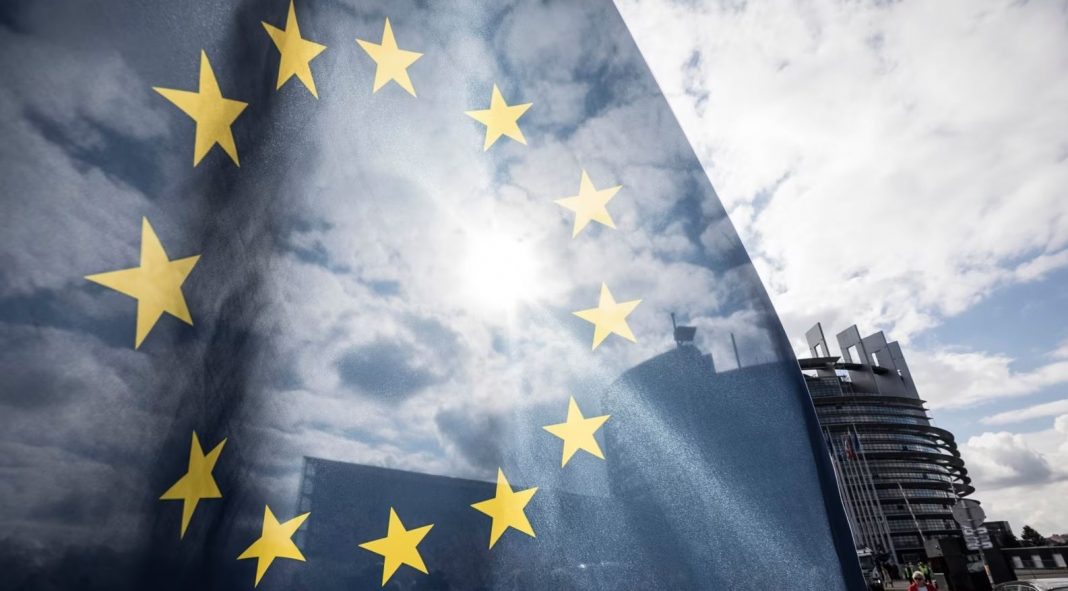
The European Union Office in Kosovo stated that changes to the Draft Law on the Independent Media Commission (IMC) should be made in a way that will not have a “negative impact” on media freedom.
In a response sent to Radio Free Europe, the spokesperson of the EU Office in Pristina, Ioanna Lachana, said that the European bloc has continuously advocated for Kosovo to review the law on the IMC to bring it in line with the EU Directive on audiovisual media services.
“It is essential for Kosovo to adopt the law promptly, through an open and transparent process, with proper consultations, involving civil society and media organizations,” said the spokesperson for the EU Office.
Lachana stated that the EU is currently analyzing the changes to the Draft Law on the IMC and will then provide comments to the “competent authorities”.
The Association of Journalists of Kosovo, the Press Council of Kosovo, as well as a group of international organizations, have called on the Government of Kosovo to abandon changes to the draft law, which aims to regulate online media. They have seen this legislation as an “attack” on the media, expressing concern that the executive branch could use this law to censor the media.
The so-called Draft Law on the Independent Media Commission was approved by the Government on December 27 of last year and has been submitted for approval to the Kosovo Assembly.
The legislation stipulates that online media producing videos must register as businesses. With the changes, the IMC will have the mandate to monitor the work of online media producing audio-visual content.
Changes in legislation foresee fines of up to 40,000 euros for media committing various legal violations.
Currently, texts published in online media are monitored by the Press Council of Kosovo. It does not fine the media for their mistakes, but it makes decisions on complaints made against the media, and these decisions can then be used to file civil lawsuits against the media in Kosovo courts.
Meanwhile, audio-visual content published in online media is not monitored by anyone. The Press Council of Kosovo has stated that in most cases, videos published are accompanied by a text on the same topic, thus they are also monitored.
In the latest Progress Report of the European Commission, it has been stated that “the amendment, which is currently in process, should further harmonize the Law with the Audiovisual Media Services Directive to extend its competencies to online audiovisual media”.




