

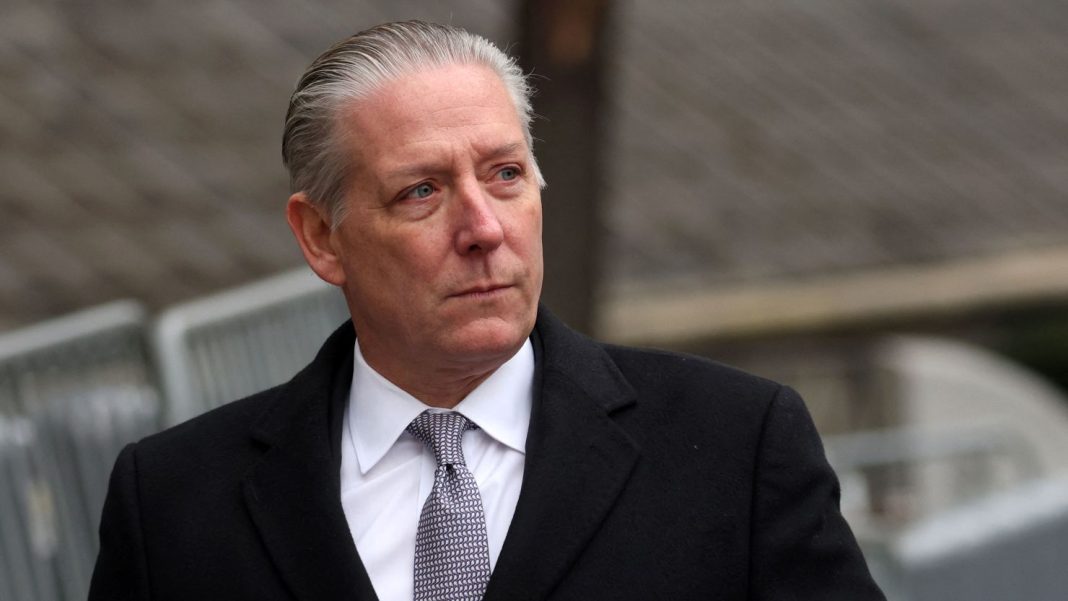
The federal court of Washington sentenced former FBI official Charles McGonigal to 28 months in prison on Friday for “serious breach of public trust” related to the $225,000 he received from Albanian-American Agron Neza and his failure to disclose contacts with officials from Albania.
Presiding over the courtroom, Judge Colleen Kollar-Kotelly stated before handing down the sentence that McGonigal’s acceptance of money from someone who introduced him to foreign officials in Albania “is a very serious violation” and that it appears McGonigal had lost his “moral compass” towards the end of his career.
During the court session, the judge stated that there could have been no motivation other than “hubris and arrogance” for McGonigal to believe he could carry out such actions without consequences.
The judge said in her ruling that she took into account his acknowledgment of responsibility by pleading guilty to receiving $225,000 from Neza and his connections with Albanian officials and expressed remorse.
Prosecutors from the Department of Justice had sought a 30-month prison sentence and a $95,000 fine for McGonigal for the “serious breach of public trust”, as stated in the memorandum concerning the charges related to the Albania case.
During the session, prosecutor Elizabeth Ann Aloi said McGonigal’s violations were blatant and constituted corruption.
“We’re dealing with a high-ranking FBI official who sold his post for $225,000,” she said.
“He did not take money from a close friend,” she said, referring to Neza, “but from someone connecting him to foreign officials”.
The prosecutor went on to say that he “went so far as to open an FBI investigation into a lobbyist”, based on information he received from his contacts in Albania.
McGonigal himself expressed regret for his actions.
At the end of the session, McGonigal declined to answer questions, saying “not now”, while his lawyer, Seth DuCharme, said they were “very relieved”.
Although McGonigal’s attorneys requested that the Washington court’s sentence be concurrent with that of New York, where he was sentenced to 50 months in prison for violating U.S. sanctions against Russia, the judge decided that the Washington sentence would be separate.
If the sentences were to be concurrent, it would mean that the Washington court’s sentence would be part of the 50 months determined for the New York trial, but both the prosecutors and the judge agreed that McGonigal should serve a separate sentence for the charges related to Albania.
According to the prosecutors in the case, McGonigal not only failed to declare the money he received but also advanced Neza’s business interests and deceived the FBI about their joint activities, thereby concealing the fact that he had conflicts of interest and private financial interests. He also concealed meetings with Albania’s Prime Minister Edi Rama, his adviser Dorian Duçka, and others.
“This fundamentally constitutes corruption that undermines transparency and trust in the integrity of the Executive Branch of Government. The defendant swore to investigate and prevent crimes against the United States and not to commit them,” prosecutors said in the document seeking McGonigal’s sentence.
In September, McGonigal pleaded guilty in federal court in Washington to all charges related to Albania, including previously unreported contacts with Albanian Prime Minister Edi Rama and his unofficial adviser, Duçka, in exchange for dropping eight other counts in the indictment.
Prime Minister Rama has stated he has never known Neza before. “I have not exchanged letters, interests, or anything else, but I have only met him in the presence of the former senior FBI official”.
Prosecutors: Charges can be proven “beyond reasonable doubt”
The agreement reached in September between McGonigal and prosecutors made it possible for the case not to go to trial. But it stated that through it, the parties declare that “if the case were to go to trial… the United States (prosecutors) could prove the facts for which McGonigal pleaded guilty beyond any reasonable doubt”.
At the September hearing, McGonigal responded “yes” to all charges for these facts.
They included, among other things, his visits to Albania, meetings with Prime Minister Rama and “maintaining a continuous relationship with him” and Duçka, as well as the fact that he “informed the Department of Justice Prosecutor… about a possible criminal investigation into an American citizen, who was registered to lobby for a party that was not Prime Minister Rama’s”.
Opening an investigation into the American lobbyist
The indictment does not identify the American lobbyist or the Albanian party.
But on November 14, 2017, lobbyist Nick Muzin deposited with the Department of Justice, albeit belatedly, documents about lobbying activities for the Democratic Party for several months.
McGonigal informed the U.S. Department of Justice about this case on November 25, “after he had received information about the American lobbyist” from Duçka one day earlier.
At that time, on November 22, BIRN had made public the fact that Muzin had declared that he had received $500,000 from the Democratic Party.
While in January 2018, the former FBI official received information again, this time from Albanian-American Neza. According to the indictment, he obtained the information from the office of the Prime Minister of Albania.
Last year, when speaking in Parliament about this issue, Prime Minister Rama said that “the time to which this moment refers coincides with the days after the scandal broke out in the media here, and I or my office, had nothing else to do with it, except the information coming out in the media; if we had it, how would we keep it hidden?” adding that, “If I had any information, more than what came out in the media, about the awful fact that the Russians financed the largest opposition of this country to overthrow the government, I would have conveyed it to anyone I could, without any debate, from partner organizations sensitive to these issues and certainly to the FBI, first of all”.
But in fact, at that time, there was no talk of Russian financing. The article published by BIRN did not deal at all with this issue, which came to light later, in March 2018, after suspicions raised by an article published by the American magazine Mother Jones.
On the other hand, the Prime Minister has never explained why Neza and Duçka were directly involved in this issue, the former serving as a confidential source for the FBI for this case and the latter, the adviser to Rama, sponsoring the trips of witnesses from Europe for their meetings with the FBI, while McGonigal did not inform the FBI about his financial relationship with Neza or his ongoing contacts with Duçka.
Documents accessed by Voice of America show that the investigation was opened in February 2018, for some discrepancies in completing the FARA documents, the law on registering lobbyists, and raised questions among FBI personnel.
FBI officials’ questions about the request to investigate the lobbyist
In support of this fact, prosecutors attached a letter from an FBI agent where some identifying data is redacted. The letter is dated March 16, 2018, and the official writing it asks why, “in conditions of limited resources and the fact that many offices in the field have difficulty investigating more serious threats”, the New York office of the FBI requests the opening of an investigation into FARA-related deficiencies, presenting it as a “threat to national security”.
Furthermore, the officer writes that he wants to be able to respond to superiors if questions arise. “I would like to explain to them why we are working on a SIM/FARA issue related to Albania when every day I fight for resources for some national security issues related to some countries that pose a high threat like…,” the letter says, with the names of other countries removed.
The decision to close the investigation was also attached, dated July 25, 2019, after McGonigal retired, stating that “the FBI’s New York office has not concluded that —- (redacted name) has committed criminal activity while representing a foreign political force and has provided the proper documentation for FARA to the Department of Justice”. This decision mentions by name the Democratic Party of Albania.
The former senior FBI official pleaded guilty in August, also in a court in New York, to charges of violating U.S. sanctions against Russia, working after retirement for Russian oligarch Oleg Deripaska, whom he had previously investigated. On December 15, McGonigal was sentenced by the Manhattan federal court to four years and two months in prison.




