

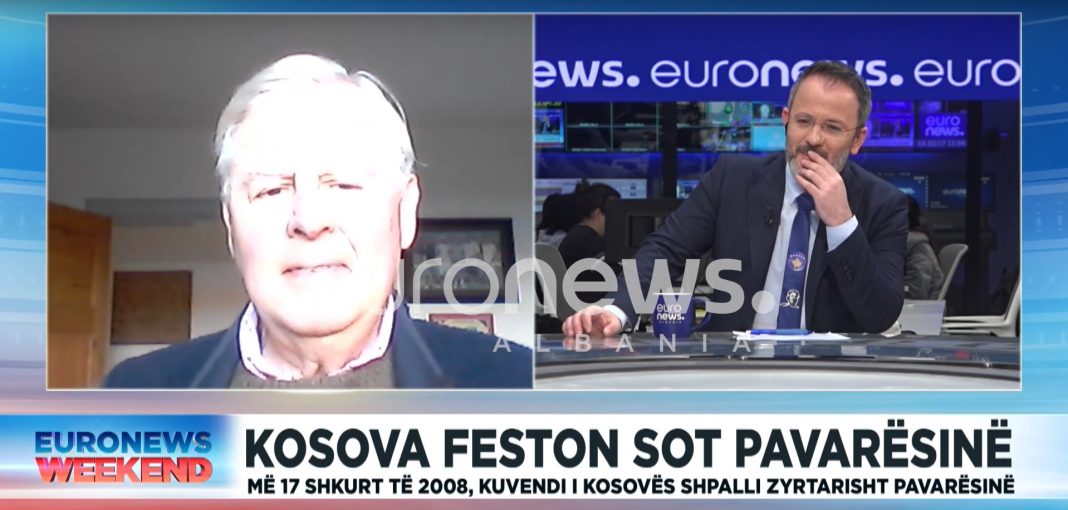
The former Special Representative of the European Union in Pristina, Pieter Feith, has spoken critically on this anniversary of Kosovo’s declaration of independence. In an interview with journalist Thimi Samarxhiu for Euronews Albania, Feith listed a series of issues, emphasizing firstly the lack of political unity in the country.
“I am happy that Kosovo is making progress but I am still a little bit disappointed. I had great expectations when 16 years ago, we witnessed the declaration of independence. Bringing all political forces, leaders together in a common purpose. I have three points. The first one is that unfortunately I don’t see that society and the political elite show enough unity to move forward, show enough political will to agree on the priorities for the nation, in view of all the challenges it is facing. I think the institutions in Kosovo are functioning quite well, but what i would have hoped is that the political leaders would come together and agree a joint common program for Kosovo for the short and medium term, so that less time is spent on bickering, disagreements and that more positive energy can be used to the benefit of Kosovo itself,” stated Feith.
The second point according to the former European diplomat was the path to normalizing relations, where not much progress has been made.
“My second point is that on the path to normalization, unfortunately not enough has been achieved. I had wished that with the Agreement in Ohrid in March last year, and the implementation schedule agreed with the European Union, that more steps would have been taken in the dialogue between Kosovo and Serbia. I realize that here are two sides, two parties. Kosovo is not alone. I am not apportioning blame to one side or the other, but the reality is that at this moment, we don’t see enough steps towards reconciliation and the independence of Kosovo still remains contested by Serbia. That is a disappointment”.
Feith further added that another problem is the geopolitical threats coming from Russia and developments from other parties, which, according to him, show that Kosovo is no longer at the top of the priorities of international chancelleries, as it was 16 years ago.
In this aspect, Feith warned that Europe must be prepared to work even without the support of the United States; as for the Kosovar political class, he has suggested that it make concessions in the dialogue with Serbia.
“The dramatically different context of geopolitical threats coming from Russia, with the war in Ukraine, threats from other sides and it means simply and we have to be very clear about this, that Kosovo is not as high on the priority list of the supporting capitals in the world as it was 16 years ago. We also face the uncertainties of what is going on in the United States with the elections and the possible return to power of Trump. I personally, like many Europeans, am feeling a certain sense of urgency to get on with it, to make sure that we in Europe are resilient and can face the threats even without the support of our American friends, if that would be necessary. I would urge political leaders in Kosovo to come together, make sure that they can be as flexible as possible and ready to make the necessary concessions in the dialogue with Belgrade and make sure that it will keep its friends and allies on its side. I’m talking NATO, European Union. The EU is still maintaining measures impacting financial support to Kosovo, which i think is absolutely unnecessary and should be stopped, but that needs steps on the side of the Kosovo Government towards de-escalation with Serbia. All in all, the sense of disappointment that Kosovo is not fully consolidated and integrated in the region and the European Union, but nevertheless, 16 years, quite an achievement, so i feel quite happy for my Kosovo friends,” concluded Feith.




