

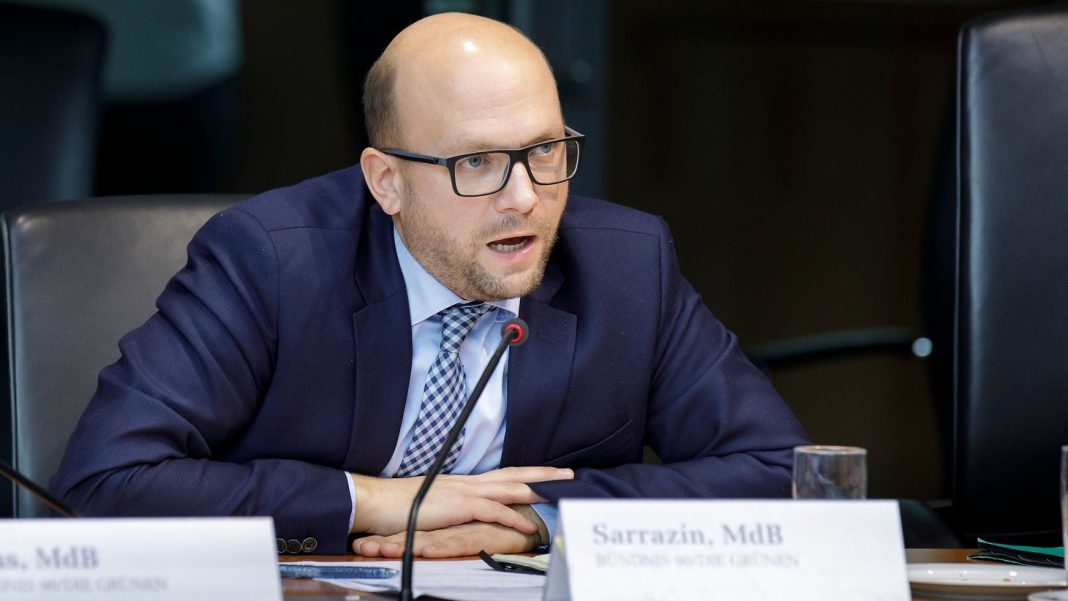
In the context of the Munich Security Conference, the German Government’s envoy for the Western Balkans, Manuel Sarrazin, emphasized to Deutsche Welle that the goal is the successful integration of the Western Balkans into the EU.
DW: The Western Balkans was noticeably absent from the official agenda of the Munich Security Conference this time. Although there were two side events where the Balkans were noted, the exclusion from the main agenda was evident. How do you explain this?
Manuel Sarrazin: I believe everyone knows that we are in a phase where the war in Ukraine, the future world order, the U.S. elections, and Trump seem to take precedence. We must not forget that the strategic ability of Europe to positively develop the Western Balkans in all these matters will be decisive in whether we will be taken seriously in other issues. Certainly, the EU is expected to support Ukraine, but the second important issue is the Western Balkans. If the EU’s capacity does not function adequately there, how can someone far, far away from us take us seriously in the global competition for major world issues?
DW: There was a panel on EU enlargement. The President of Georgia, a representative of Ukraine, participated, but the Western Balkans was missing there as well. When you are in the region, you often get the impression that people are afraid that their issue is marginalized as a result of the major challenges brought by Ukraine. How do you interpret this situation?
Manuel Sarrazin: I understand that many people are, let’s say, afraid that for a long time we have been waiting, and now it seems like others are bypassing the Balkans. First of all, I think we should consider that every success story of each country towards enlargement will benefit everyone. Ukraine has made Europe determined to want enlargement even with the Western Balkans, all capitals, not just Berlin or Brussels, others as well. The Chancellor and the Foreign Minister are very connected to the enlargement of the Western Balkans in their biography and mindset. Ukraine and the Western Balkans for us are not contradictory, but both have extraordinary geostrategic importance.
DW: Never before has there been such a good lineup of representatives for the Balkans in the EU. On the other hand, time is passing, we are now just before the European elections, and there will certainly be many changes at the European level. What should we draw from this for policy towards the Western Balkans? What should happen in this short window that is still there?
Manuel Sarrazin: I think it’s clear, everyone knows that history is being written at this time. History is often written faster than you think. I can say that I don’t feel like my work is running out of time, but the issue is that we work together so that we, the policy of the German Government as an EU member state, make our contribution so that the European concert is successful in the Western Balkans. And we are all working towards one goal, which is the successful integration of the Western Balkans into the EU. And the Commission will soon make new proposals to make the path to this goal more credible.
DW: Let’s talk about Bosnia and Kosovo. For Bosnia, March 12 is an important moment. Does it not create the impression that the country is making political progress to better fulfill its clauses? What should happen from your perspective as the Envoy for the Western Balkans so that a new chapter may open after March 12?
Manuel Sarrazin: The coalition has given some subtle signals that it is ready to make some preliminary reforms to enable us to follow the path positively. We see these subtle signs, but we really want to see them. This seems to be the situation, as it is, and we certainly will maintain strong pressure, aiming to see as many positive developments as possible. Credibility is crucial, for us to be convinced that the path of reforms will continue sustainably. And for this, we want signals from Sarajevo.
DW: The second sphere of conflict, or perhaps the largest in the region, continues to be the Kosovo-Serbia dialogue. Many are discouraged, taking two steps forward and then two steps back, sometimes three steps back and one step forward, and many have said, perhaps the window is closing now, who knows what will happen after the European elections, after the elections in the United States. What is the approach of the Envoy for the Western Balkans to bring about progress there, so that a sustainable solution may be reached in interstate relations between Kosovo and Serbia?
Manuel Sarrazin: First, it must be said that the window has not yet closed. We have the EU Special Envoy, Miroslav Lajčák, who works, he has an agenda and wants to achieve the implementation and implementation of the Ohrid Agreement. And our approach is to support him and do everything to use this window, which Miroslav Lajčák is now fulfilling. He is very active, and this is our approach. It seems pointless to think too much about what will happen afterwards. We are for Ohrid and want both parties to move forward with the implementation of Ohrid, and I think this is crucial. I see in both parties that domestic policy will be an important factor. I want to say explicitly; the future of the entire region is in the EU, and this must sometimes be above domestic politics.
DW: Both Vučić and Albin Kurti were in Munich. Is there any positive news after the talks with these two politicians to show or any sign of hope? Was there any impulse for which it could be said that something is happening?
Manuel Sarrazin: Nothing I could talk about here. But one thing can be known for sure, that the German Government remains committed to doing everything, so that there is progress soon.




